Describe the role of Intellectual Property Rights (IPR) in promoting innovation and protecting traditional knowledge in India.
In short
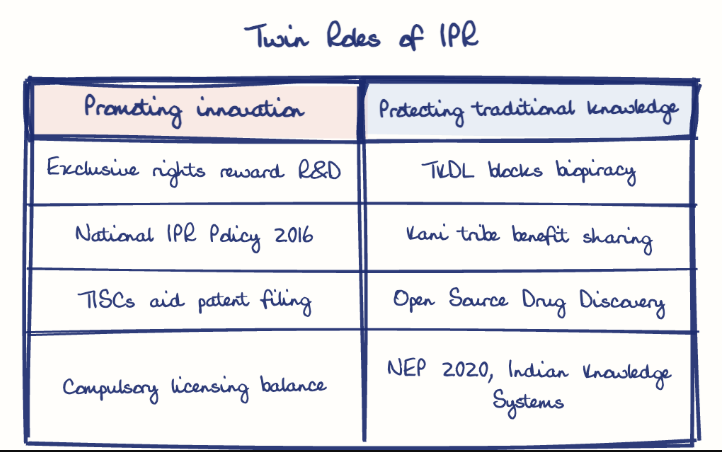
IPR promotes innovation by rewarding inventors under the National IPR Policy 2016, while TRIPS flexibilities like compulsory licensing protect public health. It protects traditional knowledge through the Traditional Knowledge Digital Library, which helps patent examiners reject biopiracy claims, and through benefit-sharing models like the Kani tribe agreement.
Model answer
Ghissu Editorial · Verified 4 Oct 2026 · 260 words
National IPR Policy 2016
Formulated by DPIIT, it promotes innovation, enforcement, and awareness nationwide, creating a cohesive framework to strengthen India’s IPR ecosystem.
Capacity Building and Awareness Programs
Initiatives like Technology and Innovation Support Centres (TISCs) provide technical assistance for patent filing and commercialization, enhancing stakeholder understanding across sectors.
Balancing Monopoly and Public Interest
India uses TRIPS flexibilities like compulsory licensing to ensure access to medicines, balancing innovation incentives with public health and food security concerns.
Private Sector1 Role
With R&D at ~0.65% GDP, Telangana’s HITEC City and pharma hubs exemplify private sector-driven innovation growth, highlighting the need for increased investment and collaboration.
Benefit-Sharing Models
Agreements like Kerala’s collaboration with the Kani tribe ensure equitable royalties and recognition, promoting social equity and sustainable use of biological resources.
National Education Policy 2020
Integrates Indian Knowledge Systems2 to link traditional knowledge with modern innovation frameworks, fostering research and awareness that enhance India’s global competitiveness.
Public Awareness and Skill Development
Expand IPR education and training programs across India to build capacity among innovators, judiciary, and rural communities.
This model answer is indicative and the model can make mistakes; please verify key facts independently.
Practise this question
1Get the answer sheet
Sized for this question.
2Write your answer
Timed, by hand.
3Get it marked
Your score and what to fix.
This chapter in the exam
Science and technology as an engine of national development3 questions
Asked in 1 of 2 sittings since 2016
Most tested: Science and technology as policy-enabled development: urban management, industrial modernization, and innovation/IPR.
Question from the official TGPSC Group-I Mains 2024 paper. Answer written by Ghissu's engine and checked against our editorial standards. Found an error? Tell us and we correct it within 48 hours.