2013 · GS Paper 1 · Q13 · 10 marks
‘American Revolution was an economic revolt against mercantilism.’ Substantiate.
In short
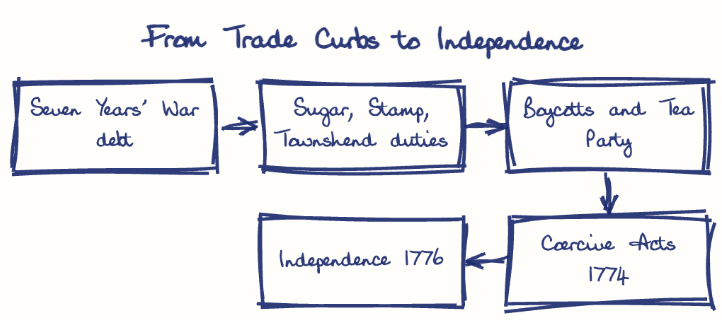
The American Revolution was largely an economic revolt against British mercantilism, since trade monopolies, curbs on manufacture and new duties after 1763 drove colonial protest. The Tea Act of 1773, which favoured the East India Company and provoked the Boston Tea Party, was the decisive flashpoint.
Model answer
Ghissu Editorial · Verified 4 Oct 2026 · 281 words
Trade monopoly
The Navigation Acts (1651, 1660) tied colonial trade to British ships and sent "enumerated" goods like tobacco only to England.
Curbs on manufacture
The Hat Act (1732) and Iron Act (1750) kept America a raw-material supplier for British industry.
Squeeze after 1763
To pay war debts, Britain enforced the Sugar Act and Currency Act (1764) and closed western land by the Proclamation of 1763, hurting merchants, debtors and speculators.
Tea as the flashpoint
The Tea Act (1773) let the East India Company undercut colonial merchants, provoking the Boston Tea Party.
Representation
"No taxation without representation" turned the Stamp Act Congress of 1765 into a constitutional protest over who may tax.
Ideas of liberty
Bernard Bailyn showed how Locke's natural rights and Paine's Common Sense (1776) recast trade grievances as a fight for a republic.
Political punishment
The Coercive Acts of 1774 attacked Massachusetts's charter, uniting the colonies around rights rather than prices.
This model answer is indicative and the model can make mistakes; please verify key facts independently.
Practise this question
1Get the answer sheet
Sized for this question.
2Write your answer
Timed, by hand.
3Get it marked
Your score and what to fix.
This chapter in the exam
Events from the 18th Century: Revolutions4 questions
Asked in 4 of 14 sittings since 2013
- 2025The French Revolution has enduring relevance to the contemporary world. Explain.
- 2019Explain how the foundations of the modern world were, laid by the American and French Revolutions.
All 4 questions, sorted by sub-topic, with model answers and practice.
Question from the official UPSC Civil Services (Main) Examination 2013 paper. Answer written by Ghissu's engine and checked against our editorial standards. Found an error? Tell us and we correct it within 48 hours.