2013 · GS Paper 1 · Q3 · 10 marks
Defying the barriers of age, gender and religion, the Indian women became the torchbearer during the struggle for freedom in India. Discuss.
In short
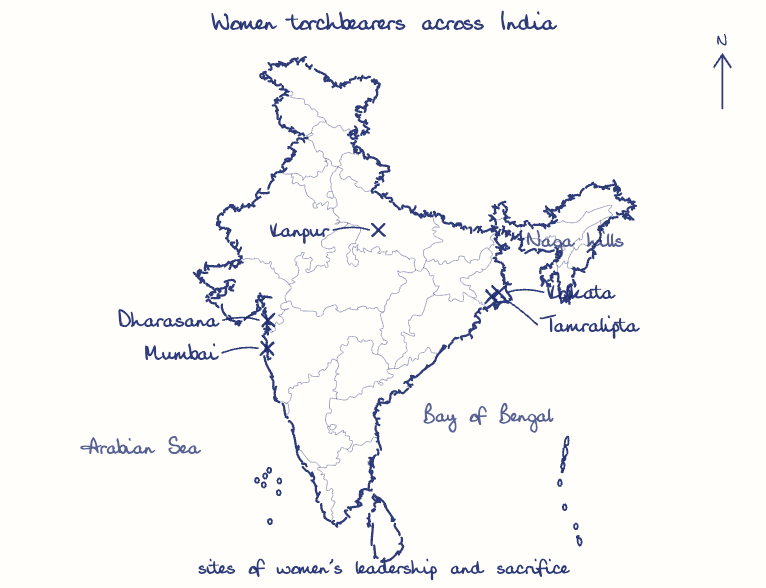
Indian women of every age, faith and region broke purdah and social walls to lead, picket, broadcast and fight for freedom. Matangini Hazra, shot at 73 at Tamluk in 1942, and 17-year-old Kanaklata Barua at Gohpur show how the barrier of age fell.
Model answer
Ghissu Editorial · Verified 4 Oct 2026 · 296 words
Age no bar
Matangini Hazra, 73, was shot leading a 1942 procession at Tamluk, and Kanaklata Barua, 17, fell at Gohpur hoisting the tricolour.
Purdah broken
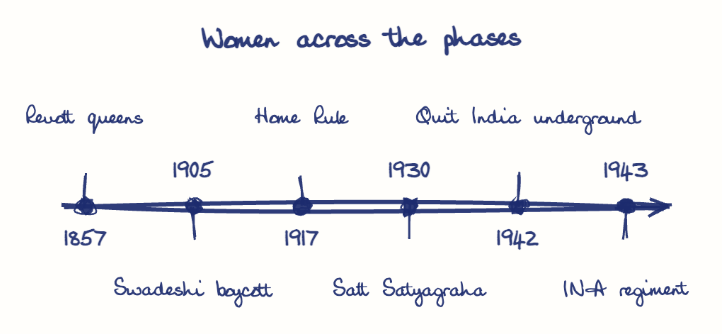
The Salt Satyagraha brought thousands of women out to make salt and picket liquor and foreign-cloth shops, and Sarojini Naidu led the Dharasana raid in 1930.
Faith and region no bar
Bi Amma toured the country for the Khilafat cause, the Parsi Bhikaiji Cama unfurled a flag at Stuttgart in 1907, and Rani Gaidinliu carried the struggle into the Naga hills.
Leading the Congress
Annie Besant (1917) and Sarojini Naidu (1925) presided over the Congress.
Keeping Quit India alive
Aruna Asaf Ali hoisted the flag at Gowalia Tank in August 1942, and Usha Mehta ran the secret Congress Radio.
The armed path
Pritilata Waddedar led the 1932 Pahartali raid, and Lakshmi Swaminathan commanded the INA's Rani of Jhansi Regiment.
Limits
Most leaders were urban and upper-caste, and women's own demands were deferred until after freedom.
This model answer is indicative and the model can make mistakes; please verify key facts independently.
Practise this question
1Get the answer sheet
Sized for this question.
2Write your answer
Timed, by hand.
3Get it marked
Your score and what to fix.
This chapter in the exam
Role of Masses and Personalities13 questions
Asked in 8 of 14 sittings since 2013
- 2026The significance of the Gandhian movements lay in the masses they mobilized. Elucidate.
- 2021Bring out the constructive programmes of Mahatma Gandhi during Non-Cooperation Movement and Civil Disobedience Movement.
All 13 questions, sorted by sub-topic, with model answers and practice.
Question from the official UPSC Civil Services (Main) Examination 2013 paper. Answer written by Ghissu's engine and checked against our editorial standards. Found an error? Tell us and we correct it within 48 hours.