2013 · GS Paper 1 · Q8 · 10 marks
Discuss the contributions of Maulana Abul Kalam Azad to pre and post-independent India.
In short
Maulana Abul Kalam Azad led Muslims into the freedom struggle as a journalist, Khilafat leader and Congress President who rejected the two-nation theory, and then built free India's education system as its first Education Minister. Under him came the UGC, IIT Kharagpur and the national Akademis.
Model answer
Ghissu Editorial · Verified 4 Oct 2026 · 281 words
The pen as a weapon
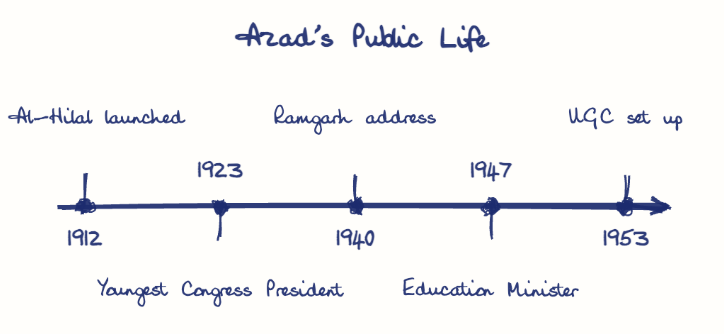
His weekly Al-Hilal (1912) roused educated Muslims against British rule and led to his internment at Ranchi (1916-20).
Mass mobilisation
He led the Khilafat agitation with Gandhi's Non-Cooperation Movement, bringing Muslim masses into the struggle, and spent 1942-45 in Ahmednagar Fort for Quit India.
Composite nationalism
The youngest Congress President (1923), his Ramgarh address of 1940 rejected the two-nation theory, and as President (1940-46) he negotiated with the Cripps Mission and the Cabinet Mission.
Architect of education
As Education Minister (1947-58) he set up the Radhakrishnan (1948) and Mudaliar (1952-53) commissions and the UGC (1953), while IIT Kharagpur (1951) opened and adult "social education" spread under him.
Cultural institutions
The ICCR (1950) and the three national Akademis (1953-54) gave the republic a cultural infrastructure.
Secular citizenship
His Jama Masjid speech of October 1947 urged Muslims to stay, though India Wins Freedom records his regret that Partition could not be averted.
This model answer is indicative and the model can make mistakes; please verify key facts independently.
Practise this question
1Get the answer sheet
Sized for this question.
2Write your answer
Timed, by hand.
3Get it marked
Your score and what to fix.
This chapter in the exam
Role of Masses and Personalities13 questions
Asked in 8 of 14 sittings since 2013
- 2026The significance of the Gandhian movements lay in the masses they mobilized. Elucidate.
- 2021Bring out the constructive programmes of Mahatma Gandhi during Non-Cooperation Movement and Civil Disobedience Movement.
All 13 questions, sorted by sub-topic, with model answers and practice.
Question from the official UPSC Civil Services (Main) Examination 2013 paper. Answer written by Ghissu's engine and checked against our editorial standards. Found an error? Tell us and we correct it within 48 hours.