2013 · GS Paper 1 · Q2(a) · 5 marks
Discuss the 'Tandava’ dance as recorded in early Indian inscriptions.
In short
Early inscriptions and labelled temple panels record Tandava as Shiva's 108-karana dance, patronised by kings and performed by temple dancers. Chidambaram's gopurams inscribe each karana with its Natyashastra verse, and Rajaraja I's Thanjavur inscriptions settle 400 dancers and name the Nataraja Adavallan.
Model answer
Ghissu Editorial · Verified 4 Oct 2026 · 290 words
Royal patronage
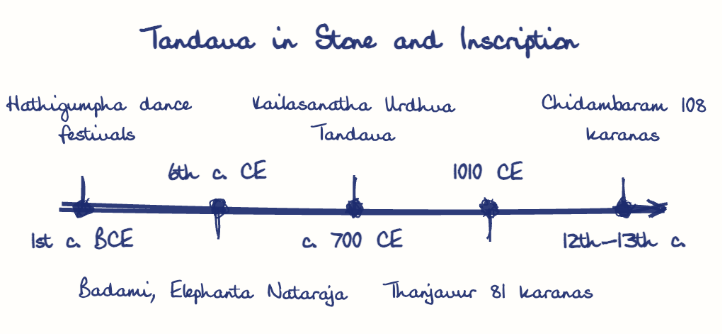
Kharavela's Hathigumpha inscription records dance, song and music festivals in his capital, the earliest epigraphic proof of state-sponsored dance, though Tandava is not yet named.
Labelled karanas
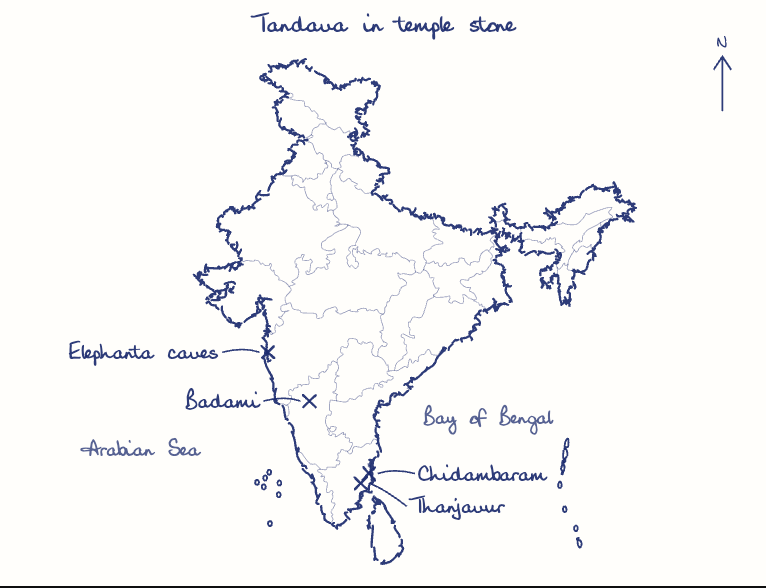
Chidambaram's gopurams carry all 108 karanas, each panel inscribed with its Natyashastra verse, a stone manual that ties performance to the text.
Chola records
Rajaraja I's Thanjavur temple (1010) carves 81 karanas, and his inscriptions settle 400 temple dancers and name the bronze Nataraja Adavallan, "the one who dances well".
Forms
The panels separate Ananda Tandava of Chidambaram from Urdhva Tandava, the leg-raised contest with Kali, while Badami's eighteen-armed Nataraja compresses many poses into one image.
Cosmic and royal meaning
The dance enacts Shiva's five acts (pancha-kritya), and Chola copper plates praise Parantaka I for covering Chidambaram's dance hall with gold.
Tandava and Lasya
The temple dancers endowed by Chola inscriptions carried a tradition pairing Shiva's forceful Tandava with Parvati's graceful Lasya, the twin base of Bharatanatyam.
This model answer is indicative and the model can make mistakes; please verify key facts independently.
Practise this question
1Get the answer sheet
Sized for this question.
2Write your answer
Timed, by hand.
3Get it marked
Your score and what to fix.
This chapter in the exam
Art Forms10 questions
Asked in 8 of 14 sittings since 2013
- 2025The sculptors filled the Chandella artform with resilient vigor and breadth of life.' Elucidate.
- 2022Discuss the significance of the lion and bull figures in Indian mythology, art and architecture.
All 10 questions, sorted by sub-topic, with model answers and practice.
Question from the official UPSC Civil Services (Main) Examination 2013 paper. Answer written by Ghissu's engine and checked against our editorial standards. Found an error? Tell us and we correct it within 48 hours.