2013 · GS Paper 1 · Q5 · 10 marks
In many ways Lord Dalhousie was the founder of modern India.” Elaborate.
In short
Lord Dalhousie (1848-56) laid the physical and institutional frame of modern India through annexations, railways, telegraph, uniform postage, a Public Works Department and Wood's Despatch, though for imperial ends. His Railway Minute of 1853 and the 1854 Post Office Act knit the country into one network.
Model answer
Ghissu Editorial · Verified 4 Oct 2026 · 279 words
A unified map
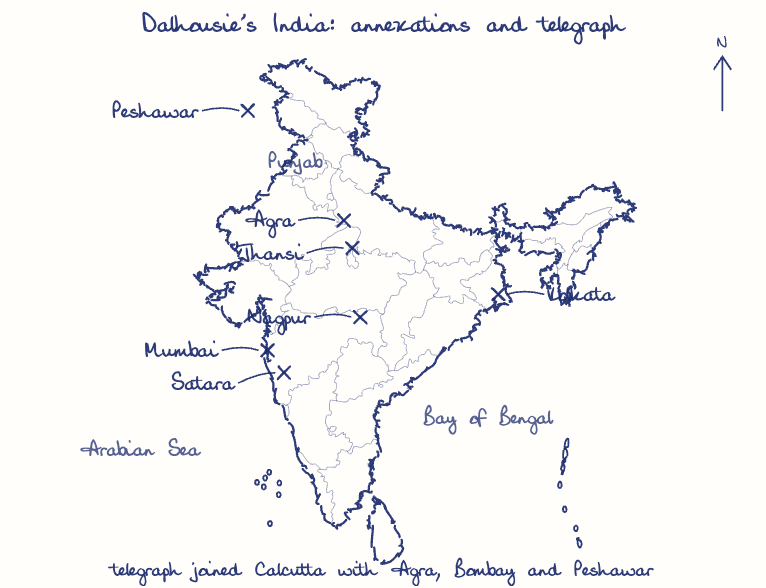
Conquest of Punjab and Lower Burma, lapse of Satara, Jhansi and Nagpur, and the Awadh annexation created a single, directly ruled territory.
Communication revolution
The Railway Minute (1853), telegraph lines from Calcutta to Agra, Bombay and Peshawar, and the half-anna post of 1854 knit the country together.
Modern governance
A Public Works Department, the Upper Ganga Canal (1854) and the Charter Act of 1853, with a legislative council and an open civil service examination, built a modern state.
Education
Wood's Despatch (1854) brought grants-in-aid, vernacular schools and the universities of 1857, which produced the first nationalist intelligentsia.
Social legislation
The Caste Disabilities Removal Act (1850) and the Widows' Remarriage Act, prepared under him and enacted in 1856, brought secular law into social life.
The colonial limit
Railways were built under guaranteed returns to serve cotton exports and troop movement, and the annexations fed the anger of 1857, though the same network later carried the national movement.
This model answer is indicative and the model can make mistakes; please verify key facts independently.
Practise this question
1Get the answer sheet
Sized for this question.
2Write your answer
Timed, by hand.
3Get it marked
Your score and what to fix.
This chapter in the exam
Role of Masses and Personalities13 questions
Asked in 8 of 14 sittings since 2013
- 2026The significance of the Gandhian movements lay in the masses they mobilized. Elucidate.
- 2021Bring out the constructive programmes of Mahatma Gandhi during Non-Cooperation Movement and Civil Disobedience Movement.
All 13 questions, sorted by sub-topic, with model answers and practice.
Question from the official UPSC Civil Services (Main) Examination 2013 paper. Answer written by Ghissu's engine and checked against our editorial standards. Found an error? Tell us and we correct it within 48 hours.