2013 · GS Paper 1 · Q25 · 10 marks
It is said that India has substantial reserves of shale oil and gas, which can feed the needs of the country for quarter century. However, tapping of the resource does not appear to be high on the agenda. Discuss critically the availability and issues involved.
In short
India's shale gas, estimated by the US EIA at 63 to 96 tcf across six basins, is promising but unproven, and water stress, land resistance, costly technology and weak pricing keep it off the agenda. ONGC's in-place estimate of 187.5 tcf contrasts with the USGS's recoverable 6.1 tcf.
Model answer
Ghissu Editorial · Verified 4 Oct 2026 · 295 words
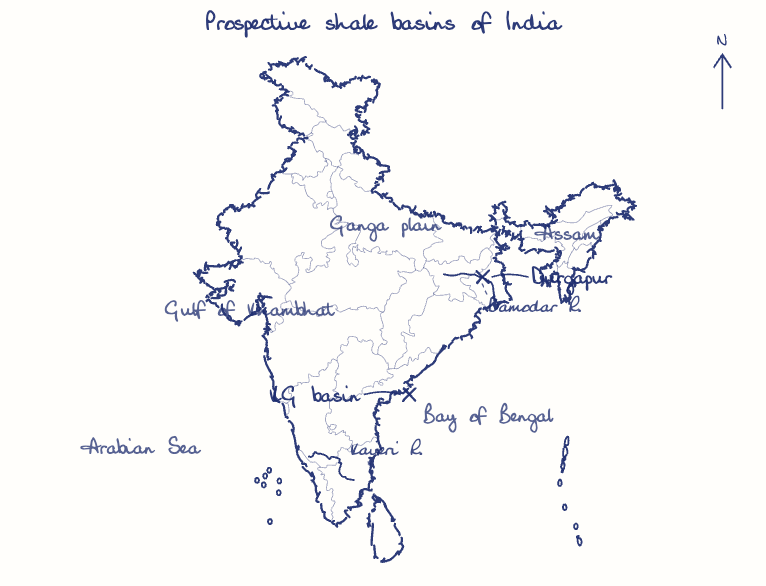
Six basins
Cambay, Krishna-Godavari, Cauvery, Assam-Arakan, Gondwana (Damodar) and Indo-Gangetic basins are shale-bearing, as identified by the DGH.
Estimate gap
ONGC's in-place 187.5 tcf contrasts with the USGS (2011) figure of about 6.1 tcf recoverable, so the promise is a ceiling, not a proven reserve.
Shale oil too
The EIA (2013) also assessed about 3.8 billion barrels of recoverable shale oil, mainly in Cambay and Assam-Arakan.
Strategic pull
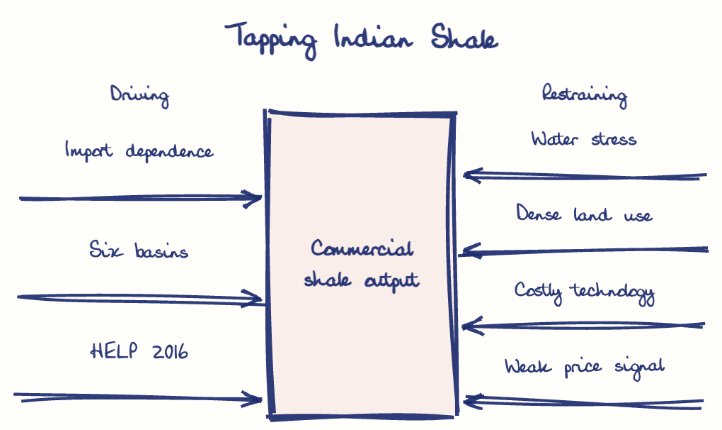
With nearly 88% of crude and close to half of gas imported (PPAC, 2024-25), even modest output would ease the import bill.
Water intensity
Fracking needs millions of litres per well in water-stressed Cambay and risks aquifer contamination.
Land rights
Unlike US landowners who earn royalties, Indian smallholders gain nothing, so dense basins resist acquisition.
Technology
Horizontal drilling and multistage fracking depend on foreign rigs and service firms, and ONGC's early wells have not shown commercial flows.
Price signal
The 2013 policy opened only ONGC and OIL blocks, and administered gas prices deterred investment until HELP (2016).
This model answer is indicative and the model can make mistakes; please verify key facts independently.
Practise this question
1Get the answer sheet
Sized for this question.
2Write your answer
Timed, by hand.
3Get it marked
Your score and what to fix.
This chapter in the exam
Resources and planning38 questions
Asked in 14 of 14 sittings since 2013
- 2026"Water resources are both an asset and a source of conflict in South Asia." Examine this statement giving examples.
- 2026Analyze the role of satellite-based technologies in achieving climate-smart agriculture and food security in India.
All 38 questions, sorted by sub-topic, with model answers and practice.
Question from the official UPSC Civil Services (Main) Examination 2013 paper. Answer written by Ghissu's engine and checked against our editorial standards. Found an error? Tell us and we correct it within 48 hours.