2013 · GS Paper 1 · Q4 · 10 marks
Several foreigners made India their homeland and participated in various movements. Analyze their role in the Indian struggle for freedom.
In short
Foreigners who made India their home gave the freedom struggle organisation, a voice in Britain, mass agitation and moral legitimacy, while its leadership and mass base stayed Indian. A.O. Hume convened the first Congress session in 1885 and Annie Besant launched the Home Rule League in 1916.
Model answer
Ghissu Editorial · Verified 4 Oct 2026 · 277 words
Organisation and lobbying
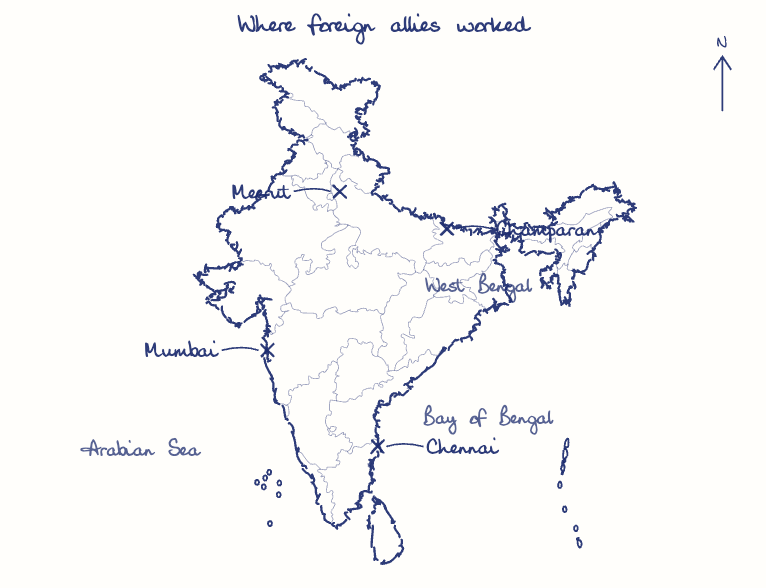
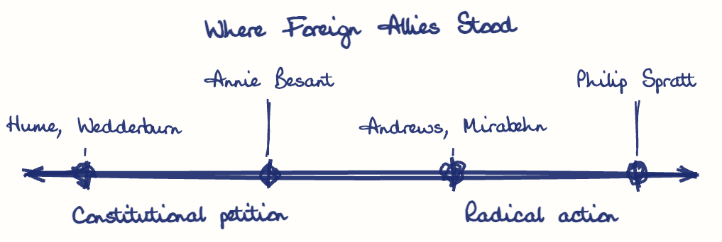
A.O. Hume convened the first Congress session in 1885, and William Wedderburn's British Committee (1889) carried Indian grievances to Parliament.
Agitation and the press
Annie Besant's Home Rule League (1916) and New India spread the swaraj demand, and B.G. Horniman's Bombay Chronicle exposed the Rowlatt repression until his deportation in 1919.
Gandhian and labour phases
C.F. Andrews campaigned against indenture, Mirabehn was detained with Gandhi in 1942, and Philip Spratt organised workers before the Meerut Conspiracy Case (1929).
Safety-valve debate
Lala Lajpat Rai and R. Palme Dutt saw Hume's Congress as a British safety valve, though Bipan Chandra reads Hume as a lightning conductor used by Indian leaders.
Moderate ceiling
Besant opposed Non-Cooperation in 1920, showing that many foreign allies stopped short of mass defiance, and her Theosophy spoke a Hindu idiom.
Indian leadership decisive
The mass phases, from Champaran (1917) to Quit India (1942), were led by Indians.
This model answer is indicative and the model can make mistakes; please verify key facts independently.
Practise this question
1Get the answer sheet
Sized for this question.
2Write your answer
Timed, by hand.
3Get it marked
Your score and what to fix.
This chapter in the exam
Role of Masses and Personalities13 questions
Asked in 8 of 14 sittings since 2013
- 2026The significance of the Gandhian movements lay in the masses they mobilized. Elucidate.
- 2021Bring out the constructive programmes of Mahatma Gandhi during Non-Cooperation Movement and Civil Disobedience Movement.
All 13 questions, sorted by sub-topic, with model answers and practice.
Question from the official UPSC Civil Services (Main) Examination 2013 paper. Answer written by Ghissu's engine and checked against our editorial standards. Found an error? Tell us and we correct it within 48 hours.