2013 · GS Paper 2 · Q10 · 10 marks
Pressure group politics is sometimes seen as the informal face of politics. With regards to the above, assess the structure and functioning of pressure groups in India.
In short
Pressure groups in India are structurally weak, often tied to parties, castes or charismatic leaders, yet they shape policy through lobbying, mass campaigns and litigation. The Samyukt Kisan Morcha's protest forcing the 2021 repeal of the farm laws shows their functional power.
Model answer
Ghissu Editorial · Verified 4 Oct 2026 · 284 words
Party-linked core
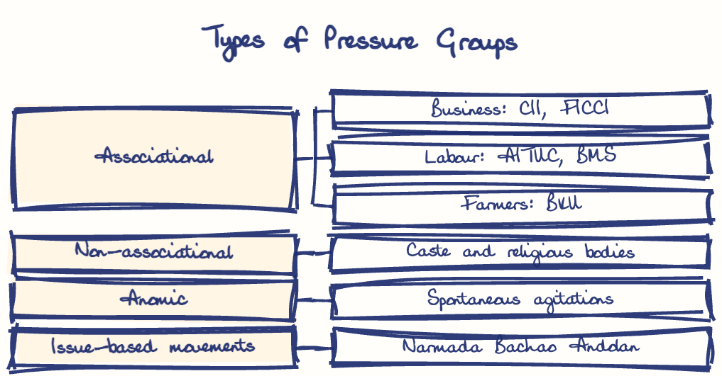
AITUC with the CPI, INTUC with the Congress and the BMS within the Sangh Parivar show that many large groups are party wings with limited autonomy.
Identity-based bodies
Caste associations such as the Nair Service Society wield strong local sway, the "modernity of tradition" in the Rudolphs' phrase.
Loose organisation
Thin paid staff, irregular funds and charismatic leaders mean movements like Chipko or Narmada Bachao rise and fade with their cause.
Lobbying
CII, FICCI and NASSCOM sit on government committees and shape budgets and IT policy through pre-budget memoranda.
Mass campaigns
The Samyukt Kisan Morcha's year-long protest forced the repeal of the three farm laws in 2021, showing the force of mobilisation.
Litigation
ADR's petitions won candidate disclosure in 2002 and the striking down of electoral bonds in 2024.
Strains
Bandhs and lopsided corporate access override the unorganised majority, and FCRA curbs since 2020 have narrowed advocacy space.
This model answer is indicative and the model can make mistakes; please verify key facts independently.
Practise this question
1Get the answer sheet
Sized for this question.
2Write your answer
Timed, by hand.
3Get it marked
Your score and what to fix.
This chapter in the exam
Pressure Groups & Formal/Informal Associations and Their Role in the Polity8 questions
Asked in 7 of 14 sittings since 2013
- 2026To what extent do pressure groups, social movements and corporate lobbies deepen pluralistic democracy in India by representing excluded interests ? Analyse whether the growing convergence of corporate and political power poses a threat to the autonomy of formal democratic institutions.
- 2025Civil Society Organizations are often perceived as being anti-State actors than non-State actors. Do you agree? Justify.
All 8 questions, sorted by sub-topic, with model answers and practice.
Question from the official UPSC Civil Services (Main) Examination 2013 paper. Answer written by Ghissu's engine and checked against our editorial standards. Found an error? Tell us and we correct it within 48 hours.