2026 · GS Paper 2 · Q15 · 15 marks
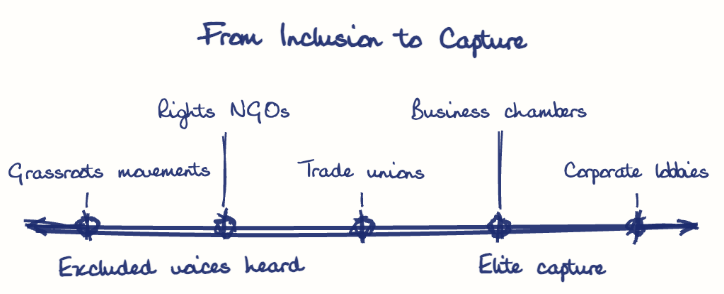
To what extent do pressure groups, social movements and corporate lobbies deepen pluralistic democracy in India by representing excluded interests ? Analyse whether the growing convergence of corporate and political power poses a threat to the autonomy of formal democratic institutions.
In short
Pressure groups and social movements have deepened Indian pluralism substantially but partially, turning excluded voices into laws such as the RTI Act, 2005, while the poorest remain under-organised. Corporate-political convergence threatens institutional autonomy, as the electoral bonds verdict in ADR v Union of India (2024) showed.
Model answer
Ghissu Editorial · Verified 4 Oct 2026 · 279 words
Voice into law
The MKSS's public hearings in Rajasthan produced the RTI Act, 2005, and the Right to Food Campaign (PUCL, 2001) fed into the National Food Security Act, 2013.
Checks between elections
The 2020-21 farmers' movement forced the repeal of three farm laws in 2021.
Partial reach
Informal workers and Adivasis organise far less easily than industry (Olson), 2020 FCRA curbs narrowed NGO space, and chambers like CII and NASSCOM add expertise but speak for capital, not the excluded.
Opaque funding
The 2024 verdict struck down the removal of the corporate donation cap as enabling quid pro quo.
Unregulated lobbying
With no disclosure law like the US Lobbying Disclosure Act, 1995, influence over drafting stays invisible.
Institutions still bite
The Competition Commission's Rs 1,337 crore penalty on Google (2022) shows the threat is real but not decisive.
Transparency rules
A lobbying register, partial state funding (Indrajit Gupta Committee, 1998) and the Pre-Legislative Consultation Policy (2014) would balance influence.
This model answer is indicative and the model can make mistakes; please verify key facts independently.
Practise this question
1Get the answer sheet
Sized for this question.
2Write your answer
Timed, by hand.
3Get it marked
Your score and what to fix.
This chapter in the exam
Pressure Groups & Formal/Informal Associations and Their Role in the Polity8 questions
Asked in 7 of 14 sittings since 2013
- 2025Civil Society Organizations are often perceived as being anti-State actors than non-State actors. Do you agree? Justify.
- 2025What are environmental pressure groups? Discuss their role in raising awareness, influencing policies and advocating for environmental protection in India.
All 8 questions, sorted by sub-topic, with model answers and practice.
Question from the official UPSC Civil Services (Main) Examination 2026 paper. Answer written by Ghissu's engine and checked against our editorial standards. Found an error? Tell us and we correct it within 48 hours.