2025 · GS Paper 2 · Q8 · 10 marks
Civil Society Organizations are often perceived as being anti-State actors than non-State actors. Do you agree? Justify.
In short
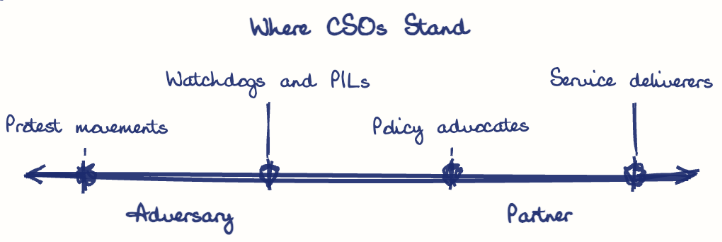
Most civil society organisations are non-State actors that complement the State through accountability, service delivery and crisis relief, while only an adversarial fringe fits the anti-State label. The RTI Act 2005, born of the Mazdoor Kisan Shakti Sangathan's jan sunwais, shows dissent improving governance.
Model answer
Ghissu Editorial · Verified 4 Oct 2026 · 276 words
Opposing projects
A 2014 Intelligence Bureau report claimed that campaigns by foreign-funded NGOs against mines, dams and nuclear plants could cut GDP growth by 2-3%.
Foreign funding fears
The FCRA Amendment 2020 banned sub-granting and capped administrative spending at 20%, upheld in Noel Harper (2022), after Greenpeace India and Amnesty International India lost access to funds.
Security framing
In 2021 the National Security Adviser called civil society the new frontier of fourth-generation warfare, open to subversion against national interest.
Accountability
The Mazdoor Kisan Shakti Sangathan's jan sunwais led to the RTI Act 2005, and ADR won disclosure of candidates' criminal records in Union of India v ADR (2002).
Service delivery
Akshaya Patra serves school meals under PM POSHAN and Pratham's ASER surveys inform learning policy.
Crisis partners
In the 2020 lockdown NITI Aayog sought help from over 92,000 CSOs for food and shelter, treating them as partners rather than threats.
This model answer is indicative and the model can make mistakes; please verify key facts independently.
Practise this question
1Get the answer sheet
Sized for this question.
2Write your answer
Timed, by hand.
3Get it marked
Your score and what to fix.
This chapter in the exam
Pressure Groups & Formal/Informal Associations and Their Role in the Polity8 questions
Asked in 7 of 14 sittings since 2013
- 2026To what extent do pressure groups, social movements and corporate lobbies deepen pluralistic democracy in India by representing excluded interests ? Analyse whether the growing convergence of corporate and political power poses a threat to the autonomy of formal democratic institutions.
- 2025What are environmental pressure groups? Discuss their role in raising awareness, influencing policies and advocating for environmental protection in India.
All 8 questions, sorted by sub-topic, with model answers and practice.
Question from the official UPSC Civil Services (Main) Examination 2025 paper. Answer written by Ghissu's engine and checked against our editorial standards. Found an error? Tell us and we correct it within 48 hours.