2016 · GS Paper 2 · Q3 · 12 marks
The Indian party system is passing through a phase of transition which looks full of contradictions and paradoxes. Discuss.
In short
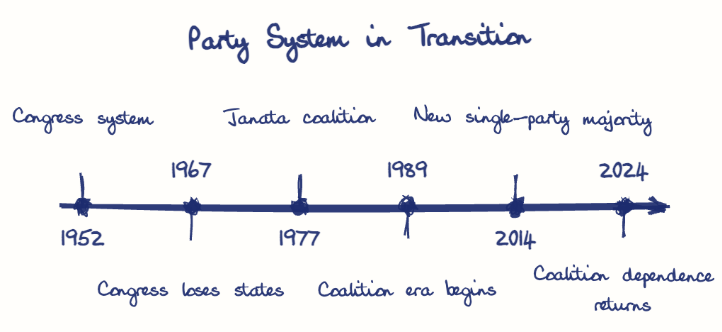
India's party system is moving from one-party dominance through a coalition era to a new dominant pole, combining national dominance with fragmentation, ideology with pragmatism and anti-defection law with defection. The BJP's 2014 majority, the first since 1984, illustrates the shift.
Model answer
Ghissu Editorial · Verified 4 Oct 2026 · 293 words
Erosion of dominance
The 1967 state losses and the 1977 Janata victory proved the Congress could be beaten.
Coalition era
From 1989 to 2014 no party won a majority, and regional parties such as the DMK and TDP became kingmakers.
New dominant pole
In 2014 the BJP won a majority alone, which Palshikar calls a second dominant-party system, though in 2024 allies again became indispensable.
Ideology yet pragmatism
The BJP and PDP governed Jammu and Kashmir together in 2015, and the Shiv Sena allied with the Congress and NCP in 2019.
Democracy without inner democracy
Parties are run by a high command or a family, and the Law Commission's 170th Report (1999) on inner-party democracy remains unenacted.
Anti-defection yet defection
Despite the Tenth Schedule and the 91st Amendment, mass switches toppled governments in Karnataka and Madhya Pradesh.
Participation versus probity
Turnout reached a record 67.4 per cent in 2019, yet ADR found 46 per cent of Lok Sabha members elected in 2024 declared criminal cases.
This model answer is indicative and the model can make mistakes; please verify key facts independently.
Practise this question
1Get the answer sheet
Sized for this question.
2Write your answer
Timed, by hand.
3Get it marked
Your score and what to fix.
This chapter in the exam
Pressure Groups & Formal/Informal Associations and Their Role in the Polity8 questions
Asked in 7 of 14 sittings since 2013
- 2026To what extent do pressure groups, social movements and corporate lobbies deepen pluralistic democracy in India by representing excluded interests ? Analyse whether the growing convergence of corporate and political power poses a threat to the autonomy of formal democratic institutions.
- 2025Civil Society Organizations are often perceived as being anti-State actors than non-State actors. Do you agree? Justify.
All 8 questions, sorted by sub-topic, with model answers and practice.
Question from the official UPSC Civil Services (Main) Examination 2016 paper. Answer written by Ghissu's engine and checked against our editorial standards. Found an error? Tell us and we correct it within 48 hours.