2017 · GS Paper 2 · Q4 · 10 marks
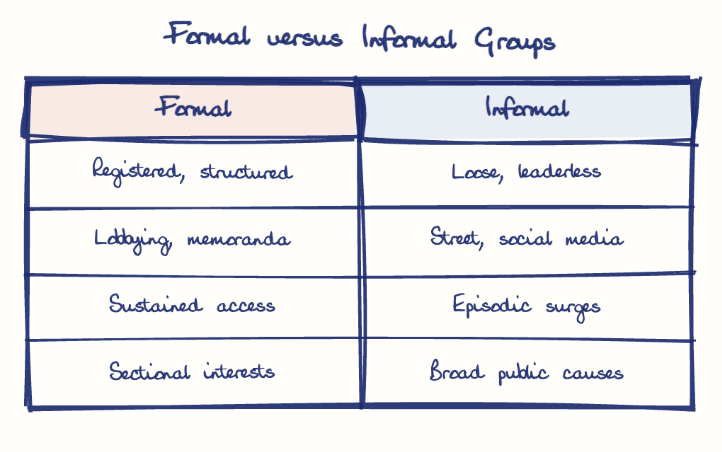
How do pressure groups influence Indian political process? Do you agree with this view that informal pressure groups have emerged as powerful than formal pressure groups in recent years?
In short
Pressure groups shape Indian politics through electioneering, lobbying, protest and litigation, and informal groups have become more visible and decisive on salient issues while formal groups keep steadier influence. The 2012 Nirbhaya protests led to the Criminal Law (Amendment) Act 2013.
Model answer
Ghissu Editorial · Verified 4 Oct 2026 · 293 words
Electioneering
Trade unions like INTUC and the Bharatiya Mazdoor Sangh back allied parties, and caste associations deliver bloc votes.
Lobbying
FICCI and CII submit pre-budget memoranda and depose before Parliamentary Standing Committees.
Protest and litigation
Dharnas and media campaigns mould opinion, and ADR's PIL won disclosure of candidates' criminal records in Union of India v ADR (2002).
Rise of informal power
The 2012 Nirbhaya protests led to the Criminal Law (Amendment) Act 2013, and the 2017 Jallikattu protests on Marina beach produced a state law within days.
Why informal groups gain
Social media, distrust of parties and weaker party-tied unions let movements mobilise faster, as India Against Corruption did in pushing the Lokpal and Lokayuktas Act 2013.
Formal groups still decisive
The IMA got the bridge course dropped from the National Medical Commission Bill in 2018 through steady institutional access.
Limits of informal power
India Against Corruption split in 2012, and even the 2020-21 farmers' protest was led by established farmers' unions.
This model answer is indicative and the model can make mistakes; please verify key facts independently.
Practise this question
1Get the answer sheet
Sized for this question.
2Write your answer
Timed, by hand.
3Get it marked
Your score and what to fix.
This chapter in the exam
Pressure Groups & Formal/Informal Associations and Their Role in the Polity8 questions
Asked in 7 of 14 sittings since 2013
- 2026To what extent do pressure groups, social movements and corporate lobbies deepen pluralistic democracy in India by representing excluded interests ? Analyse whether the growing convergence of corporate and political power poses a threat to the autonomy of formal democratic institutions.
- 2025Civil Society Organizations are often perceived as being anti-State actors than non-State actors. Do you agree? Justify.
All 8 questions, sorted by sub-topic, with model answers and practice.
Question from the official UPSC Civil Services (Main) Examination 2017 paper. Answer written by Ghissu's engine and checked against our editorial standards. Found an error? Tell us and we correct it within 48 hours.