2023 · GS Paper 1 · Q18 · 15 marks
Does urbanization lead to more segregation and/or marginalization of the poor in Indian metropolises?
In short
Urbanisation in Indian metropolises has largely deepened segregation and marginalisation of the poor through eviction, peripheral resettlement and caste and religious sorting, though city life also loosens caste. Census 2011 counted about 6.5 crore slum dwellers, including roughly four in ten residents of Greater Mumbai.
Model answer
Ghissu Editorial · Verified 4 Oct 2026 · 286 words
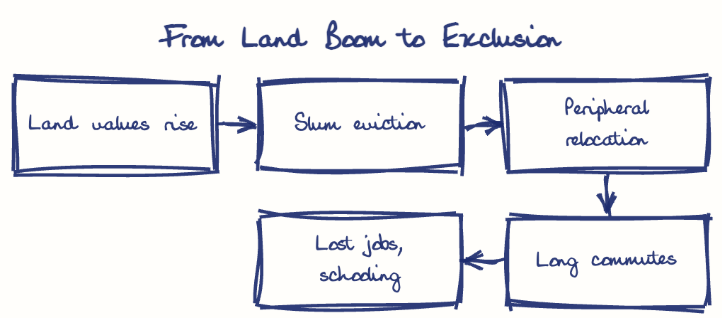
Eviction to the periphery
Delhi's slum dwellers were resettled to Bawana and Savda Ghevra, and Chennai's to Kannagi Nagar, far from their jobs, while Mumbai's were moved to polluted Mahul beside refineries.
Caste and religious sorting
Sukhadeo Thorat and colleagues (EPW, 2015) found Dalit and Muslim tenants in Delhi-NCR faced far more refusals, and Ahmedabad's Juhapura shows religious ghettoisation.
Invisible workers
The 2020 lockdown exodus showed metropolises depend on migrant labour they neither house nor register for welfare.
Weaker ascriptive ties
As Louis Wirth argued, urbanism loosens traditional bonds, widening inter-caste work and dining, and Dharavi's recycling and leather units give migrants a foothold.
Legal and tenure protection
Olga Tellis (1985) tied livelihood to Article 21, Ajay Maken (Delhi HC, 2019) required rehabilitation before demolition, and Odisha's Jaga Mission grants in-situ land rights.
In-situ upgrading and rental housing
Scale Jaga-style tenure, PMAY-Urban 2.0 and Affordable Rental Housing Complexes over distant relocation.
Participatory planning
Activate ward committees under the 74th Amendment and bar discriminatory housing refusals.
This model answer is indicative and the model can make mistakes; please verify key facts independently.
Practise this question
1Get the answer sheet
Sized for this question.
2Write your answer
Timed, by hand.
3Get it marked
Your score and what to fix.
This chapter in the exam
Poverty and developmental issues9 questions
Asked in 6 of 14 sittings since 2013
- 2025Achieving sustainable growth with emphasis on environmental protection could come into conflict with poor people's needs in a country like India - Comment.
- 2025How does smart city in India, address the issues of urban poverty and distributive justice ?
All 9 questions, sorted by sub-topic, with model answers and practice.
Question from the official UPSC Civil Services (Main) Examination 2023 paper. Answer written by Ghissu's engine and checked against our editorial standards. Found an error? Tell us and we correct it within 48 hours.