2023 · GS Paper 1 · Q17 · 15 marks
From being net food importer in 1960s, India emerged as a net food exporter to the world. Provide reasons.
In short
India turned from a net food importer into an exporter through Green Revolution seeds, irrigation and inputs, allied revolutions in milk and fish, assured MSP procurement, and post-1991 trade opening with export promotion. Foodgrain output rose from about 82 million tonnes in 1960-61 to 357.7 million tonnes in 2024-25.
Model answer
Ghissu Editorial · Verified 4 Oct 2026 · 291 words
In 1966 India imported over 10 million tonnes of grain, mostly under US PL-480 aid. Foodgrain output has since risen from about 82 million tonnes in 1960-61 to 357.7 million tonnes in 2024-25, and India has been the largest rice exporter since 2012.
Production Revolutions Behind Self-Sufficiency
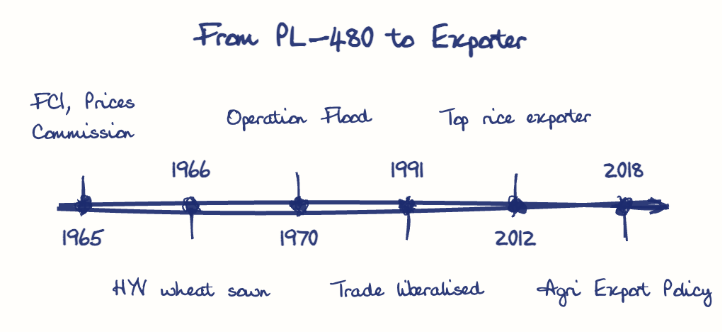
From PL-480 to Exporter → 1965 :: FCI, Prices Commission → 1966 :: HYV wheat sown → 1970 :: Operation Flood → 1991 :: Trade liberalised → 2012 :: Top rice exporter → 2018 :: Agri Export Policy
1. High-yielding seeds: Dwarf wheat adapted under M.S. Swaminathan and IR-8 rice multiplied yields in Punjab, Haryana and western Uttar Pradesh. 2. Irrigation and inputs: Tubewells, Bhakra Nangal, subsidised fertiliser and electrification took irrigation beyond half the net sown area. 3. Allied revolutions: Operation Flood made India the largest milk producer, and fish output doubled to 197.75 lakh tonnes by 2024-25 (Department of Fisheries, PIB).
Assured prices
MSP and FCI procurement guaranteed markets and built buffer stocks well above norms, freeing grain for export.
Liberalisation
The 1991 reforms and the 1995 WTO Agreement on Agriculture let low-cost rice, sugar and buffalo meat compete abroad.
Export promotion
APEDA, the Agriculture Export Policy 2018 and the Basmati GI tag built brands and cold chains.
Close gaps
The National Mission on Edible Oils-Oilseeds (2024) must cut imports of over half of India's edible oil.
Sustainability
Crop diversification away from water-hungry rice and stable export policy, unlike the 2023 rice curbs, will sustain the surplus.
This model answer is indicative and the model can make mistakes; please verify key facts independently.
Practise this question
1Get the answer sheet
Sized for this question.
2Write your answer
Timed, by hand.
3Get it marked
Your score and what to fix.
This chapter in the exam
Resources and planning38 questions
Asked in 14 of 14 sittings since 2013
- 2026"Water resources are both an asset and a source of conflict in South Asia." Examine this statement giving examples.
- 2026Analyze the role of satellite-based technologies in achieving climate-smart agriculture and food security in India.
All 38 questions, sorted by sub-topic, with model answers and practice.
Question from the official UPSC Civil Services (Main) Examination 2023 paper. Answer written by Ghissu's engine and checked against our editorial standards. Found an error? Tell us and we correct it within 48 hours.