2025 · GS Paper 2 · Q15 · 15 marks
What are environmental pressure groups? Discuss their role in raising awareness, influencing policies and advocating for environmental protection in India.
In short
Environmental pressure groups are associations, from research bodies like CSE to movements like Chipko, that raise awareness, shape laws and defend ecosystems without contesting elections. Chipko's campaign won a 15-year ban on green felling in Uttar Pradesh's Himalayan forests in 1980.
Model answer
Ghissu Editorial · Verified 4 Oct 2026 · 276 words
Research and reports
CSE's State of India's Environment reports and its 2003 pesticide-in-soft-drinks study, which led to a Joint Parliamentary Committee, put pollution on the public agenda.
Grassroots mobilisation
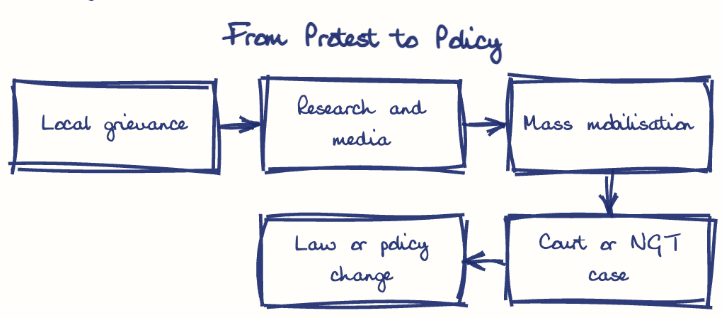
Chipko women at Reni in 1974 won a 15-year ban on green felling in Uttar Pradesh's Himalayan forests in 1980.
Shaping law
The Campaign for Survival and Dignity pressed for the Forest Rights Act 2006, and CSE backed the 1998 M.C. Mehta order moving Delhi's buses to CNG.
Forest dwellers' rights
The Niyamgiri Suraksha Samiti stood with the Dongria Kondh, whose gram sabhas rejected Vedanta's mine after the 2013 Supreme Court ruling.
Pollution accountability
Thoothukudi protests led to the Sterlite smelter's closure in 2018, upheld by the Supreme Court in 2024.
Limits
A 2014 Intelligence Bureau report accused foreign-funded groups of stalling growth, and some campaigns ignore local development needs.
Consultation and transparency
A formal role in EIA hearings, evidence-based campaigns and full fund disclosure would make advocacy credible.
This model answer is indicative and the model can make mistakes; please verify key facts independently.
Practise this question
1Get the answer sheet
Sized for this question.
2Write your answer
Timed, by hand.
3Get it marked
Your score and what to fix.
This chapter in the exam
Pressure Groups & Formal/Informal Associations and Their Role in the Polity8 questions
Asked in 7 of 14 sittings since 2013
- 2026To what extent do pressure groups, social movements and corporate lobbies deepen pluralistic democracy in India by representing excluded interests ? Analyse whether the growing convergence of corporate and political power poses a threat to the autonomy of formal democratic institutions.
- 2025Civil Society Organizations are often perceived as being anti-State actors than non-State actors. Do you agree? Justify.
All 8 questions, sorted by sub-topic, with model answers and practice.
Question from the official UPSC Civil Services (Main) Examination 2025 paper. Answer written by Ghissu's engine and checked against our editorial standards. Found an error? Tell us and we correct it within 48 hours.