Critically examine the impact of British colonial rule on the Indian economy.
In short
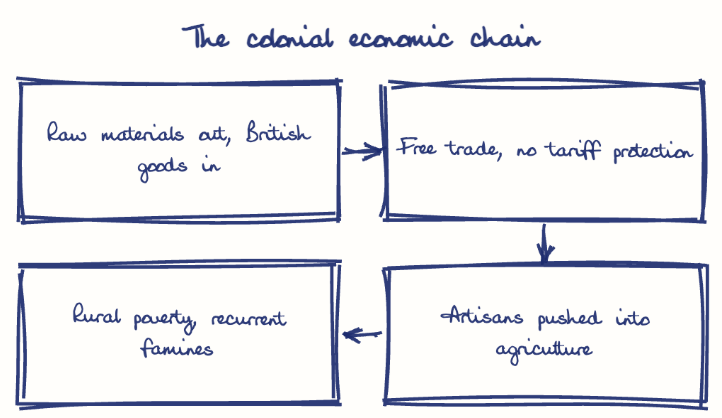
British rule turned India into an exporter of raw materials and a market for British goods, causing deindustrialisation, wealth drain, agrarian distress and recurrent famines. India's share of the world economy fell from nearly 23% in the early eighteenth century to about 3% by 1947.
Model answer
Ghissu Editorial · Verified 4 Oct 2026 · 303 words
Subordination to British Interests
India’s economy was designed to export raw materials like cotton and jute while importing British manufactured goods, suppressing indigenous industrial growth. The Permanent Settlement and other land revenue systems entrenched landlordism, worsening rural poverty and limiting agricultural investment.
Drain of Wealth
Dadabhai Naoroji’s “drain theory” highlights how colonial policies transferred India’s economic surplus to Britain, financing its industrial revolution at India’s expense. Minimal reinvestment in Indian infrastructure or social sectors deepened economic stagnation.
Regional Disparities
Industrialisation was uneven, favouring Bombay’s cotton mills and Bengal’s jute industry, while neglecting heavy industries and power generation, entrenching regional inequalities. This lopsided growth hindered national economic integration and sustained poverty in neglected regions.
Inclusive Industrial Policy
Targeted support for small and medium enterprises and balanced regional development can address colonial-era disparities. Learning from post-independence industrial policies can help nurture indigenous industries and reduce regional imbalances.
Address Wealth Inequality
Progressive taxation and social welfare are needed to correct entrenched inequalities, with the top 1% holding ~40% of wealth and ~22.6% of national income, higher than during colonial times. Strengthening rural investment and land reforms can also reduce poverty rooted in colonial land revenue systems.
This model answer is indicative and the model can make mistakes; please verify key facts independently.
Practise this question
1Get the answer sheet
Sized for this question.
2Write your answer
Timed, by hand.
3Get it marked
Your score and what to fix.
This chapter in the exam
British Rule 1757-1856, the 1857 Revolt, Socio-Religious Reform & the Rise of Nationalism20 questions
Asked in 8 of 8 sittings since 2008
Most tested: Colonialism’s impact on Indian society/economy and reform-led social uplift, especially untouchability and caste reform.
- 2025What do you understand by the Permanent Settlement, and what impact did it have on Indian society? Comment.
- 2025What do you understand by the 'safety valve' theory? Explain it in the context of the Indian National Congress?
All 20 questions, sorted by sub-topic, with model answers and practice.
Question from the official APPSC Group-I Mains 2008 paper. Answer written by Ghissu's engine and checked against our editorial standards. Found an error? Tell us and we correct it within 48 hours.