Is India a Federation ?
In short
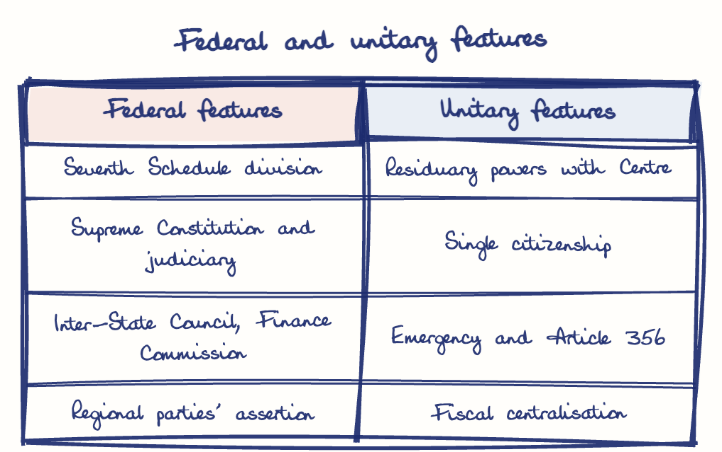
India is a federation of its own kind, a "Union of States" with a written constitution, divided powers and an independent judiciary, but with a strong Centre and unitary features. Residuary powers under Article 248, Parliament's power over state boundaries under Article 3 and emergency provisions make it quasi-federal.
Model answer
Ghissu Editorial · Verified 4 Oct 2026 · 263 words
Written Constitution and Division of Powers
The Seventh Schedule and Articles 245-263 clearly demarcate Union and State powers, establishing a federal framework with Union, State, and Concurrent Lists.
Asymmetric Federalism and Single Citizenship
India’s asymmetric federalism and single citizenship (Article 5) centralise authority while managing diversity, unlike classical federations with dual citizenship.
Institutional Mechanisms
The Finance Commission1, especially the 15th, balances fiscal equity and regional concerns through devolution to states and local bodies. The Inter-State Council also facilitates dialogue, promoting cooperative federalism.
K.C. Wheare’s Quasi-Federalism
India is described as quasi-federal due to the strong Centre and absence of state sovereignty or secession rights, reflecting a unitary bias within a federal framework.
Political Dynamics and Regional Assertion
The fragmentation of political alliances and regional demands, such as in Andhra Pradesh post-bifurcation, test federal governance and require accommodation of regional aspirations.
Strengthen Dialogue and Fiscal Federalism
Empower the Inter-State Council and Finance Commissions to enhance cooperative federalism and address vertical fiscal imbalances, especially for revenue-deficit states like Andhra Pradesh.
Reform Emergency Provisions
Amend Article 356 to prevent misuse of President’s Rule and protect state autonomy through judicial oversight.
This model answer is indicative and the model can make mistakes; please verify key facts independently.
Practise this question
1Get the answer sheet
Sized for this question.
2Write your answer
Timed, by hand.
3Get it marked
Your score and what to fix.
This chapter in the exam
Federal structure, Governor and distribution of powers17 questions
Asked in 8 of 8 sittings since 2008
Most tested: Centre–State balance and the extent of Union supremacy over States
- 2025The procedure of enacting a law from a bill differs at the Union and State levels, primarily to safeguard the interests of the Union Government in state legislation. Elucidate this aspect.
- 2025Although States have their separate list for law-making, this authority is not beyond the overarching legislative powers of the Parliament. Examine.
All 17 questions, sorted by sub-topic, with model answers and practice.
Question from the official APPSC Group-I Mains 2008 paper. Answer written by Ghissu's engine and checked against our editorial standards. Found an error? Tell us and we correct it within 48 hours.