Critically examine the Economic, Political and Administrative reforms introduced by the British in Modern India.
In short
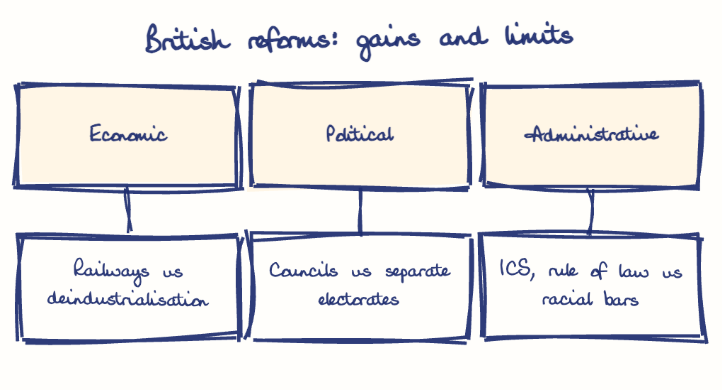
British reforms served imperial interests: economic policies caused deindustrialisation and agrarian distress, political reforms offered limited representation, and administrative reforms built a centralised, merit-based bureaucracy with codified law. Yet the Indian Councils Acts, the Government of India Acts of 1919 and 1935, and the civil service shaped independent India's governance.
Model answer
Ghissu Editorial · Verified 4 Oct 2026 · 258 words
Deindustrialisation and Agrarian Distress
British policies prioritized raw material extraction, causing decline of indigenous industries and rural poverty; Permanent Settlement and Ryotwari systems imposed heavy taxes, sparking unrest like Andhra Pradesh’s Anti-Zamindari movements. The fiscal pressure led to widespread indebtedness and dispossession among peasants.
Infrastructure Development and Limited Industrialization
Railways, telegraphs, and roads integrated markets, facilitating economic activity despite serving colonial extraction. Additionally, modern industries such as railways and mining were introduced but remained capital-intensive and employed few, limiting broad economic benefits.
Representative Institutions and Communalism
Indian Councils Acts and Government of India Acts expanded limited Indian participation; Morley-Minto Reforms (1909) institutionalized separate electorates, entrenching communal divisions. This divide-and-rule policy weakened the nationalist movement and contributed to communal tensions.
Political Exclusion and Leadership Training
Franchise restrictions excluded most Indians, but reforms created a political class crucial for independence. Indian politicians gained experience in governance, which later aided the freedom struggle and post-independence state-building.
Centralized Bureaucracy and Rule of Law
Merit-based Indian Civil Service and codified laws brought uniformity and efficiency; however, racial discrimination persisted, exemplified by laws like the Arms Act that restricted Indian rights and maintained colonial hierarchies.
This model answer is indicative and the model can make mistakes; please verify key facts independently.
Practise this question
1Get the answer sheet
Sized for this question.
2Write your answer
Timed, by hand.
3Get it marked
Your score and what to fix.
This chapter in the exam
British Rule 1757-1856, the 1857 Revolt, Socio-Religious Reform & the Rise of Nationalism20 questions
Asked in 8 of 8 sittings since 2008
Most tested: Colonialism’s impact on Indian society/economy and reform-led social uplift, especially untouchability and caste reform.
- 2025What do you understand by the Permanent Settlement, and what impact did it have on Indian society? Comment.
- 2025What do you understand by the 'safety valve' theory? Explain it in the context of the Indian National Congress?
All 20 questions, sorted by sub-topic, with model answers and practice.
Question from the official APPSC Group-I Mains 2011 paper. Answer written by Ghissu's engine and checked against our editorial standards. Found an error? Tell us and we correct it within 48 hours.