Describe the rise and growth of socio-religious reform movements in Modern India with special reference to Rajarammohan Roy, Jyotiba Phule and Narayana Guru.
In short
Socio-religious reform movements grew from the colonial encounter and Western education, challenging sati, caste and gender inequality. Raja Rammohan Roy founded the Brahmo Samaj (1828), Jyotiba Phule the Satyashodhak Samaj and a girls' school (1848), and Narayana Guru challenged Brahmin control of worship at Aruvippuram (1888).
Model answer
Ghissu Editorial · Verified 4 Oct 2026 · 306 words
Colonial Impact and Western Education
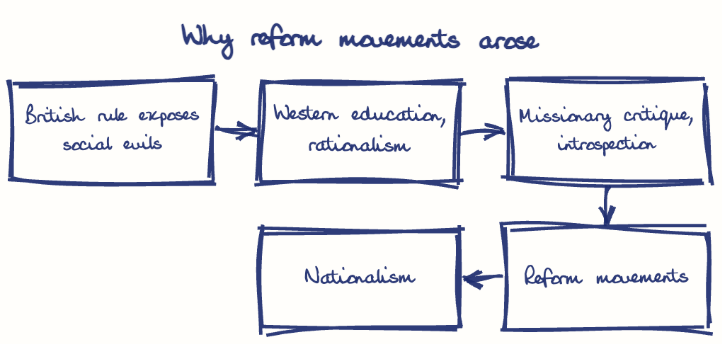
British rule revealed social ills like sati and caste rigidity; English education spread Enlightenment values, inspiring Raja Rammohan Roy to challenge idol worship and priestly dominance. The new middle class demanded social reforms to align with modern ideals.
Religious Awakening and Nationalism
Encounters with Christian critiques led to Hindu reform efforts like Brahmo Samaj and Arya Samaj1; reform was linked to nationalist aspirations for political freedom. Reformers believed social regeneration was essential for national pride and independence.
Early Reform Movements
Brahmo Samaj (1828) campaigned against sati and caste discrimination; Satyashodhak Samaj (Phule) emphasized anti-caste activism and education for Dalits; Narayana Guru promoted temple entry and social equality in Kerala. These movements diversified regionally, addressing local social issues.
Raja Rammohan Roy
Father of Indian Renaissance; founded Brahmo Samaj; instrumental in abolition of sati (1829); championed women's property rights and modern education. He advocated monotheism and rationalism, opposing blind faith and idol worship.
Jyotiba Phule
Founded the Satyashodhak Samaj (1873) and opened a school for girls in 1848, challenging Brahminical supremacy and working for the education of lower castes and women.
Narayana Guru
Led Kerala’s social equality movement; advocated temple entry rights and spiritual upliftment. His efforts promoted unity among oppressed castes and challenged caste-based discrimination in religious spaces.
This model answer is indicative and the model can make mistakes; please verify key facts independently.
Practise this question
1Get the answer sheet
Sized for this question.
2Write your answer
Timed, by hand.
3Get it marked
Your score and what to fix.
This chapter in the exam
British Rule 1757-1856, the 1857 Revolt, Socio-Religious Reform & the Rise of Nationalism20 questions
Asked in 8 of 8 sittings since 2008
Most tested: Colonialism’s impact on Indian society/economy and reform-led social uplift, especially untouchability and caste reform.
- 2025What do you understand by the Permanent Settlement, and what impact did it have on Indian society? Comment.
- 2025What do you understand by the 'safety valve' theory? Explain it in the context of the Indian National Congress?
All 20 questions, sorted by sub-topic, with model answers and practice.
Question from the official APPSC Group-I Mains 2011 paper. Answer written by Ghissu's engine and checked against our editorial standards. Found an error? Tell us and we correct it within 48 hours.