Explain the powers and functions of the Human Rights Commission.
In short
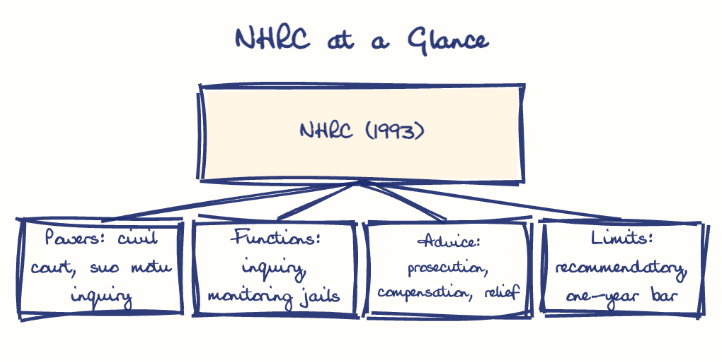
The NHRC, set up under the Protection of Human Rights Act, 1993, inquires into rights violations with civil court powers, monitors jails and promotes human rights awareness. Its recommendations are not binding, and it cannot take up complaints over a year old or directly probe armed forces.
Model answer
Ghissu Editorial · Verified 4 Oct 2026 · 267 words
Civil Court Powers
NHRC wields civil court powers under the Code of Civil Procedure, 1908, enabling it to summon witnesses and collect evidence, giving it quasi-judicial authority.
Inquiry Authority and Limitations
It can inquire suo motu or on complaints about violations by public servants, but cannot investigate armed forces directly and must act within one year of the violation. It can also call for reports from governments to aid investigations.
Promotion and Advisory Role
It promotes human rights awareness through campaigns and NGOs, advises governments on prosecution and compensation, but its recommendations are non-binding. It may approach courts for necessary directions or writs.
Recommendatory Nature and Constraints
NHRC’s recommendations lack binding force; inadequate staffing and financial autonomy hamper its effectiveness, as noted by the Supreme Court. This limits timely investigations, especially in remote areas.
Limited Armed Forces Jurisdiction
The Commission’s inability to directly investigate armed forces limits accountability in conflict zones, including Andhra Pradesh’s sensitive areas, where human rights concerns are acute.
Enhance Autonomy and Jurisdiction
Grant full financial independence, increase manpower, and amend laws to empower NHRC to investigate armed forces directly, ensuring better protection in conflict-affected regions.
This model answer is indicative and the model can make mistakes; please verify key facts independently.
Practise this question
1Get the answer sheet
Sized for this question.
2Write your answer
Timed, by hand.
3Get it marked
Your score and what to fix.
This chapter in the exam
Statutory, regulatory, quasi-judicial bodies and Civil Services9 questions
Asked in 6 of 8 sittings since 2008
Most tested: National Commission for Women and quasi-judicial bodies/Administrative Tribunals.
- 2025Under which Act was the National Commission for Women (NCW) established? Describe its main features and limitations.
- 2025Which constitutional provisions empower the formation of quasi-judicial authorities in India? Explain with suitable examples.
All 9 questions, sorted by sub-topic, with model answers and practice.
Question from the official APPSC Group-I Mains 2011 paper. Answer written by Ghissu's engine and checked against our editorial standards. Found an error? Tell us and we correct it within 48 hours.