Give instances wherein the Constitution provides control of the Union over the States.
In short
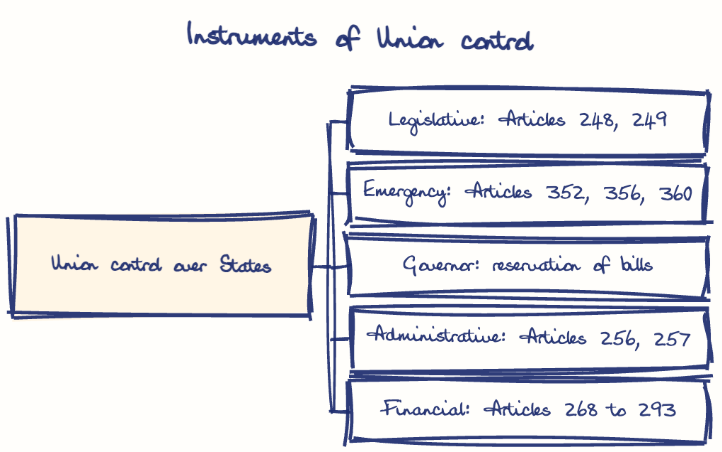
The Constitution gives the Union legislative, administrative, financial and emergency control over States, including Union law prevailing under Article 254, Parliament legislating on State subjects under Article 249 and binding directions under Articles 256 and 257. Under Article 356, the Union can impose President's Rule when state constitutional machinery fails.
Model answer
Ghissu Editorial · Verified 4 Oct 2026 · 278 words
Legislative Supremacy via Seventh Schedule
Parliament exclusively controls the Union List and residuary subjects (Article 248); Union law overrides State law on Concurrent List conflicts (Article 254), ensuring central legislative dominance.
Emergency Provisions Enabling Central Override
Articles 352, 356, and 360 empower the Union to impose President’s Rule during crises, exemplified by Andhra Pradesh’s President’s Rule episodes. These provisions allow temporary suspension of State autonomy to restore constitutional order.
Parliament’s Power to Legislate on State Subjects
Article 249 allows Parliament to legislate on State List matters with Rajya Sabha’s two-thirds resolution in national interest. This extends Union legislative reach during critical situations.
Centralisation vs. State Autonomy Tension
The Union’s overriding powers often cause friction, as seen in Andhra Pradesh’s bifurcation and demands for autonomy. States frequently seek greater fiscal and administrative independence.
Financial Control and Fiscal Dependence
Union controls major taxes and grants (Articles 268-293); Andhra Pradesh’s demand for Special Category Status highlights fiscal tensions. The Finance Commission’s recommendations mediate resource sharing but do not eliminate disputes.
This model answer is indicative and the model can make mistakes; please verify key facts independently.
Practise this question
1Get the answer sheet
Sized for this question.
2Write your answer
Timed, by hand.
3Get it marked
Your score and what to fix.
This chapter in the exam
Federal structure, Governor and distribution of powers17 questions
Asked in 8 of 8 sittings since 2008
Most tested: Centre–State balance and the extent of Union supremacy over States
- 2025The procedure of enacting a law from a bill differs at the Union and State levels, primarily to safeguard the interests of the Union Government in state legislation. Elucidate this aspect.
- 2025Although States have their separate list for law-making, this authority is not beyond the overarching legislative powers of the Parliament. Examine.
All 17 questions, sorted by sub-topic, with model answers and practice.
Question from the official APPSC Group-I Mains 2011 paper. Answer written by Ghissu's engine and checked against our editorial standards. Found an error? Tell us and we correct it within 48 hours.