What are the principles adopted by the Courts in an irreconcilable conflict between a law made by the Parliament and a law made by the State legislature?
In short
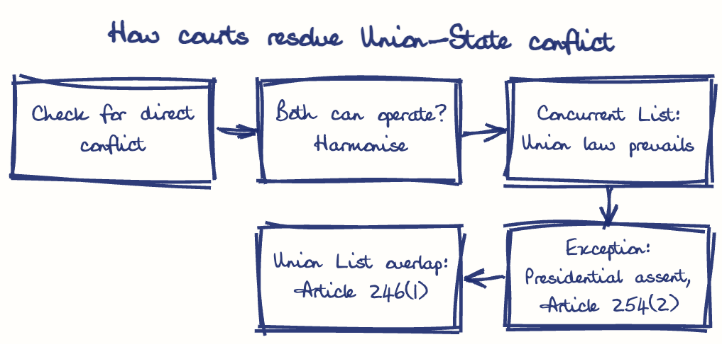
Under Article 254(1), a Parliamentary law prevails over a repugnant State law on a Concurrent List subject, but courts find repugnancy only for direct conflict, intent to occupy the whole field, or laws that cannot coexist. Under Article 254(2), a reserved State law with Presidential assent prevails in that State.
Model answer
Ghissu Editorial · Verified 4 Oct 2026 · 269 words
Article 254’s Primacy Rule
Article 254(1) mandates Parliamentary law prevails over conflicting State laws on Concurrent List subjects, voiding the latter to the extent of repugnancy.
Doctrine of Repugnancy Tests
The Supreme Court examines direct conflict, Parliament’s intent to occupy the field exhaustively, and impossibility of coexistence before declaring repugnancy, preventing automatic invalidation of State laws.
Judicial Safeguards for Federalism
The *SR Bommai* judgment (1994) reinforced federalism as a basic structure, limiting Parliament’s power to override States arbitrarily and protecting State legislative space.
Harmonizing Laws to Preserve Federal Balance
In cases like *M. Karunanidhi v. Union of India* (1979) and *Ch. Tika Ramji v. State of U.P.*, the Court emphasized harmonizing conflicting laws wherever possible, reflecting constitutional morality and cooperative federalism.
Political Complexities
Presidential assent is a political process, causing delays, as seen in Andhra Pradesh’s Special Category Status demand post-bifurcation.
Strengthening Cooperative Federalism
Institutionalizing Inter-State Council dialogue and streamlining assent procedures can reduce conflicts and promote coordinated legislation.
This model answer is indicative and the model can make mistakes; please verify key facts independently.
Sources
Practise this question
1Get the answer sheet
Sized for this question.
2Write your answer
Timed, by hand.
3Get it marked
Your score and what to fix.
This chapter in the exam
Federal structure, Governor and distribution of powers17 questions
Asked in 8 of 8 sittings since 2008
Most tested: Centre–State balance and the extent of Union supremacy over States
- 2025The procedure of enacting a law from a bill differs at the Union and State levels, primarily to safeguard the interests of the Union Government in state legislation. Elucidate this aspect.
- 2025Although States have their separate list for law-making, this authority is not beyond the overarching legislative powers of the Parliament. Examine.
All 17 questions, sorted by sub-topic, with model answers and practice.
Question from the official APPSC Group-I Mains 2011 paper. Answer written by Ghissu's engine and checked against our editorial standards. Found an error? Tell us and we correct it within 48 hours.