Explain the structure of Indian Banking System
In short
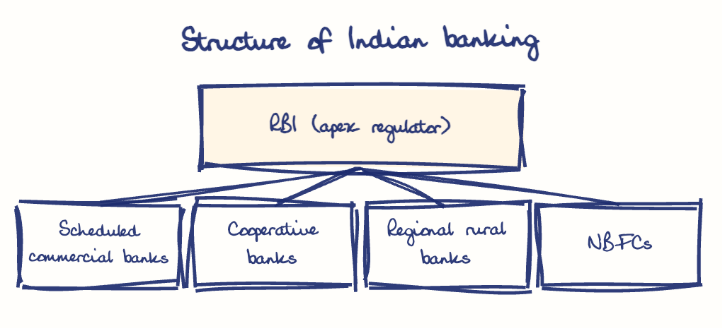
India's banking system has the RBI (1935) at its apex, regulating scheduled commercial banks (public, private and foreign), cooperative banks, Regional Rural Banks (1976) and NBFCs. Commercial banks lend widely, cooperative banks and RRBs serve rural credit under dual RBI-state or NABARD oversight, and NBFCs reach borrowers banks avoid.
Model answer
Ghissu Editorial · Verified 4 Oct 2026 · 277 words
Reserve Bank of India (RBI)
Established in 1935, RBI is the apex monetary authority regulating commercial banks, cooperative banks, and NBFCs. It manages liquidity via instruments like Cash Reserve Ratio (CRR) and Statutory Liquidity Ratio (SLR), supervises payment systems, and ensures overall financial stability.
Scheduled Commercial Banks (SCBs)
Including public sector banks like State Bank of India (nationalized in 1955), private and foreign banks, SCBs mobilize deposits and provide credit. PSBs have a social obligation to lend to priority sectors, supporting inclusive growth, while private banks focus on retail and corporate banking.
Cooperative Banks and Regional Rural Banks (RRBs)
Cooperative banks, regulated by RBI and state governments, serve agriculture and small businesses, playing a crucial role in regions like Andhra Pradesh. RRBs, established under the Regional Rural Banks Act, 1976, extend rural credit, jointly owned by central and state governments and sponsoring banks, enhancing financial inclusion in rural areas.
RBI as Apex Regulator
RBI supervises SCBs, NBFCs, and urban cooperative banks, enforcing prudential norms, licensing, and compliance under the Banking Regulation Act, 1949, ensuring capital adequacy and risk management.
Scheduled Commercial Banks under RBI Supervision
SCBs operate under RBI guidelines; PSBs are government-owned but regulated by RBI to maintain financial soundness and market discipline.
This model answer is indicative and the model can make mistakes; please verify key facts independently.
Practise this question
1Get the answer sheet
Sized for this question.
2Write your answer
Timed, by hand.
3Get it marked
Your score and what to fix.
This chapter in the exam
Resource Mobilization in Indian Economy19 questions
Asked in 7 of 8 sittings since 2008
Most tested: Public debt and its sustainability in post-reform India.
- 2025Differentiate between internal and external public debt. Explain their relative advantages and risks for a developing country like India.
- 2025Discuss the key instruments of Monetary Policy (RBI) and Fiscal Policy in India and evaluate their role in resource mobilisation and inflation management.
All 19 questions, sorted by sub-topic, with model answers and practice.
Question from the official APPSC Group-I Mains 2011 paper. Answer written by Ghissu's engine and checked against our editorial standards. Found an error? Tell us and we correct it within 48 hours.