What are the medieval Indian Temple construction styles? Discuss with suitable examples.
In short
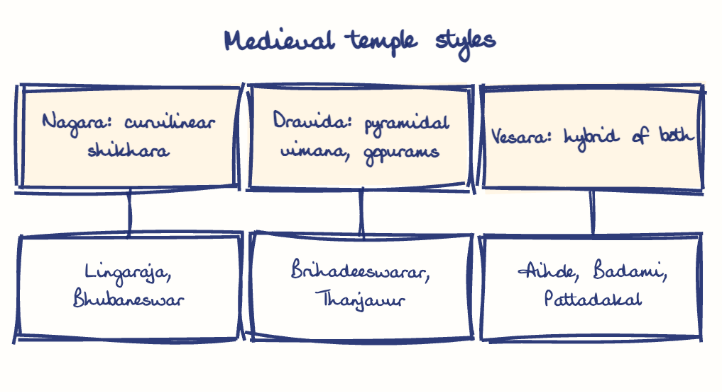
Medieval Indian temples followed three main styles: northern Nagara with curvilinear shikharas, southern Dravida with pyramidal vimanas and gopurams, and Deccan Vesara blending both. The Lingaraja Temple at Bhubaneswar, the Chola Brihadeeswarar Temple at Thanjavur and the Chalukyan temples at Aihole and Pattadakal exemplify them.
Model answer
Ghissu Editorial · Verified 4 Oct 2026 · 244 words
Nagara Style
Predominant in northern India, characterized by a curvilinear beehive-shaped shikhara with multiple spires; the Lingaraja Temple in Bhubaneswar exemplifies this style’s intricate carvings and clustered skyline. It often features a square sanctum and subsidiary shrines arranged around the main temple.
Dravida Style
Found in peninsular India, marked by pyramidal vimanas with stacked storeys, large gopurams, and enclosed prakara; the Brihadeeswarar Temple at Thanjavur, built by the Cholas, showcases massive granite construction and elaborate mandapas. The temple complex is enclosed by high walls, creating a sacred precinct.
Dravida Techniques
Use of granite and advanced stone-cutting for massive vimanas over 60 meters tall; interlocking stones without mortar; large pillared halls and monumental gopurams. The Brihadeeswarar Temple’s engineering reflects sophisticated load distribution and aesthetic grandeur.
Conservation and Education
Promote scientific restoration and integrate temple architecture into curricula to preserve and inspire. Community involvement and interdisciplinary research on lesser-known regional styles can enrich heritage understanding.
This model answer is indicative and the model can make mistakes; please verify key facts independently.
Practise this question
1Get the answer sheet
Sized for this question.
2Write your answer
Timed, by hand.
3Get it marked
Your score and what to fix.
This chapter in the exam
Early Medieval & Medieval India - Pallavas to Cholas, Delhi Sultanate, Bhakti & Sufi, Kakatiya-Vijayanagara-Bahmani-Qutubshahi13 questions
Asked in 8 of 8 sittings since 2008
Most tested: Medieval cultural history through Bhakti/Sufi and South Indian dynastic contributions to religion, architecture, and social organization.
- 2025Describe the contributions of the Chalukya rulers of Kalyani in the fields of sculpture, architecture, and literature.
- 2025Describe the characteristics of the Sufi movement and assess its impact on Indian culture.
All 13 questions, sorted by sub-topic, with model answers and practice.
Question from the official APPSC Group-I Mains 2012 paper. Answer written by Ghissu's engine and checked against our editorial standards. Found an error? Tell us and we correct it within 48 hours.