What was the role of Socialists and the influence of Socialistic ideas on the Pre and Post Independence India?
In short
Socialists radicalised the freedom struggle by adding economic justice to its goals, through the Karachi resolutions of 1931, the Congress Socialist Party (1934) and the Kisan Sabhas. After independence their ideas shaped the Directive Principles, planning and bank nationalisation, and the 42nd Amendment added "socialist" to the Preamble.
Model answer
Ghissu Editorial · Verified 4 Oct 2026 · 257 words
Radicalizing the National Movement
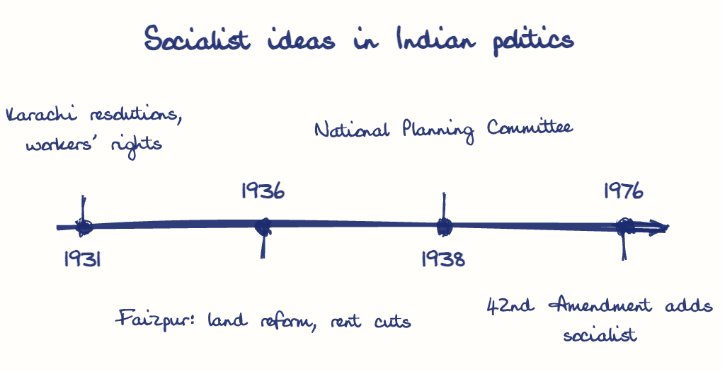
Socialists expanded the freedom struggle’s focus to economic grievances of peasants and workers, exemplified by the 1931 Karachi Congress session adopting workers’ rights and agrarian reforms.
Influence of Leaders
Jawaharlal Nehru and Subhas Chandra Bose, inspired by socialism, advocated state intervention and equitable wealth distribution, leading to the 1938 National Planning Committee for a planned economy.
Congress Socialist Party (1934)
Jayaprakash Narayan, Acharya Narendra Dev and Ram Manohar Lohia pushed the Congress towards agrarian reform and workers’ rights, and later led much of the underground resistance in 1942.
Economic Critique and Gandhian Synthesis
Socialistic critique of colonial economic exploitation merged with Gandhi’s trusteeship concept, where wealth holders act as public welfare trustees, rejecting violent class struggle.
Political Manifestos
Congress manifestos from the 1930s, like the Faizpur session (1936), reflected socialist influence with land reforms and workers’ rights.
Constitutional Socialism
The 42nd Amendment (1976) added “socialist” to the Preamble; Directive Principles aimed at economic equality without abolishing private property.
Mixed Economy and Planning
India adopted a Soviet-inspired planned economy balancing public and private sectors; Five-Year Plans focused on industrialization, land reforms, and poverty alleviation.
This model answer is indicative and the model can make mistakes; please verify key facts independently.
Sources
Practise this question
1Get the answer sheet
Sized for this question.
2Write your answer
Timed, by hand.
3Get it marked
Your score and what to fix.
This chapter in the exam
Indian Nationalism in Three Phases; Independence, Partition and After22 questions
Asked in 8 of 8 sittings since 2008
Most tested: Gandhian mass movements and their impact, alongside peasant mobilisation and communalism/partition.
- 2025Discuss the role and contributions of the moderate leaders of Congress from 1885 to 1905.
- 2025Describe the major movements led by Mahatma Gandhi between 1920 and 1947.
All 22 questions, sorted by sub-topic, with model answers and practice.
Question from the official APPSC Group-I Mains 2012 paper. Answer written by Ghissu's engine and checked against our editorial standards. Found an error? Tell us and we correct it within 48 hours.