Discuss the administrative relations between the Union and the States. How are the Inter State Water Disputes resolved in India?
In short
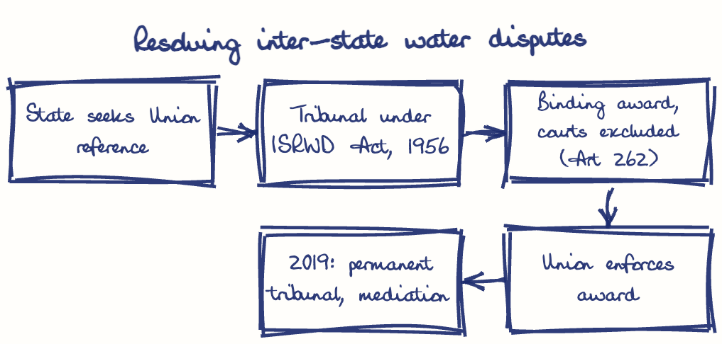
Union-State administrative relations rest on Articles 256 and 257, which bind States to comply with Union laws, Article 258 delegation and the All India Services, while inter-state water disputes are settled under Article 262. The Inter-State River Water Disputes Act, 1956 refers disputes to tribunals whose awards are binding.
Model answer
Ghissu Editorial · Verified 4 Oct 2026 · 266 words
Federal Division of Powers
The Constitution assigns water powers to Union (Entry 56, List I) and States (Entry 17, List II), balancing state autonomy with Union regulation of interstate rivers.
Cooperative yet Conflictual Federalism
States control water use but often resist central intervention, complicating integrated river basin management, as seen in the bifurcation of Andhra Pradesh and Krishna river disputes.
Article 262 and ISRWD Act
Article 262 empowers Parliament to exclude Supreme Court jurisdiction, leading to the Inter-State River Water Disputes Act (1956) which sets up tribunals with binding awards.
Permanent Tribunals and Mediation
The 2019 Amendment Bill proposed a permanent tribunal and a dispute resolution committee to expedite resolution, addressing delays like the 17-year Cauvery Tribunal process.
Delays and Enforcement Weakness
Tribunals face decades-long delays, data deficiencies, and enforcement depends on Union’s political will, weakening dispute resolution.
Mahanadi Tribunal’s Institutional Mediation
The Mahanadi Water Disputes Tribunal1 involving Odisha and Chhattisgarh, with central agencies like the Ministry of Jal Shakti, shows progress in cooperative dispute management.
Strengthen Basin Governance and Data
Integrated river basin authorities and transparent water data systems can reduce conflicts.
Empower Tribunals and Councils
Grant stronger enforcement powers and utilize Inter-State Councils for dialogue and consensus-building.
This model answer is indicative and the model can make mistakes; please verify key facts independently.
Practise this question
1Get the answer sheet
Sized for this question.
2Write your answer
Timed, by hand.
3Get it marked
Your score and what to fix.
This chapter in the exam
Federal structure, Governor and distribution of powers17 questions
Asked in 8 of 8 sittings since 2008
Most tested: Centre–State balance and the extent of Union supremacy over States
- 2025The procedure of enacting a law from a bill differs at the Union and State levels, primarily to safeguard the interests of the Union Government in state legislation. Elucidate this aspect.
- 2025Although States have their separate list for law-making, this authority is not beyond the overarching legislative powers of the Parliament. Examine.
All 17 questions, sorted by sub-topic, with model answers and practice.
Question from the official APPSC Group-I Mains 2012 paper. Answer written by Ghissu's engine and checked against our editorial standards. Found an error? Tell us and we correct it within 48 hours.