Comment briefly on the financial relations between the Union and the States in India. What are irritants generally encountered?
In short
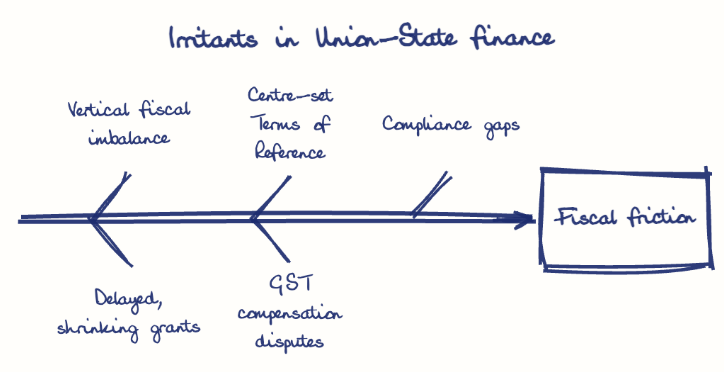
Union-State financial relations rest on a constitutional division of taxes, Finance Commission devolution under Article 280 and central grants, with the GST Council pooling indirect taxes. States now get about 41% of central taxes, but vertical imbalance, shrinking grants, Centre-set Finance Commission terms and GST compensation remain irritants.
Model answer
Ghissu Editorial · Verified 4 Oct 2026 · 261 words
Constitutional Tax Powers
The Seventh Schedule allocates Union taxes on income and customs, States tax local items like stamp duties and excise on alcohol, balancing revenue sources.
Finance Commission3 and Transfers
Article 280 mandates the Finance Commission to recommend tax devolution4 and grants; states’ share5 increased to about 41%. The Sixteenth Finance Commission continues this trend, but states contest ToR issues, including6 outdated population data affecting allocations.
Central Schemes and GST
States receive funds via Centrally Sponsored Schemes and Central Sector Schemes, with transfers projected at ₹26.21 lakh crore by 2026-27. The GST Council governs tax rates and compensation; however, Andhra Pradesh’s CAG audit revealed ₹1,806 crore revenue impact and major GST compliance gaps7.
Delayed and Insufficient Grants
Central grants fell from ₹1.95 lakh crore in 2015-16 to ₹1.65 lakh crore in 2023-24, straining state finances.
GST Compensation and Compliance
Delays and disputes over GST compensation persist; Andhra Pradesh’s CFMS audit found ₹968 crore excess payments and 48% public account share, while Mines & Geology audits revealed revenue gaps.
Enhance State Tax Powers
Widen states' own revenue room through property and land-based taxes and a larger say within GST.
Finance Commission Reform
Update ToR with current data and include state representatives for equitable resource sharing.
This model answer is indicative and the model can make mistakes; please verify key facts independently.
Practise this question
1Get the answer sheet
Sized for this question.
2Write your answer
Timed, by hand.
3Get it marked
Your score and what to fix.
This chapter in the exam
Federal structure, Governor and distribution of powers17 questions
Asked in 8 of 8 sittings since 2008
Most tested: Centre–State balance and the extent of Union supremacy over States
- 2025The procedure of enacting a law from a bill differs at the Union and State levels, primarily to safeguard the interests of the Union Government in state legislation. Elucidate this aspect.
- 2025Although States have their separate list for law-making, this authority is not beyond the overarching legislative powers of the Parliament. Examine.
All 17 questions, sorted by sub-topic, with model answers and practice.
Question from the official APPSC Group-I Mains 2016 paper. Answer written by Ghissu's engine and checked against our editorial standards. Found an error? Tell us and we correct it within 48 hours.