"The Indian constitution is federal in form but unitary in spirit" - Discuss.
In short
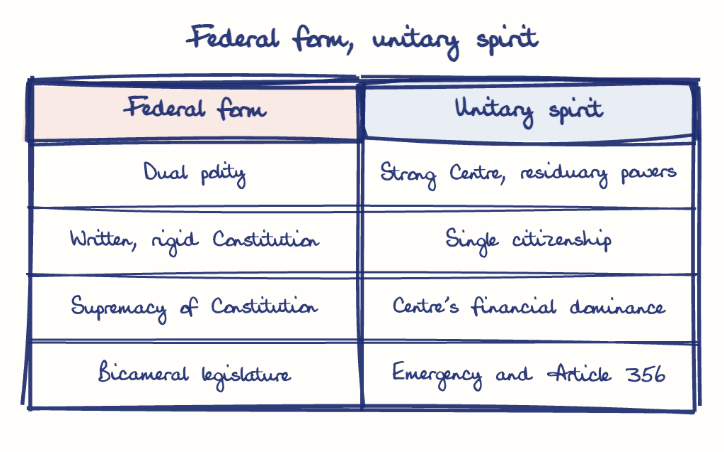
The Constitution is federal in form, with dual polity, a written rigid constitution, divided powers and the Rajya Sabha, but unitary in spirit through a strong Centre, single citizenship and Union financial dominance. Article 356 President's Rule, though curbed by the Bommai judgment, best shows this unitary tilt.
Model answer
Ghissu Editorial · Verified 4 Oct 2026 · 272 words
Dual Polity Structure
The Constitution creates Union and State governments with distinct jurisdictions under the Seventh Schedule, each having legislative, executive, and judicial powers.
Written and Rigid Constitution
Article 368’s special amendment procedure protects federalism by preventing arbitrary changes to Centre-State relations.
Judicial Guardianship
The Supreme Court adjudicates Centre-State disputes under Articles 245-263, as in the Kesavananda Bharati Case2 (1973), which upheld federalism as part of the Constitution’s basic structure.
Strong Centre with Residuary Powers
Article 248 grants residuary powers to the Centre, centralising authority and overriding States in Concurrent List conflicts.
Single Citizenship and Indestructible Union
Article 1 declares India a “Union of States,” denying secession and providing single citizenship, unlike classical federations.
Balancing Unity and Autonomy
The Centre intervenes in disputes like the Krishna and Godavari water conflicts to maintain harmony and national integration.
Cooperative Federalism
Institutions like the Inter-State Council and GST Council foster collaboration, mitigating tensions from Centre’s dominance.
Judicial Role
The Supreme Court’s Kesavananda Bharati judgment upheld federalism’s basic structure despite political centralisation trends.
Dynamic Adaptation
The 2014 Andhra Pradesh Reorganisation Act exemplifies constitutional flexibility in balancing state demands with national interests.
This model answer is indicative and the model can make mistakes; please verify key facts independently.
Sources
Practise this question
1Get the answer sheet
Sized for this question.
2Write your answer
Timed, by hand.
3Get it marked
Your score and what to fix.
This chapter in the exam
Federal structure, Governor and distribution of powers17 questions
Asked in 8 of 8 sittings since 2008
Most tested: Centre–State balance and the extent of Union supremacy over States
- 2025The procedure of enacting a law from a bill differs at the Union and State levels, primarily to safeguard the interests of the Union Government in state legislation. Elucidate this aspect.
- 2025Although States have their separate list for law-making, this authority is not beyond the overarching legislative powers of the Parliament. Examine.
All 17 questions, sorted by sub-topic, with model answers and practice.
Question from the official APPSC Group-I Mains 2016 paper. Answer written by Ghissu's engine and checked against our editorial standards. Found an error? Tell us and we correct it within 48 hours.