Describe the MOM (Mars Orbiter Mission – Mangalyaan) programme of India? What are its distinguishing features?
In short
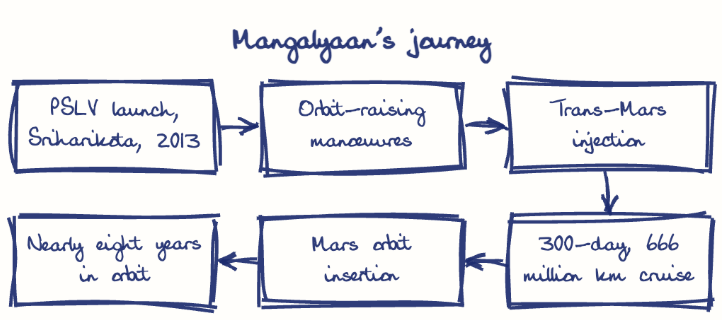
The Mars Orbiter Mission (Mangalyaan), launched by PSLV from Sriharikota on 5 November 2013, was India's first interplanetary mission, the first Asian mission to reach Mars orbit on a maiden attempt. Its distinguishing features were a low cost of about $73 million, five payloads and nearly eight years of operation.
Model answer
Ghissu Editorial · Verified 4 Oct 2026 · 273 words
ISRO’s Leadership and Infrastructure
MOM was developed by ISRO using the PSLV from Satish Dhawan Space Centre, Sriharikota, with mission control at ISTRAC Bengaluru and support from the Indian Deep Space Network antennae in Karnataka.
Cost-Effective Indigenous Technology
Executed at approximately $73 million, MOM is one of the most economical Mars missions globally, showcasing India’s efficient use of indigenous technology.
Technical and Operational Success
MOM overcame challenges of interplanetary travel, including multiple orbit maneuvers and Mars orbit insertion, operating successfully for nearly eight years before losing contact in 2022 during a Martian eclipse.
Scientific Contributions and Global Impact
The mission’s five scientific instruments studied Mars’ atmosphere and surface, with data accessed by over 7,200 users worldwide via the ISRO Science Data Centre, enhancing planetary science and India’s global space stature.
Enhance Indigenous R&D and Data Access
Strengthen ISRO’s interplanetary mission technologies and expand data platforms to foster innovation, especially engaging institutions in Andhra Pradesh.
Promote Public-Private Partnerships and Skill Development
Encourage collaboration between ISRO and private sector entities in Andhra Pradesh and establish training programs to build a skilled workforce supporting advanced space missions.
This model answer is indicative and the model can make mistakes; please verify key facts independently.
Sources
Practise this question
1Get the answer sheet
Sized for this question.
2Write your answer
Timed, by hand.
3Get it marked
Your score and what to fix.
This chapter in the exam
Indian Space Programme, ISRO, Satellites and DRDO23 questions
Asked in 8 of 8 sittings since 2008
Most tested: Remote sensing and satellite applications for agriculture, natural resources, and rural development.
- 2025Describe the role of the Indian Remote Sensing (IRS) satellite programme. How do these satellites assist in natural resource management?
- 2025Discuss the vision and mission of DRDO? Describe the role of DRDO in the contribution to national development.
All 23 questions, sorted by sub-topic, with model answers and practice.
Question from the official APPSC Group-I Mains 2016 paper. Answer written by Ghissu's engine and checked against our editorial standards. Found an error? Tell us and we correct it within 48 hours.