Write a short note on the following: (i) Broadband digital communication (ii) Fixed-Satellite Services (FSS)
In short
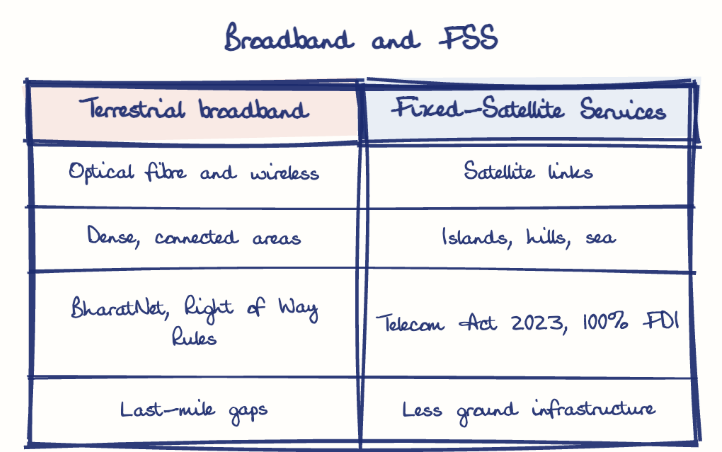
Broadband digital communication is always-on, high-speed internet over fibre, wireless and satellite links, while Fixed-Satellite Services (FSS) are satellite links between fixed earth stations used for VSAT networks, TV distribution and backhaul. BharatNet fibre serves dense areas, and FSS reaches islands, hills and seas where terrestrial networks cannot.
Model answer
Ghissu Editorial · Verified 4 Oct 2026 · 265 words
TRAI and DoT Spectrum Policies
The Telecom Act 2023 and TRAI Recommendations facilitate spectrum allocation for FSS, encouraging private investment and affordable satellite broadband. Liberalization allowing 100% FDI has further boosted private sector participation.
FSS Connectivity in Remote Regions
FSS enables broadband in difficult terrains and islands, as in Lakshadweep, which relied on satellite links until the Kochi-Lakshadweep submarine cable arrived in 2024.
Digital Divide and Literacy
Despite progress, rural internet tele-density is 46.73%3, with only 28% of rural women having internet access, necessitating focused digital literacy programs in Andhra Pradesh. This gap is pronounced in drought-prone and remote regions like Rayalaseema.
R&D and Indigenous Capabilities
Leveraging ISRO’s Sriharikota launch facility to boost satellite manufacturing and reduce costs, enhancing service reliability and innovation.
Inclusion Programs
Targeted digital literacy in rural and drought-affected areas of Andhra Pradesh to bridge gender and regional divides, ensuring equitable access to digital services.
This model answer is indicative and the model can make mistakes; please verify key facts independently.
Practise this question
1Get the answer sheet
Sized for this question.
2Write your answer
Timed, by hand.
3Get it marked
Your score and what to fix.
This chapter in the exam
Indian Space Programme, ISRO, Satellites and DRDO23 questions
Asked in 8 of 8 sittings since 2008
Most tested: Remote sensing and satellite applications for agriculture, natural resources, and rural development.
- 2025Describe the role of the Indian Remote Sensing (IRS) satellite programme. How do these satellites assist in natural resource management?
- 2025Discuss the vision and mission of DRDO? Describe the role of DRDO in the contribution to national development.
All 23 questions, sorted by sub-topic, with model answers and practice.
Question from the official APPSC Group-I Mains 2016 paper. Answer written by Ghissu's engine and checked against our editorial standards. Found an error? Tell us and we correct it within 48 hours.