"In spite of unitary features of the Constitution, federalism survived in India." Comment.
In short
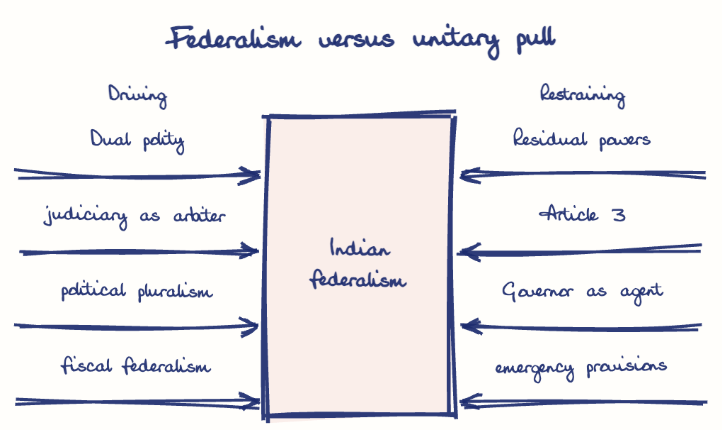
Federalism has survived despite unitary features like residuary powers, Governors and emergency provisions because the Seventh Schedule divides powers, courts arbitrate Centre-State disputes and regional parties govern states autonomously. The Bommai judgment (1994) curbed misuse of Article 356, protecting elected state governments.
Model answer
Ghissu Editorial · Verified 4 Oct 2026 · 266 words
Residual Powers to Centre
Article 248 vests residual legislative powers exclusively in the Union Parliament, underscoring central dominance in unforeseen areas.
Constitutional Division of Powers
The Seventh Schedule demarcates Union, State, and Concurrent Lists, sustaining federal governance by allowing states to legislate independently on state subjects.
Judicial Protection of Federalism
The Supreme Court’s S.R. Bommai (1994) judgment curbs misuse of Article 356, reinforcing federalism by limiting arbitrary dismissal of state governments.
Political Pluralism and State Autonomy
Regional parties like Telugu Desam Party in Andhra Pradesh demonstrate operational federalism where states exercise significant political autonomy.
Political Pluralism and Centre-State Negotiation
Disputes over river waters involving Andhra Pradesh and the presence of diverse regional parties reflect ongoing negotiation between central authority and state interests.
Strengthen Institutions
Empower the Inter-State Council and Finance Commission for balanced Centre-State cooperation and fiscal autonomy.
Reform Emergency Provisions
Amend Article 356 to prevent misuse and protect federalism, ensuring safeguards against arbitrary central intervention.
This model answer is indicative and the model can make mistakes; please verify key facts independently.
Practise this question
1Get the answer sheet
Sized for this question.
2Write your answer
Timed, by hand.
3Get it marked
Your score and what to fix.
This chapter in the exam
Federal structure, Governor and distribution of powers17 questions
Asked in 8 of 8 sittings since 2008
Most tested: Centre–State balance and the extent of Union supremacy over States
- 2025The procedure of enacting a law from a bill differs at the Union and State levels, primarily to safeguard the interests of the Union Government in state legislation. Elucidate this aspect.
- 2025Although States have their separate list for law-making, this authority is not beyond the overarching legislative powers of the Parliament. Examine.
All 17 questions, sorted by sub-topic, with model answers and practice.
Question from the official APPSC Group-I Mains 2017 paper. Answer written by Ghissu's engine and checked against our editorial standards. Found an error? Tell us and we correct it within 48 hours.