Critically explain the role of Subsidiary Alliance system in the rise and expansion of British Raj in India.
In short
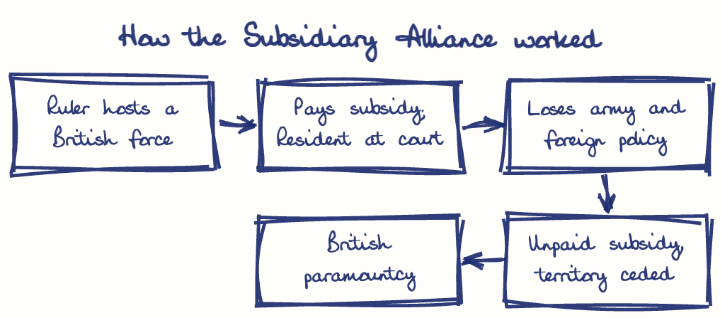
Lord Wellesley's Subsidiary Alliance made Indian rulers host and pay for a permanent British force and accept a British Resident, surrendering control of defence and foreign policy. Unpaid subsidies forced territorial cessions, as in Awadh, turning the Company from a trader into the paramount power.
Model answer
Ghissu Editorial · Verified 4 Oct 2026 · 303 words
Treaty Terms
Indian rulers agreed to host British troops and pay for them, surrendering control over defense and foreign policy. British Residents stationed at courts exercised significant influence over internal administration and diplomacy, effectively undermining the rulers’ sovereignty.
Territorial Gains and Rival Neutralization
The financial burden of maintaining British forces led to territorial cessions; for example, Hyderabad’s expulsion of French troops neutralized European rivals, consolidating British supremacy. Awadh’s forced cession of Rohilkhand under the pretext of misgovernance exemplified how the British used the alliance to annex territories.
Loss of Sovereignty and Political Subordination
Indian rulers lost diplomatic autonomy and military independence, becoming British puppets. The treaty forbade independent armies and foreign alliances, entrenching British paramountcy over Indian states.
Historical Reassessment
A balanced historiography is needed to understand both the system’s role in political consolidation and its exploitative consequences, fostering a comprehensive view of colonial strategies.
Sovereignty Lessons for Today
The legacy of the Subsidiary Alliance underscores the importance of safeguarding sovereign autonomy in contemporary foreign policy and defense agreements to prevent external domination.
This model answer is indicative and the model can make mistakes; please verify key facts independently.
Practise this question
1Get the answer sheet
Sized for this question.
2Write your answer
Timed, by hand.
3Get it marked
Your score and what to fix.
This chapter in the exam
British Rule 1757-1856, the 1857 Revolt, Socio-Religious Reform & the Rise of Nationalism20 questions
Asked in 8 of 8 sittings since 2008
Most tested: Colonialism’s impact on Indian society/economy and reform-led social uplift, especially untouchability and caste reform.
- 2025What do you understand by the Permanent Settlement, and what impact did it have on Indian society? Comment.
- 2025What do you understand by the 'safety valve' theory? Explain it in the context of the Indian National Congress?
All 20 questions, sorted by sub-topic, with model answers and practice.
Question from the official APPSC Group-I Mains 2020 paper. Answer written by Ghissu's engine and checked against our editorial standards. Found an error? Tell us and we correct it within 48 hours.