Explain the Lokpal and Lokyukta Act.
In short
The Lokpal and Lokayukta Act, 2013 created a Lokpal (up to eight members, at least half judicial) covering the Prime Minister, ministers and MPs, and required state Lokayuktas. The first Lokpal came in 2019, and it lacks suo motu powers, relying on the CBI and CVC to investigate.
Model answer
Ghissu Editorial · Verified 4 Oct 2026 · 265 words
Statutory Establishment
The Act mandates a Lokpal at the national level and Lokayuktas in states, with states like Andhra Pradesh1 required to enact their own laws within a year for contextual adaptation.
Composition and Representation
Lokpal has a Chairperson and up to eight members, with at least 50% judicial members and half from SC/ST/OBC, minorities, or women, ensuring diversity and expertise.
Jurisdictional Scope
Covers the Prime Minister (except in national security, foreign affairs, atomic energy, public order), Union Ministers, MPs, central officials, and government-funded NGOs.
Delayed Operationalization
First Lokpal appointed in 2019; states like Andhra Pradesh face delays or vacancies in Lokayukta appointments, weakening enforcement.
Restrictive Complaint Procedures
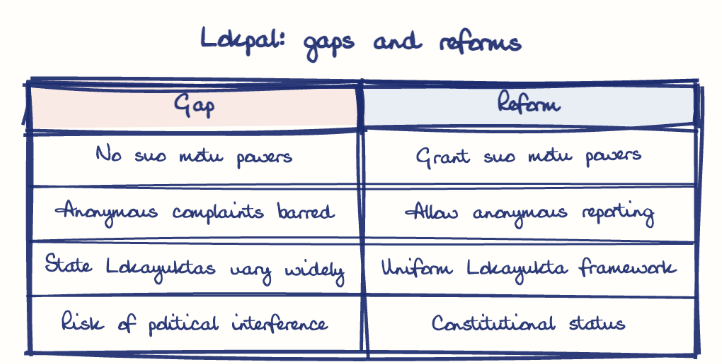
Disallows anonymous complaints and penalizes false ones, discouraging whistleblowers.
Jurisdictional Gaps
Judiciary excluded; limited inquiry powers against the Prime Minister; state Lokayuktas vary widely, causing inconsistent enforcement in states like Andhra Pradesh.
Grant Constitutional Status
Elevate Lokpal to constitutional body to enhance independence and public trust.
Empower Suo Motu Action
Allow Lokpal to initiate investigations proactively.
Uniform Lokayukta Framework
Encourage states, including Andhra Pradesh, to adopt uniform powers and jurisdiction.
Simplify Complaint Mechanism
Allow anonymous reporting and reduce procedural barriers to boost whistleblower participation.
This model answer is indicative and the model can make mistakes; please verify key facts independently.
Sources
Practise this question
1Get the answer sheet
Sized for this question.
2Write your answer
Timed, by hand.
3Get it marked
Your score and what to fix.
This chapter in the exam
Public Service ethics, codes, corruption and Lokpal8 questions
Asked in 3 of 8 sittings since 2008
Most tested: Ethical leadership, integrity and accountability in public service governance.
- 2025In what ways can the implementation of a code of ethics in public administration help in resolving conflicts of interest and promoting ethical decision-making?
- 2025Discuss the significance of integrity, transparency and accountability in leadership. How can public leaders demonstrate these values in their decision-making process?
All 8 questions, sorted by sub-topic, with model answers and practice.
Question from the official APPSC Group-I Mains 2020 paper. Answer written by Ghissu's engine and checked against our editorial standards. Found an error? Tell us and we correct it within 48 hours.