The National Education Policy (2020) has been criticized as denuding the autonomy of states. In this connection, examine the rationale behind the transfer of matters from the State list to the Concurrent list.
In short
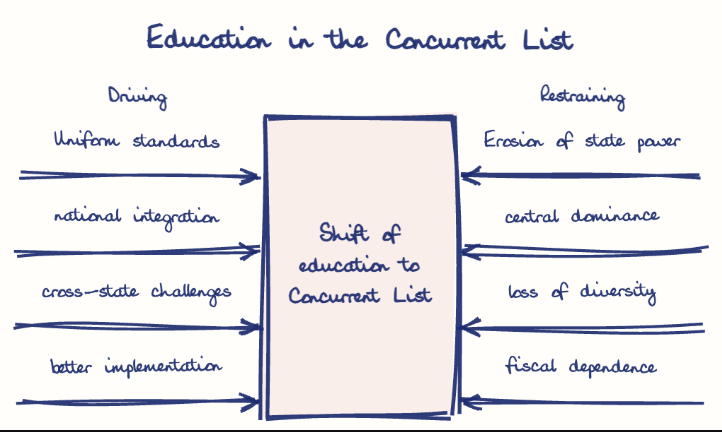
Education moved to the Concurrent List through the 42nd Amendment in 1976 to secure uniform standards, national integration and coordinated action on cross-state challenges. Critics argue NEP 2020's central bodies like HECI and PARAKH erode state autonomy, so cooperative federalism and state flexibility are essential.
Model answer
Ghissu Editorial · Verified 4 Oct 2026 · 295 words
Uniform Educational Standards
Transferring subjects facilitates consistent quality and access nationwide, supporting NEP 2020’s inclusive aims via schemes like NIPUN Bharat and PM SHRI, with Andhra Pradesh4 as a key example. This helps reduce disparities in infrastructure and learning outcomes.
Cross-State Coordination
Concurrent List status enables joint action on digital education and teacher training, addressing challenges beyond state borders. It also supports coordinated vocational training and resource pooling for nationwide impact.
Cultural and Fiscal Concerns
Uniform frameworks risk sidelining regional languages and histories; Andhra Pradesh highlights tensions between central mandates and local needs. Additionally, states face increased fiscal dependence on central funding, reducing discretion in resource allocation.
Cooperative Federalism Strain
Power asymmetry may convert cooperation into central dominance, causing resistance from states like Andhra Pradesh and uneven reforms across the country.
Need for Institutional Dialogue
Strengthening bodies like the Inter-State Council and a robust Education Council is vital to harmonize policies, mediate conflicts, and ensure states’ voices influence education governance.
This model answer is indicative and the model can make mistakes; please verify key facts independently.
Practise this question
1Get the answer sheet
Sized for this question.
2Write your answer
Timed, by hand.
3Get it marked
Your score and what to fix.
This chapter in the exam
Federal structure, Governor and distribution of powers17 questions
Asked in 8 of 8 sittings since 2008
Most tested: Centre–State balance and the extent of Union supremacy over States
- 2025The procedure of enacting a law from a bill differs at the Union and State levels, primarily to safeguard the interests of the Union Government in state legislation. Elucidate this aspect.
- 2025Although States have their separate list for law-making, this authority is not beyond the overarching legislative powers of the Parliament. Examine.
All 17 questions, sorted by sub-topic, with model answers and practice.
Question from the official APPSC Group-I Mains 2023 paper. Answer written by Ghissu's engine and checked against our editorial standards. Found an error? Tell us and we correct it within 48 hours.