Define sustainable development and critically evaluate its relevance in the context of modern industrialization.
In short
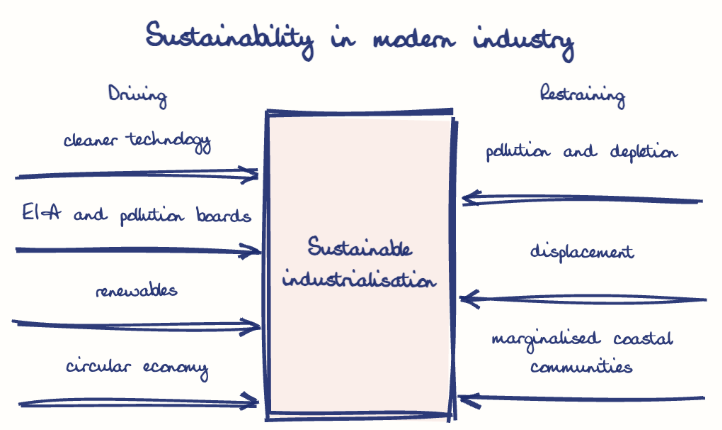
Sustainable development, as defined by the 1987 Brundtland Report, is development that meets present needs without compromising future generations' ability to meet theirs, balancing economy, society and environment. It is highly relevant to modern industrialisation, which brings pollution, resource depletion and displacement, as around Visakhapatnam's industries and Polavaram.
Model answer
Ghissu Editorial · Verified 4 Oct 2026 · 280 words
Brundtland Commission Definition
It is development that meets present needs without compromising future generations, emphasizing intergenerational equity (1987 Brundtland Report).
Three Pillars Integration
It harmonizes economic growth, social equity, and environmental protection, ensuring resource conservation and social welfare.
Industrialization’s Environmental Costs
Industrial hubs like Visakhapatnam face pollution, resource depletion, and biodiversity loss, necessitating sustainable development to mitigate these impacts and preserve ecosystem services.
Social Equity and Livelihood Security
Vulnerable groups in coastal Andhra Pradesh depend on sustainable practices to secure livelihoods amid industrial growth, preventing marginalization and ensuring equitable resource access.
Mutual Dependence and Tension
Industrialization drives growth but strains resources; sustainable development promotes cleaner technologies and resource efficiency to resolve this tension.
Policy and Governance Integration
Andhra Pradesh’s pollution control boards and environmental impact assessments embed sustainability into industrial operations, ensuring environmental compliance and social safeguards.
Strengthen Environmental Governance
Enforce laws and integrate sustainability in industrial approvals, especially in Andhra Pradesh’s industrial corridors, to ensure accountability and reduce ecological harm.
Promote Green Technologies
Incentivize renewable energy and pollution control in industries through subsidies and partnerships, supporting India’s transition to a low-carbon economy.
This model answer is indicative and the model can make mistakes; please verify key facts independently.
Sources
Practise this question
1Get the answer sheet
Sized for this question.
2Write your answer
Timed, by hand.
3Get it marked
Your score and what to fix.
This chapter in the exam
Development vs Environment: natural resources, climate change, EIA, natural disasters48 questions
Asked in 8 of 8 sittings since 2008
Most tested: Climate change and mining/environmental degradation links
- 2025Explain the different types of natural resources in India. How are they being conserved through government initiatives?
- 2025Investigate the relationship between mining activities and the occurrence of earthquakes. Explain how mining operations can be regulated to minimize seismic risks.
All 48 questions, sorted by sub-topic, with model answers and practice.
Question from the official APPSC Group-I Mains 2025 paper. Answer written by Ghissu's engine and checked against our editorial standards. Found an error? Tell us and we correct it within 48 hours.