Explain the regulatory framework governing genetically modified organisms in India and assess its adequacy in addressing modern challenges.
In short
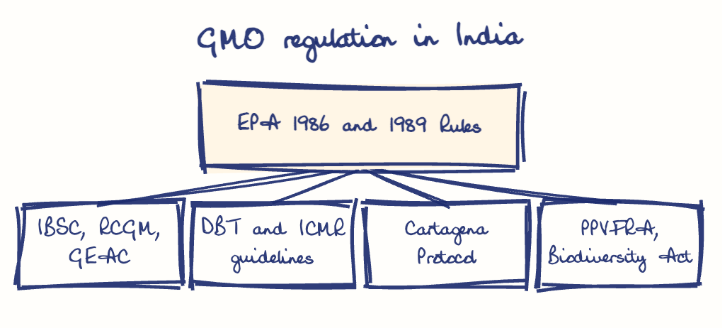
India regulates GMOs under the Environment Protection Act, 1986 and its 1989 Rules through tiered committees (IBSC, RCGM and GEAC), DBT biosafety guidelines and the Cartagena Protocol. It is only partly adequate, as conflicts of interest, weak state involvement and slow approvals hamper challenges like gene editing.
Model answer
Ghissu Editorial · Verified 4 Oct 2026 · 301 words
Legal Instruments and Institutional Bodies
The Environment Protection Act 1986 and 1989 Rules form the legal basis, with six statutory committees including IBSC, RCGM, and GEAC, the apex approval body under MoEFCC, overseeing environmental release approvals.
Biosafety Guidelines and International Commitments
DBT issues detailed biosafety protocols covering research, field trials, and risk assessments; ICMR advises on health risks. India adheres to the Cartagena Protocol on Biosafety and complements biosafety with the Protection of Plant Varieties and Farmers’ Rights Act 2001 and the Biological Diversity Act 2002.
State-Level Coordination and Innovation Challenges
Lack of mandatory state permissions hampers field trials, critical for states like Andhra Pradesh with diverse agro-climatic zones. High compliance costs and lingering questions on gene-edited products, even after SDN-1 and SDN-2 were exempted in 2022, deter innovation, delaying public-sector GM mustard (DMH-11). The Standing Committee on Agriculture recommended mandatory state involvement to improve coordination and public trust.
Statutory Empowerment
Enact a dedicated Biosafety Act creating an independent statutory regulator to give GEAC and related committees greater autonomy, ensuring transparent, conflict-free decision-making.
Strengthen State Coordination
Mandate state government involvement in approvals and field trials to address local agro-ecological diversity and improve regulatory efficiency.
This model answer is indicative and the model can make mistakes; please verify key facts independently.
Practise this question
1Get the answer sheet
Sized for this question.
2Write your answer
Timed, by hand.
3Get it marked
Your score and what to fix.
This chapter in the exam
Biotechnology & Nanotechnology: scope, ethics, genetic engineering, biodiversity, fermentation, immuno-diagnosis50 questions
Asked in 8 of 8 sittings since 2008
Most tested: Biodiversity and biotechnology governance/ethics, especially conservation, GMOs, and applied public-health biotech.
- 2025Trace the evolution of India's National Biotechnology Development Strategy (NBDS) and discuss its key objectives. Critically evaluate its impact on the growth of the biotechnology sector in India.
- 2025Analyze the potential of plant-derived biopharmaceuticals in promoting sustainable healthcare. Explain how the application of green pharmacy principles can help minimize environmental harm at each stage of the pharmaceutical lifecycle.
All 50 questions, sorted by sub-topic, with model answers and practice.
Question from the official APPSC Group-I Mains 2025 paper. Answer written by Ghissu's engine and checked against our editorial standards. Found an error? Tell us and we correct it within 48 hours.