Provide a comprehensive overview of the primary reasons for deforestation in Andhra Pradesh in the past two decades.
In short
Deforestation in Andhra Pradesh over the past two decades stems from agricultural expansion for chillies and horticulture, forest diversion for industrial corridors and ports, illegal logging and encroachment, mining, and urban pressure on fuelwood and land. Weak enforcement worsened it, and compensatory afforestation has rarely matched the ecological value lost.
Model answer
Ghissu Editorial · Verified 4 Oct 2026 · 240 words
Industrial and Infrastructure Development
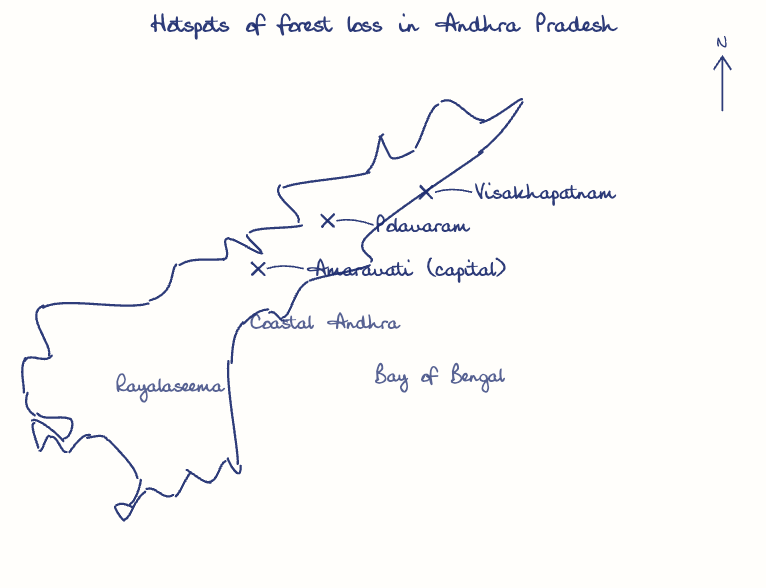
Large projects such as the Visakhapatnam-Chennai Industrial Corridor and Polavaram irrigation project cause permanent forest diversion, with compensatory afforestation efforts by APCAMPA facing challenges. Infrastructure expansion along the 974 km coastline, including port development, further contributes to forest loss.
Mining Activities
Mining in forest zones, highlighted by the CAG audit report (2021-22) for regulatory lapses and revenue shortfalls, leads to forest clearance and ecosystem pollution. The report underscores governance gaps that hinder sustainable mining, causing soil erosion and habitat degradation.
Strengthen Governance and Sustainable Practices
Enhance enforcement under APCAMPA to curb illegal logging and encroachment, promote agroforestry via AP Community Managed Natural Farming (APCNF) to reduce forest pressure, and enforce rigorous Environmental Impact Assessments for development projects with transparent public consultations.
Integrated Urban and Rural Planning
Incorporate green belts and protect forest patches in urban expansion plans, improve solid waste management to reduce pollution, and engage local communities in forest conservation to ensure ecological balance.
This model answer is indicative and the model can make mistakes; please verify key facts independently.
Practise this question
1Get the answer sheet
Sized for this question.
2Write your answer
Timed, by hand.
3Get it marked
Your score and what to fix.
This chapter in the exam
Development vs Environment: natural resources, climate change, EIA, natural disasters48 questions
Asked in 8 of 8 sittings since 2008
Most tested: Climate change and mining/environmental degradation links
- 2025Explain the different types of natural resources in India. How are they being conserved through government initiatives?
- 2025Investigate the relationship between mining activities and the occurrence of earthquakes. Explain how mining operations can be regulated to minimize seismic risks.
All 48 questions, sorted by sub-topic, with model answers and practice.
Question from the official APPSC Group-I Mains 2025 paper. Answer written by Ghissu's engine and checked against our editorial standards. Found an error? Tell us and we correct it within 48 hours.