What is Environmental Impact Assessment (EIA)? Describe its key stages.
In short
Environmental Impact Assessment is the process of assessing a project's environmental and social effects before approval, mandated under the Environment (Protection) Act, 1986 and the EIA Notification 2006. Its stages are screening, scoping, baseline data, impact prediction, mitigation and reporting, public consultation, decision making and post-clearance monitoring.
Model answer
Ghissu Editorial · Verified 4 Oct 2026 · 288 words
Legal Foundation
EIA is mandated under the Environment (Protection) Act, 1986, with MoEF&CC and State Environmental Impact Assessment Authorities like in Andhra Pradesh managing implementation. The 1994 EIA Notification requires prior environmental clearance for specified projects to prevent degradation.
Judicial Support
Supreme Court rulings such as TN Godavarman (1997) reinforce strict environmental clearance, and courts have repeatedly scrutinised ex-post facto approvals, strengthening the legal framework and ensuring accountability.
Process Flow
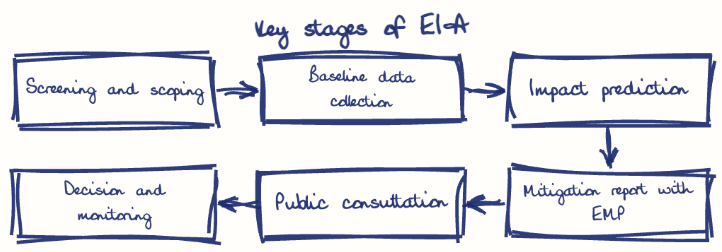
Screening → Scoping → Baseline Data Collection → Impact Prediction → Mitigation and Reporting → Public Consultation → Decision Making → Post-Clearance Monitoring. Each stage ensures systematic assessment and management of environmental impacts.
Public Consultation
Critical for transparency, as seen in Visakhapatnam port expansion, incorporating local concerns into decision-making. It enhances legitimacy and helps address socio-environmental issues effectively.
Regulatory Dilution
The 2020 draft notification’s reduced scrutiny and exemptions threaten environmental safeguards, raising concerns about weakening the EIA process and necessitating stronger governance and institutional capacity.
This model answer is indicative and the model can make mistakes; please verify key facts independently.
Practise this question
1Get the answer sheet
Sized for this question.
2Write your answer
Timed, by hand.
3Get it marked
Your score and what to fix.
This chapter in the exam
Development vs Environment: natural resources, climate change, EIA, natural disasters48 questions
Asked in 8 of 8 sittings since 2008
Most tested: Climate change and mining/environmental degradation links
- 2025Explain the different types of natural resources in India. How are they being conserved through government initiatives?
- 2025Investigate the relationship between mining activities and the occurrence of earthquakes. Explain how mining operations can be regulated to minimize seismic risks.
All 48 questions, sorted by sub-topic, with model answers and practice.
Question from the official APPSC Group-I Mains 2025 paper. Answer written by Ghissu's engine and checked against our editorial standards. Found an error? Tell us and we correct it within 48 hours.