APPSC Group-I Prelims 2010
382 questions from the 2010 papers, each with the official answer and an explanation.
A question repeated across years is listed once, under one of the years it appeared.
- Q281SCHOOL PHYSICS
If there is a 100 percent increase in an object's momentum, what is the increase in its kinetic energy?
- aThere will be a 300 percent increase.Answer
- bThere will be a 200 percent increase.
- cThere will be a 100 percent increase.
- dThere will be a 50 percent increase.
Explanation
Option A is correct because kinetic energy is proportional to the square of momentum, so doubling the momentum quadruples the kinetic energy, resulting in a 300 percent increase. Kinetic energy formula: KE = p^2 / (2m) Initial momentum: p New momentum after 100 percent increase: p' = 2p New kinetic energy: KE' = (2p)^2 / (2m) = 4 * KE Percentage increase: ((4 * KE - KE) / KE) * 100 = 300 percent Option B: A 200 percent increase mistakenly assumes kinetic energy triples rather than quadruples when momentum doubles. Option C: A 100 percent increase assumes a linear relationship between momentum and kinetic energy, ignoring the squared dependence. Option D: A 50 percent increase incorrectly divides the percentage change rather than applying the quadratic relationship.
- Q282SCHOOL PHYSICS
Among the following, in which does tea get cold very easily?
- aGlass cup
- bMetal cupAnswer
- cClay cup
- dPorcelain cup
Explanation
Option B is correct because metals are excellent thermal conductors with high thermal conductivity, allowing heat to rapidly conduct from the tea to the outer surface and dissipate into the air. Option A: Glass is a thermal insulator and dissipates heat far more slowly than metal. Option C: Clay has low thermal conductivity and porous walls that trap heat relatively well compared to metal. Option D: Porcelain is a ceramic material with very low thermal conductivity that retains heat effectively.
- Q283SCHOOL PHYSICS
A crack in a glass plate appears as an illusion:
- alike silverAnswer
- bgreen
- cblack
- dcolorful
Explanation
Option A is correct because total internal reflection occurs at the air-glass boundary inside the crack, reflecting almost all incident light and making the crack glisten like a polished silver surface. Option B: Total internal reflection reflects all visible wavelengths equally rather than selectively reflecting green light. Option C: Total internal reflection returns light to the viewer instead of absorbing it, which would otherwise make it look black. Option D: The crack does not act like a prism separating light systematically to produce a colorful appearance.
- Q284SCHOOL PHYSICS
To a geographer, the sky from a ship appears as:
- ablack
- bblueAnswer
- cblue
- dwhite
Explanation coming soon.
- Q285SCHOOL PHYSICS
The distance between two consecutive points in the same phase is its:
- aFrequency
- bAmplitude
- cLight intensity
- dWavelengthAnswer
Explanation
Option D is correct because wavelength is defined as the spatial distance between any two successive points that are in the same phase of oscillation, such as two consecutive crests or troughs. Option A: Frequency is the number of wave cycles passing a fixed point per unit time, not a physical distance. Option B: Amplitude is the maximum displacement of particles from their equilibrium position. Option C: Light intensity is a measure of radiant power per unit area, not a length or distance.
- Q286SCHOOL PHYSICS
What we use for alternating current:
- aEliminator
- bTransformerAnswer
- cBattery
- dDynamo
Explanation
Option B is correct because a transformer operates on the principle of mutual electromagnetic induction, which strictly requires a continuously varying or alternating current to induce a voltage in the secondary winding. Option A: A battery eliminator converts alternating current into direct current rather than utilizing AC for AC-specific tasks. Option C: A battery stores and delivers direct current and cannot operate on or provide alternating current directly. Option D: A standard dynamo produces direct current using a split-ring commutator.
- Q287SCHOOL PHYSICS
Albert Einstein was awarded the Nobel Prize for which of the following?
- aTheory of Special Relativity
- bPhotoelectric effectAnswer
- cInvention of the atomic bomb
- dBrownian motion
Explanation
Option B is correct because Albert Einstein was awarded the 1921 Nobel Prize in Physics specifically for his services to theoretical physics and especially for his discovery of the law of the photoelectric effect. Option A: Theory of Special Relativity was considered too controversial and unverified by the Nobel Committee at that time and was not cited for the award. Option C: Invention of the atomic bomb is historically incorrect because Einstein did not invent or build the atomic bomb. Option D: Brownian motion was mathematically explained by Einstein in 1905, but it was not the cited reason for his Nobel Prize.
- Q288Logical reasoning and analytical ability
What does a factory always have?
- asellers
- bfiles
- celectricity
- dworkersAnswer
Explanation
Option D is correct because a factory is an industrial production facility that fundamentally requires workers to carry out manufacturing operations, even if it operates manually without modern amenities. Option A: sellers are involved in marketing and retail distribution, not an inherent component located inside every factory. Option B: files are administrative tools that may be absent in informal or non-bureaucratic factories. Option C: electricity is not universal to all factories, as traditional or manual manufacturing units can operate without it.
- Q289Logical reasoning and analytical ability
A cube needs to be colored, avoiding the same color on adjacent surfaces. The minimum number of colors required for this is
- athreeAnswer
- bfour
- cfive
- dsix
Explanation
Option A is correct because a standard cube has three pairs of mutually opposite faces, and each pair can share the same color without any adjacent faces having matching colors. Option B: It uses more colors than the absolute minimum required. Option C: It exceeds the minimum necessary number of colors. Option D: It assigns a distinct color to each of the six faces, which is not the minimum.
- Q290Logical reasoning and analytical ability
Five girls are sitting in a row. Neither Sulekha nor Abha is next to Rakhi. Anuradha is not next to Sulekha. Rakhi is next to Monika. Monika is in the middle of the row. Then, who among the following is Anuradha next to?
- aRakhiAnswer
- bMonika
- cAbha
- dSulekha
Explanation
Option A is correct because Monika occupies the center position and Rakhi sits next to her, forcing Anuradha into the adjacent end seat since Sulekha and Abha cannot sit next to Rakhi. Row positions: 1, 2, 3, 4, 5 Position 3: Monika Position 2: Rakhi Positions next to Rakhi cannot be Sulekha or Abha: Position 1 must be Anuradha Positions 4 and 5: Sulekha and Abha in some order Anuradha at position 1 is adjacent to Rakhi at position 2 Option B: Monika is separated from Anuradha by Rakhi. Option C: Abha is placed on the opposite side of Monika and is not adjacent to Anuradha. Option D: Sulekha is placed on the opposite side of Monika and cannot be next to Anuradha.
- Q291Series, analogy and odd man out
Which one of the following numbers is wrong in the series? 1,6,2,12,8,24
- a2
- b8Answer
- c6
- d24
Explanation
Option B is correct because 8 breaks the alternating pattern of operations in the sequence. 1 × 6 = 6 6 ÷ 3 = 2 2 × 6 = 12 12 ÷ 3 = 4 4 × 6 = 24 Option A: 2 is correct in the series as it correctly follows 6 divided by 3. Option C: 6 is correct in the series as it correctly follows 1 multiplied by 6. Option D: 24 is correct in the series as it correctly follows 4 multiplied by 6.
- Q292Series, analogy and odd man out
One of the following sequence of numbers is incorrect. Identify it: 1, 6, 2, 12, 8, 24
- a-2
- b8Answer
- c6
- d24
Explanation
Option B is correct because replacing 8 with 4 maintains the consistent alternating rule of multiplying by 6 and dividing by 3. 1 × 6 = 6 6 ÷ 3 = 2 2 × 6 = 12 12 ÷ 3 = 4 4 × 6 = 24 Option A: -2 is not even an element in the original sequence. Option C: 6 correctly follows the rule 1 × 6 = 6. Option D: 24 correctly follows the rule 4 × 6 = 24.
- Q293Series, analogy and odd man out
Find the missing letter in the alternatives given below:
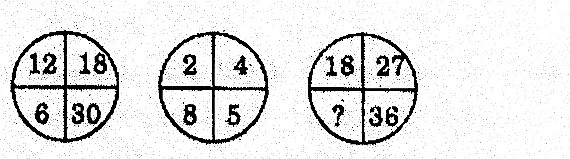
- a9Answer
- b12
- c18
- d6
Explanation coming soon.
- Q294Series, analogy and odd man out
Rearrange the letters BCARLMEDS to make a meaningful word:
- aCRUMBLED
- bSCRAMBLEDAnswer
- cLEADERS
- dDEALERS
Explanation
Option B is correct because SCRAMBLED contains the exact nine letters given in BCARLMEDS. Option A: CRUMBLED includes the letter U, which is not present in the given letters. Option C: LEADERS contains only seven letters and uses two Es, whereas the given set has only one E. Option D: DEALERS contains only seven letters and repeats E, which is missing from the original set.
- Q295Series, analogy and odd man out
Rearrange the letters BCARLMEDS to form a meaningful word?
- aCRUMBLED
- bSCRAMBLEDAnswer
- cLEADERS
- dDEALERS
Explanation
Option B is correct because the letter collection B, C, A, R, L, M, E, D, S contains exactly 9 letters which can be rearranged to spell the word SCRAMBLED. Option A: CRUMBLED contains the letter U, which is not present in BCARLMEDS. Option C: LEADERS contains only 7 letters and uses letters not matching the full original set. Option D: DEALERS contains only 7 letters and does not use all the letters provided.
- Q296Series, analogy and odd man out
Among the following, identify the odd one out:
- a529
- b629Answer
- c729
- d1089
Explanation
Option B is correct because 629 is not a perfect square, whereas all the other options are perfect squares of integers. 529 is the square of 23 729 is the square of 27 1089 is the square of 33 629 is not a perfect square, being equal to 17 multiplied by 37 Option A: 529 is the exact square of 23. Option C: 729 is the exact square of 27. Option D: 1089 is the exact square of 33.
- Q297Series, analogy and odd man out
Arrange the following information in order from general to specific: A. Animal B. Phylum C. Leopard D. Mammal E. Vertebrate F. Cat
- aA,B,C,D,E,F
- bA,C,E,D,B,F
- cA,F,C,E,D,B
- dA,E,D,B,C,FAnswer
Explanation coming soon.
- Q298Series, analogy and odd man out
Identify the odd one out from the following:
- aHinduismAnswer
- bChristianity
- cZoroastrianism
- dIslam
Explanation
Option A is correct because Hinduism does not have a single historical founder, whereas Christianity, Zoroastrianism, and Islam are founded religions traced back to specific prophets or founders (Jesus Christ, Zoroaster, and Prophet Muhammad, respectively). Option B: Christianity was founded by a specific historical figure, Jesus Christ. Option C: Zoroastrianism was founded by the prophet Zoroaster. Option D: Islam was founded historically through the teachings of Prophet Muhammad.
- Q299Series, analogy and odd man out
If currency is Rupee, then nationality?
- aNation
- bPerson
- cPatriotism
- dIndianAnswer
Explanation
Option D is correct because Rupee is a specific instance of the general category currency, and Indian is a specific instance of the general category nationality. Option A: Nation represents the overarching political entity rather than a specific nationality term. Option B: Person denotes a human being rather than an identity based on nationality. Option C: Patriotism refers to a sentiment or value of national loyalty, not a nationality.
- Q300Series, analogy and odd man out
Just as organs are connected in the body, what is connected in a tree?
- aSeed
- bStem
- cBranchAnswer
- dRoot
Explanation
Option C is correct because organs are individual functioning components joined together to form the body structure, just as branches are interconnected limbs attached to form the overall framework of a tree. Option A: Seed is the embryonic plant unit from which a tree originates, not an interconnected part of a mature tree. Option B: Stem is the central single axis or trunk rather than multiple interconnected structural units. Option D: Root is an anchoring and nutrient-absorbing underground structure, not the interconnected spreading limbs analogous to organs.
- Q301Coding, decoding and relations
If the letters RIDANI DINAGM are rearranged, whose name among the following does it belong to?
- aPoliticianAnswer
- bPresident
- cGovernor
- dActor / Actress
Explanation
Option A is correct because rearranging the letters forms the name of a prominent political leader, Indira Gandhi. Option B: Indira Gandhi was the Prime Minister of India, not a President. Option C: Indira Gandhi never held the post of Governor. Option D: Indira Gandhi was a statesman and politician, not an actor or actress.
- Q302Coding, decoding and relations
If KNOWLEDGE is coded as ‘256535476’, how can ‘GENERAL’ be coded?
- a7545993
- b7969393
- c7555912
- d7555913Answer
Explanation
Option D is correct because each letter is coded as the sum of the digits of its positional rank in the English alphabet. G = 7 E = 5 N = 14 = 1 + 4 = 5 E = 5 R = 18 = 1 + 8 = 9 A = 1 L = 12 = 1 + 2 = 3 Option A: codes N as 4 instead of 5. Option B: incorrectly assigns values of 9 and 6 to E and N. Option C: codes L as 2 instead of 3.
- Q303Coding, decoding and relations
Rearrange the letters SESTA to form a meaningful word?
- aSets
- bAssetAnswer
- cTests
- dTseas
Explanation
Option B is correct because rearranging all five given letters S, E, S, T, and A in the sequence A-S-S-E-T forms the valid English word Asset. Option A: uses only four letters and omits the letter A. Option C: contains two Ts, which are not present in the given set of letters. Option D: forms a non-existent word that has no meaning in English.
- Q304Coding, decoding and relations
B is A's son, D is B's son. E married C. C is B's daughter. Then, how is D related to E?
- aBrother-in-lawAnswer
- bFather-in-law
- cUncle
- dBrother
Explanation
Option A is correct because D and C are brother and sister, and since E is married to C, D is the brother of E's wife, making him E's brother-in-law. Option B: D is in the same generation as E, not his father-in-law. Option C: D is E's wife's brother, which does not make him an uncle. Option D: D is related to E by marriage, not as a biological brother.
- Q305Coding, decoding and relations
Introducing a man, a woman said, “He is my grandmother's only son”. How is that woman related to that man?
- aSister
- bSonAnswer
- cAunt
- dMother
Explanation coming soon.
- Q306Coding, decoding and relations
A person walked 10 meters forward, then 10 meters to the right. After that, turning left each time, he walked 5, 15, and 15 meters respectively. Now, how far is he from the starting point?
- a20 meters
- b15 meters
- c10 meters
- d5 metersAnswer
Explanation
Option D is correct because tracking the coordinates after all turns shows the person ends up exactly 5 meters away from the starting point along the west-east axis. Initial movement forward: 10 m North First right turn: 10 m East First left turn: 5 m North Second left turn: 15 m West Third left turn: 15 m South Net North-South position: 10 + 5 - 15 = 0 m Net East-West position: 10 - 15 = -5 m Distance from starting point: 5 meters Option A: 20 meters is incorrect because it fails to account for the canceling out of opposite directional movements. Option B: 15 meters is incorrect because the final southward movement brings the person back to the horizontal axis of the origin. Option C: 10 meters is incorrect because the net westward shift is 5 meters, not 10 meters.
- Q307Coding, decoding and relations
In a class, Rahul is ranked tenth from the top and thirty-fourth from the bottom. How many students are there in the class?
- a45
- b43Answer
- c46
- d44
Explanation
Option B is correct because the total number of students in a ranking line is found by adding the position from the top and the position from the bottom, then subtracting one to avoid counting the same person twice. Rank from top: 10 Rank from bottom: 34 Total students: 10 + 34 - 1 = 43 Option A: 45 is incorrect because it adds two extra positions rather than subtracting the double count. Option C: 46 is incorrect because it simply adds the two values plus two. Option D: 44 is incorrect because it represents the raw sum 10 + 34 without subtracting 1 for Rahul's double count.
- Q308Shapes, figures and Venn diagrams
In a group of 15, 7 people study French and 8 people study English. Among them, three (3) do not study either of these. How many people study both French and English?
- a0
- b3Answer
- c4
- d5
Explanation
Option B is correct because deducting the 3 people who study neither language leaves 12 people studying at least one, and subtracting that from the sum of individual counts yields 3 people studying both. Total who study at least one subject = 15 - 3 = 12 People studying French = 7 People studying English = 8 Both French and English = 7 + 8 - 12 = 3 Option A: 0 incorrectly treats French and English learners as completely mutually exclusive. Option C: 4 underestimates the number of individuals studying at least one subject. Option D: 5 incorrectly calculates the intersection using the entire group of 15 without removing non-learners.
- Q309Shapes, figures and Venn diagrams
What does the following 'sign' indicate?

- aRoad end
- bNo right turn
- cStopping place
- dNo stopping zoneAnswer
Explanation coming soon.
- Q310Clocks, calendars and ages
Which two months have the same calendar?
- aJune, October
- bApril, JulyAnswer
- cOctober, December
- dApril, November
Explanation
Option B is correct because two months have the exact same calendar if the total number of days between their starting dates is a multiple of 7, leaving zero odd days. Days in April: 30 Days in May: 31 Days in June: 30 Total days from April 1 to July 1: 30 + 31 + 30 = 91 days 91 divided by 7 leaves 0 odd days Option A: June to October spans 122 days, leaving 3 odd days, so their start days differ. Option C: October to December spans 61 days, leaving 5 odd days, so their start days differ. Option D: April to November spans 214 days, leaving 4 odd days, so their start days differ.
- Q311Clocks, calendars and ages
Which two months among the following have the same type of calendar?
- aApril, June
- bJanuary, December
- cApril, JulyAnswer
- dJune, October
Explanation
Option C is correct because the number of days between the first day of April and the first day of July is an exact multiple of 7, meaning both months start on the same weekday. Days in April: 30 Days in May: 31 Days in June: 30 Total days between April 1 and July 1: 91 91 divided by 7 leaves a remainder of 0 odd days Option A: April to June covers 61 days, leaving 5 odd days, so they do not share the same calendar. Option B: January to December covers 335 or 336 days, leaving odd days, so their calendars do not match. Option D: June to October covers 122 days, leaving 3 odd days, so they start on different weekdays.
- Q312Number system and basic operations
Among the numbers from 11 to 50, how many numbers are exactly divisible by 7 but not by 3?
- atwo
- bfive
- cfourAnswer
- dsix
Explanation
Option C is correct because among the multiples of 7 between 11 and 50, exactly two are divisible by 3, leaving four numbers. Multiples of 7 from 11 to 50 are 14, 21, 28, 35, 42, 49. Multiples also divisible by 3 are 21 and 42. Numbers divisible by 7 but not by 3 are 14, 28, 35, 49. Total count = 4 Option A: undercounts the valid numbers by omitting 28 and 35. Option B: overcounts by failing to eliminate one of the multiples of 3. Option D: counts all multiples of 7 without excluding those divisible by 3.
- Q313Number system and basic operations
In descending order, which of the following is the correct order? A. Trillion B. Thousand C. Billion D. Hundred E. Million
- aA, B, C, D, E
- bA, C, E, B, DAnswer
- cD, B, E, C, A
- dE, C, B, D, A
Explanation
Option B is correct because arranging the units from largest power of ten to smallest gives the sequence Trillion, Billion, Million, Thousand, Hundred. Trillion = 10^12 Billion = 10^9 Million = 10^6 Thousand = 10^3 Hundred = 10^2 Option A: places Thousand before Billion and Million, violating descending order. Option C: lists the units in ascending order rather than descending order. Option D: starts with Million, which is smaller than Trillion and Billion.
- Q314Number system and basic operations
A student made twice as many mistakes as correct answers in calculations. If he attempted 36 problems, how many problems did he do correctly?
- a18
- b24
- c9
- d12Answer
Explanation
Option D is correct because solving the relationship between the correct answers and mistakes yields 12 correct calculations. Let correct answers be C and mistakes be M M = 2C Total attempted = C + M = C + 2C = 3C = 36 C = 36 / 3 = 12 Option A: 18 assumes the student got half of the attempted problems correct. Option B: 24 represents the number of mistakes made rather than the correct answers. Option C: 9 corresponds to attempting 27 problems under the same ratio.
- Q315Time, work, speed and distance
A train is travelling at a speed of 120 km/hr. How much time will it take to travel a distance of 10 km?
- a5 minutesAnswer
- b10 minutes
- c15 minutes
- d30 minutes
Explanation
Option A is correct because dividing the given distance by the speed gives the required time in hours, which converts directly to 5 minutes. Time = Distance / Speed Time = 10 km / 120 km/hr = 1/12 hour 1/12 hour = (1/12) × 60 minutes = 5 minutes Option B: It mistakenly doubles the required time to 10 minutes. Option C: It results from calculating (15/60) × 120 = 30 km instead of 10 km. Option D: It corresponds to half an hour, which would cover a distance of 60 km.
- Q316Mensuration and geometry
If a box is 2 m wide and 1m deep, how long should it be hold 16 cubic metres of sand?
- a12m
- b16m
- c8mAnswer
- d10m
Explanation
Option C is correct because the required length equals the volume divided by the cross-sectional area, giving 8 m. Volume = length × width × depth 16 = length × 2 × 1 Length = 16 / 2 = 8 m Option A: 12m gives an incorrect length that would yield a volume of 24 cubic metres. Option B: 16m fails to divide the volume by the base dimensions. Option D: 10m is an arithmetic mistake.
- Q317Mensuration and geometry
If a box has a width of 2 m and a depth of 1 m, what should be its length to hold 16 cubic meters of sand?
- a12 m
- b16 m
- c8 mAnswer
- d10 m
Explanation
Option C is correct because dividing the total volume by the product of the width and depth yields a length of 8 m. Volume = length × width × depth 16 = length × 2 × 1 Length = 16 / 2 = 8 m Option A: 12 m incorrectly calculates the required length. Option B: 16 m forgets to divide by the width of the box. Option D: 10 m is an arithmetic error.
- Q318Vocabulary
The synonym for ‘haste’ is
- aHurryAnswer
- bFast
- cRush
- dQuick
Explanation
Option A is correct because haste is a noun referring to excessive speed or urgency of movement or action, which directly corresponds to hurry. Option B: Fast is an adjective or adverb describing speed rather than a direct noun equivalent of haste. Option C: Rush can denote forceful movement or sudden flow, whereas haste specifically emphasizes urgency in time. Option D: Quick is an adjective describing promptness rather than an equivalent noun.
- Q319Vocabulary
Synonym of Haste:
- aHurryAnswer
- bFast
- cRush
- dQuick
Explanation
Option A is correct because haste denotes speed or urgency in action, making the noun hurry its most accurate synonym. Option B: Fast is predominantly an adjective or adverb describing the rate of movement, not a noun synonym. Option C: Rush implies forceful or uncontrolled physical motion rather than simply acting with urgency. Option D: Quick is an adjective indicating rapid action or response rather than the state of urgency.
- Q320Vocabulary
Which of the following always indicates worry?
- aNon-Cooperation
- bUnrestAnswer
- cPoignancy
- dDifficulty
Explanation
Option B is correct because unrest denotes a state of agitation, internal turbulence, or continuous mental disquiet and worry. Option A: Non-Cooperation refers to a refusal to collaborate or comply, which is an action rather than an emotional state of worry. Option C: Poignancy refers to a quality that evokes a keen sense of sadness, regret, or sharp feeling rather than worry. Option D: Difficulty refers to an external obstacle or hardship, which does not inherently denote the internal state of worry.
Keep your place and save questions
Pick up where you stopped, bookmark questions to revise, and get topic-wise PYQ sets with short Telugu notes. Join the waitlist for early access.