APPSC Group-I Prelims 2019
238 questions from the 2019 papers, each with the official answer and an explanation.
A question repeated across years is listed once, under one of the years it appeared.
- Q161STATE SCIENCE: what the two states run
Prana Raksha web application has been developed by the Chittoor Police. The app has been designed
- aTo save the lives of road accident victims and reach out to women in distress.Answer
- bTo control the sandalwood smugglers and arrest them.
- cTo provide better guida and protection to pilgrims who visiting Tirumala.
- dAny citizen can use this app for any purpose.
Explanation
Option A is correct because the Prana Raksha mobile and web application was designed by the Chittoor Police to enable rapid medical intervention for road accident victims and assist women facing safety emergencies. Option B: Sandalwood and red sanders smuggling operations are tackled through dedicated anti-smuggling task forces rather than this citizen-centric emergency app. Option C: Pilgrim assistance in Tirumala is managed by the Tirumala Tirupati Devasthanams security setup. Option D: The application is restricted to emergency health and safety interventions rather than general-purpose citizen tasks.
- Q162Series, analogy and odd man out
Identify the wrong number in the following series. 3, 27, 75, 150, 243, 363
- a363
- b75
- c150Answer
- d243
Explanation
Option C is correct because each term is obtained by multiplying 3 by the square of consecutive integers, which makes the fourth term 147 instead of 150. 3 x 1 squared = 3 3 x 3 squared = 27 3 x 5 squared = 75 3 x 7 squared = 147 3 x 9 squared = 243 3 x 11 squared = 363 Option A: 363 is correct as 3 x 121 = 363. Option B: 75 is correct as 3 x 25 = 75. Option D: 243 is correct as 3 x 81 = 243.
- Q163Series, analogy and odd man out
ba_ba_bac_acb_cbac
- aaacb
- bbbca
- cccbaAnswer
- dcbac
Explanation coming soon.
- Q164Series, analogy and odd man out
A, B, N, C, D, O, E, F, P, ?, ?, ?.
- aG, H, I
- bG, H, J
- cG, H, QAnswer
- dJ, K, L
Explanation
Option C is correct because the sequence consists of two consecutive alphabetical letters followed by a third letter from a secondary series starting at N. A, B followed by N C, D followed by O E, F followed by P G, H followed by Q Option A: G, H, I fails to follow the secondary series N, O, P, which must continue with Q. Option B: G, H, J incorrectly skips letters in the secondary series instead of continuing from P to Q. Option D: J, K, L incorrectly skips the primary alphabetical sequence that must resume at G and H.
- Q165Coding, decoding and relations
JURISPRUDENCE is coded in a code as LWTKURTWFGPEG. What is the code for AMAZINGLY under the same rule ?
- aBNBAJOHMZ
- bCOCBKPINB
- cCOBAJOHMZ
- dCOCBKPINAAnswer
Explanation
Option D is correct because each letter of the word is shifted forward by two positions in the English alphabet. A plus 2 gives C M plus 2 gives O A plus 2 gives C Z plus 2 gives B I plus 2 gives K N plus 2 gives P G plus 2 gives I L plus 2 gives N Y plus 2 gives A Option A: It applies a shift of plus one instead of plus two. Option B: It incorrectly shifts the final letter Y by three positions to B instead of A. Option C: It fails to apply the plus two shift consistently across the middle and final letters.
- Q166Coding, decoding and relations
UNIVERSAL is coded in a code as VRUILSANE. What is the code for ABOLISHED under the same rule ?
- aLSAOHDEBI
- bLSAODHEBIAnswer
- cLSAODEHBI
- dLSAODEBHI
Explanation
Option B is correct because the letters of the word are rearranged according to the permutation pattern formed by their original index positions: 4, 6, 1, 3, 9, 7, 8, 2, 5. Position 4 is L Position 6 is S Position 1 is A Position 3 is O Position 9 is D Position 7 is H Position 8 is E Position 2 is B Position 5 is I Option A: LSAOHDEBI swaps the positions of letters D and H. Option C: LSAODEHBI transposes the positions of letters H and E. Option D: LSAODEBHI places H in the wrong position relative to B.
- Q167Coding, decoding and relations
In a particular code, HOSPITALS is coded as HSOL SAPTL. The code of BIOLOGICALS will be
- aBLICOALIOSG
- bBOLGICAILOS
- cSBLAOILOBCG
- dBSILOALCOIGAnswer
Explanation
Option D is correct because alternating the first half and the reversed second half followed by the middle letter gives the coded sequence, whereas Option A fails to alternate the two halves properly, Option B incorrectly arranges the internal letters, Option C duplicates letters and alters the sequence order.
- Q168Coding, decoding and relations
If BAG = 71, then VICE = ?
- a69Answer
- b70
- c75
- d90
Explanation
Option A is correct because the code represents the sum of the reverse alphabetical positions of the letters in the word. V has reverse rank 27 - 22 = 5 I has reverse rank 27 - 9 = 18 C has reverse rank 27 - 3 = 24 E has reverse rank 27 - 5 = 22 Total sum = 5 + 18 + 24 + 22 = 69 Option B: It miscalculates the sum of the reverse positional values by adding one extra. Option C: It overstates the total reverse numerical value by six. Option D: It significantly overcounts the sum of the reverse letter values.
- Q169Coding, decoding and relations
In a certain coding system, ‘SHEEP’ is written as ‘GAXXR’ and ‘BLEAT’ as ‘HPXTN’. How can ‘SLATE’ be written in that same coding system?
- aGPTNXAnswer
- bGPTXN
- cGPXNT
- dPTGXN
Explanation
Option A is correct because this is a direct letter-substitution cipher where each letter in the target word takes the corresponding coded letter from the given words. S is coded as G L is coded as P A is coded as T T is coded as N E is coded as X Option B: It reverses the positions of the last two letters, giving XN instead of NX. Option C: It incorrectly places X before N and T. Option D: It swaps the first two letters as PT instead of GP.
- Q170Coding, decoding and relations
Each of these questions is based on the following information : M % N means M is the son of N. M @ N means M is the sister of N. M $ N means M is the father of N. Which of the following shows the relation that C is the granddaughter of E ?
- aC%B$F$E
- bB$F$E%C
- cC@B%F%EAnswer
- dE%B$F$C
Explanation
Option C is correct because the expression establishes that C is the sister of B, B is the son of F, and F is the son of E, which makes C the granddaughter of E. C @ B means C is the sister of B, confirming C is female. B % F means B is the son of F, so C is the daughter of F. F % E means F is the son of E. A daughter of E's son is the granddaughter of E. Option A: The relation C % B makes C the son of B, which contradicts C being female. Option B: Here C is placed at the bottom receiving a percentage relation, making E the child rather than the grandparent. Option D: Here E is at the youngest level as the son of B, reversing the genealogical order.
- Q171Coding, decoding and relations
If P + Q means P is the husband of Q, P ÷ Q means P is the sister of Q and P × Q means P is the son of Q, which of the following shows A is the daughter of B ?
- aCxB÷A
- bB+CxA
- cDxB+C÷A
- dA÷DxBAnswer
Explanation
Option D is correct because A ÷ D establishes that A is the sister of D, confirming A is female, and D × B establishes that D is the son of B, which together prove that A is the daughter of B. Option A: establishes C as the son of B and B as the sister of A, which fails to show that A is the child of B. Option B: defines B as the husband of C and C as the son of A, making B the son-in-law of A rather than the parent. Option C: makes D the son of B, B the husband of C, and C the sister of A, making A an aunt or uncle to D.
- Q172Coding, decoding and relations
Pramod walked 100 metres towards East, took a right turn and walked 400 metres. Then he took a left turn and walked 300 metres. In which direction is he now from the starting point ?
- aNorth-East
- bSouth-West
- cNorth-West
- dSouth-EastAnswer
Explanation
Option D is correct because Pramod's net displacement from his starting point is positive along both the East axis and the South axis, placing him in the South-East direction. Starts at (0, 0) Walks 100 m East: (+100, 0) Turns right (South) and walks 400 m: (+100, -400) Turns left (East) and walks 300 m: (+400, -400) Net position: 400 m East and 400 m South, which is South-East Option A: North-East assumes the first turn was to the left towards the North. Option B: South-West reverses the net eastward travel into a westward direction. Option C: North-West reverses both the vertical and horizontal components of travel.
- Q173Shapes, figures and Venn diagrams
The following question is based on the diagram given below in which the rectangle stands for illiterate, the square stands for employed, the triangle stands for farmer and the circle stands for the backward. Which of the following statements is not true?
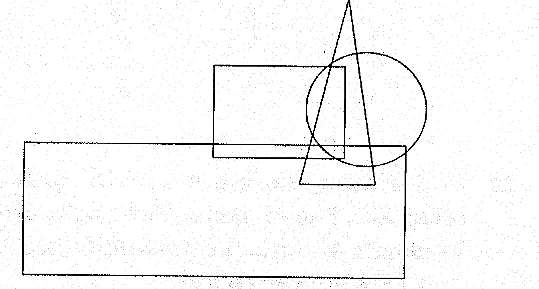
- aSome farmers who are employed are either backward or illiterate or both.
- bSome unemployed farmers are backward illiterate
- cSomebackward farmers who are employed aer not illiterateAnswer
- dAll those backward persons who are not illiterate are either farmers or employed or neither of these.
Explanation coming soon.
- Q174Shapes, figures and Venn diagrams
Find out from amongst the four alternatives as to how the pattern would appear when the transparent sheet of X is folded towards left at the dotted line.
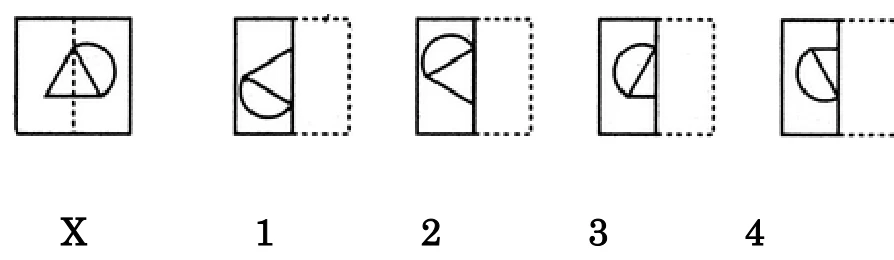
- aFigure 1
- bFigure 2
- cFigure 3Answer
- dFigure 4
Explanation coming soon.
- Q175Shapes, figures and Venn diagrams
Find the number of squares in the given figure.
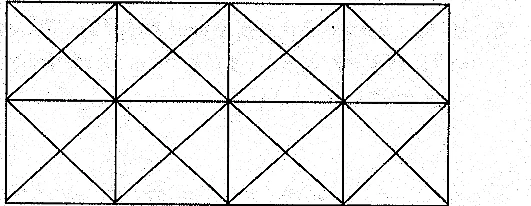
- a12
- b22
- c24Answer
- d26
Explanation coming soon.
- Q176Shapes, figures and Venn diagrams
Which digit will appear on the face opposite to the face with the number 4?
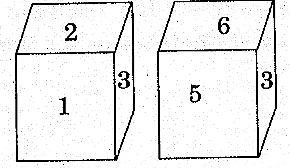
- a3Answer
- b5
- c6
- d1
Explanation coming soon.
- Q177Clocks, calendars and ages
At what time between 5:30 and 6 will the hands of a clock be at right angles?
- a43 5/11 min. past 5
- b43 7/11 min. past 5Answer
- c40 min. past 5
- d45 min. past 5
Explanation
Option B is correct because the hands form a 90 degree angle between 5:30 and 6 when the minute hand gains 240 degrees over the hour hand, occurring at 43 7/11 minutes past 5. At 5 o'clock, the hour hand is at 150 degrees. For a right angle after 5:30, the minute hand must be 90 degrees ahead of the hour hand. Total angle to be covered: 150 + 90 = 240 degrees Relative speed of minute hand: 5.5 degrees per minute Time: 240 / 5.5 = 480 / 11 = 43 7/11 minutes past 5 Option A: 43 5/11 min. past 5 makes an arithmetic error in the remainder when dividing 480 by 11. Option C: 40 min. past 5 neglects the simultaneous movement of the hour hand. Option D: 45 min. past 5 incorrectly assumes the hands are perpendicular at quarter to six.
- Q178Clocks, calendars and ages
It was Saturday on March 16, 2019. What will be the day of the week on March 16, 2025 ?
- aMonday
- bSundayAnswer
- cSaturday
- dTuesday
Explanation
Option B is correct because the six-year period from 16 March 2019 to 16 March 2025 contains two leap days, yielding one odd day overall and shifting the day from Saturday to Sunday. Number of years: 2025 - 2019 = 6 years Leap years with February 29 included: 2020 and 2024 = 2 leap years Total odd days: 6 + 2 = 8 days 8 divided by 7 leaves a remainder of 1 odd day Saturday + 1 day = Sunday Option A: Monday corresponds to two odd days, incorrectly counting an extra leap year. Option C: Saturday implies zero net day shift, failing to add the odd days. Option D: Tuesday corresponds to three odd days, which overcounts the day shift.
- Q179Number system and basic operations
Find the remainder when 2⁸⁹ is divided by 89.
- a1
- b2Answer
- c87
- d88
Explanation
Option B is correct because according to Fermat's Little Theorem, 2^(p-1) is congruent to 1 modulo p for any prime p, which directly simplifies the remainder of 2^89 divided by 89 to 2. 89 is a prime number By Fermat's Little Theorem: 2^(89 - 1) = 2^88 = 1 (mod 89) 2^89 = (2^88) x 2 = 1 x 2 = 2 (mod 89) Option A: 1 is the remainder for 2^88, omitting the final multiplication by 2. Option C: 87 corresponds to -2 mod 89, confusing the sign of the modular residue. Option D: 88 corresponds to -1 mod 89, which occurs when 2^((p-1)/2) evaluates to -1 rather than the value of 2^p.
- Q180Number system and basic operations
What should come in place of the question marks in ³√? / 2.56 = 100 / ? ?
- a16
- b4
- c64Answer
- d256
Explanation
Option C is correct because equating the cross-multiplication of the fractions yields x^(4/3) = 256, which gives x = 64. x^(1/3) / 2.56 = 100 / x x^(1/3) × x = 2.56 × 100 x^(4/3) = 256 256 = 4^4, so x^(1/3) = 4 x = 4^3 = 64 Option A: 16 is incorrect because (16)^(4/3) is approximately 39.99, not 256. Option B: 4 is incorrect because it is the value of the cube root of the required number. Option D: 256 is incorrect because it is the value of x^(4/3), not x itself.
- Q181Number system and basic operations
The least common multiple of two numbers is 168 and highest common factor of them is 12. If the difference between the numbers is 60, what is the sum of the numbers ?
- a108Answer
- b96
- c122
- d144
Explanation
Option A is correct because the two numbers are 84 and 24, which satisfy all conditions and sum to 108. Let the numbers be 12a and 12b with coprime a and b (a > b) LCM = 12ab = 168, so ab = 14 Difference = 12a - 12b = 12(a - b) = 60, so a - b = 5 Factors of 14 with difference 5 are a = 7 and b = 2 Numbers are 12 × 7 = 84 and 12 × 2 = 24 Sum = 84 + 24 = 108 Option B: 96 is incorrect because the numbers summing to 96 with difference 60 would be 78 and 18, whose HCF is 6, not 12. Option C: 122 is incorrect because it is not divisible by the HCF of 12. Option D: 144 is incorrect because it corresponds to numbers 102 and 42, which do not have LCM 168.
- Q182Number system and basic operations
The value of 1 / (1 + √2) + 1 / (√2 + √3) + 1 / (√3 + √4) +....+ 1 / (√15 + √16)
- a0
- b3Answer
- c-3
- d1
Explanation
Option B is correct because rationalizing the denominator of each term causes intermediate terms to cancel in a telescoping sum, leaving 3. 1 / (√n + √(n+1)) = √(n+1) - √n Sum = (√2 - 1) + (√3 - √2) + ... + (√16 - √15) Sum = √16 - 1 = 4 - 1 = 3 Option A: It incorrectly assumes all terms cancel completely including the boundary terms. Option C: It subtracts the final term from the first term instead of the reverse. Option D: It neglects to evaluate the square root of 16 properly, keeping only 1.
- Q183Number system and basic operations
If × is replaced with +, ÷ is replaced with ×, – is replaced with ÷, + is replaced with –, then 50 ÷ 10 × 75 – 25 + 7 = ?
- a496Answer
- b357
- c557
- d466
Explanation
Option A is correct because substituting the operators as defined and evaluating using the BODMAS rule results in 496. 50 × 10 + 75 ÷ 25 - 7 50 × 10 + 3 - 7 500 + 3 - 7 = 496 Option B: It results from incorrect division and subsequent subtraction errors. Option C: It adds 7 instead of subtracting it at the final step. Option D: It improperly evaluates the multiplication and subtraction steps.
- Q184Number system and basic operations
How many days are there in x weeks x days ?
- a14x
- b7
- c7x²
- d8xAnswer
Explanation
Option D is correct because one week contains seven days, so x weeks plus x days totals 8x days. Number of days in 1 week = 7 Number of days in x weeks = 7x Total days = 7x + x = 8x Option A: Represents 14x, which would mistakenly count each week as 13 days or double the week value. Option B: Represents 7, which gives a fixed constant instead of accounting for the variable x. Option C: Represents 7x², which wrongly multiplies the number of weeks by the days instead of adding them.
- Q185Number system and basic operations
If X% of Y is 100 and Y% of Z is 200, find the relation between X and Z.
- aZ=X/2
- bZ=2XAnswer
- cX=Z/4
- dZ=4X
Explanation
Option B is correct because dividing the second relationship by the first directly yields the proportionality ratio between Z and X. XY / 100 = 100 gives XY = 10000 YZ / 100 = 200 gives YZ = 20000 YZ / XY = 20000 / 10000 gives Z / X = 2, so Z = 2X Option A: Z = X/2 inverts the ratio, implying YZ is less than XY. Option C: X = Z/4 incorrectly squares or halves the factor of 2. Option D: Z = 4X overstates the multiple by doubling it again.
- Q186Number system and basic operations
For what value of *, the statement * / 15 X * / 135 = 1 ?
- a35
- b65
- c45Answer
- d55
Explanation
Option C is correct because multiplying the fractions together and taking the square root gives the value of 45. (* / 15) * (* / 135) = 1 *^2 / (15 * 135) = 1 *^2 = 15 * 135 *^2 = 15 * (15 * 9) = 225 * 9 = 2025 * = sqrt(2025) = 45 Option A: 35 gives a product of 35^2 / 2025, which equals 1225/2025, not 1. Option B: 65 gives a product of 65^2 / 2025, which equals 4225/2025, not 1. Option D: 55 gives a product of 55^2 / 2025, which equals 3025/2025, not 1.
- Q187Ratio, percentage and commercial arithmetic
Income of Rahim is Rs. 12000 per month and that of Ami is Rs. 191520 per annum. If the monthly expenditure of each of them is Rs.9960 per month, find the ratio of their savings.
- a17:50Answer
- b16:40
- c16:50
- d17:40
Explanation
Option A is correct because Rahim's monthly savings are Rs. 2,040 and Ami's monthly savings are Rs. 6,000, which reduces to a ratio of 17:50. Rahim monthly income = Rs. 12,000 Rahim monthly expenditure = Rs. 9,960 Rahim monthly savings = 12,000 - 9,960 = Rs. 2,040 Ami annual income = Rs. 1,91,520 Ami monthly income = 1,91,520 / 12 = Rs. 15,960 Ami monthly savings = 15,960 - 9,960 = Rs. 6,000 Ratio of savings = 2,040 : 6,000 = 17 : 50 Option B: 16:40 miscalculates Ami's monthly income or savings. Option C: 16:50 makes an arithmetic error when reducing Rahim's savings. Option D: 17:40 misstates Ami's monthly savings as Rs. 4,800 instead of Rs. 6,000.
- Q188Ratio, percentage and commercial arithmetic
In a bag, there are a certain number of toy-blocks with alphabets A, B, C and D written on them. The ratio of blocks A:B:C:D is in the ratio 4:7:3:1. If the number of ‘A’ blocks is 50 more than the number of ‘C’ blocks, what is the number of ‘B’ blocks ?
- a550
- b450
- c350Answer
- d250
Explanation
Option C is correct because the difference of 1 ratio unit between A and C corresponds to 50 blocks, making 7 units for B equal to 350 blocks. Ratio A : B : C : D = 4 : 7 : 3 : 1 Difference between A and C in ratio units = 4 - 3 = 1 unit 1 unit = 50 blocks Number of B blocks = 7 * 50 = 350 Option A: 550 is incorrect because it corresponds to 11 units rather than 7 units. Option B: 450 is incorrect because it corresponds to 9 units rather than 7 units. Option D: 250 is incorrect because it corresponds to 5 units rather than 7 units.
- Q189Ratio, percentage and commercial arithmetic
Suresh invested Rs. 500 in SBI for 2 years. He also invested Rs. 300 in ICICI for 4 years. At the end he received Rs. 220 from both banks as simple interest. What must have been the rate of interest ?
- a10%Answer
- b12%
- c11%
- d5.5%
Explanation
Option A is correct because expressing the simple interest from both investments in terms of the common interest rate gives a linear equation that yields 10%. Interest from SBI = (500 * R * 2) / 100 = 10 * R Interest from ICICI = (300 * R * 4) / 100 = 12 * R Total interest = 10 * R + 12 * R = 22 * R Given total interest = 220 22 * R = 220, so R = 10% Option B: 12% would result in a total interest of Rs 264, exceeding the given Rs 220. Option C: 11% would produce Rs 242 in total interest. Option D: 5.5% halves the required rate, producing only Rs 121 in interest.
- Q190Ratio, percentage and commercial arithmetic
The percentage of values in a set of values which are less than ( more than ) the median value is
- a100 percent
- b75 percent
- c50 percentAnswer
- d25 percent
Explanation
Option C is correct because the median is defined as the middle value of a distribution, dividing the sorted observations into two equal halves. Option A: Represents the total percentage of the dataset, not the portion on either side of the median. Option B: Corresponds to the third quartile or the upper 75 percent threshold. Option D: Corresponds to the first quartile or the lower 25 percent threshold.
- Q191Time, work, speed and distance
A man can do a piece of work in 5 days, but with the help of his son, he can do it in 3 days. In what time can the son do it alone ?
- a6½ days
- b7 days
- c7½ daysAnswer
- d8 days
Explanation
Option C is correct because the son's individual daily work rate is obtained by subtracting the man's daily rate from their combined daily rate. Man's 1-day work = 1/5 Combined 1-day work of man and son = 1/3 Son's 1-day work = 1/3 - 1/5 = (5 - 3)/15 = 2/15 Time taken by son alone = 15/2 = 7½ days Option A: 6½ days miscalculates the rate difference as 2/13. Option B: 7 days is an inaccurate approximation. Option D: 8 days incorrectly adds rather than subtracting the reciprocal rates.
- Q192Time, work, speed and distance
A can do a piece of work in 20 days. He works at it for 5 days and then B finishes it in 10 more days. In how many days will A and B together finish the work?
- a9
- b10
- c7
- d8Answer
Explanation
Option D is correct because the combined work rate of A and B is 1/8 of the work per day, meaning together they complete the entire work in 8 days. A daily rate = 1/20 Work done by A in 5 days = 5 * (1/20) = 1/4 Remaining work = 1 - 1/4 = 3/4 B daily rate = (3/4) / 10 = 3/40 Combined daily rate = 1/20 + 3/40 = 5/40 = 1/8 Total days needed together = 1 / (1/8) = 8 Option A: Overestimates the required time by assuming a slower combined rate. Option B: Represents the time taken by B alone to do the remaining three-fourths work. Option C: Underestimates the total days needed at a combined rate of 1/8 per day.
- Q193Time, work, speed and distance
Two trains of length 150 m and 170 m respectively are running at the speed of 40 km/hr and 32 km/hr on parallel tracks in opposite directions. In what time will they cross each other ?
- a12 seconds
- b14 seconds
- c15 seconds
- d16 secondsAnswer
Explanation
Option D is correct because the time taken to cross each other when traveling in opposite directions is the sum of the train lengths divided by their relative speed. Total distance = 150 + 170 = 320 m Relative speed = 40 + 32 = 72 km/hr Relative speed in m/s = 72 * (5/18) = 20 m/s Time = 320 / 20 = 16 seconds Option A: 12 seconds incorrectly assumes a higher relative speed. Option B: 14 seconds arises from an error in calculating total distance or speed conversion. Option C: 15 seconds is an inaccurate division of 320 by 20.
- Q194Mensuration and geometry
What is the minimum number of square marbles required to tile a floor of length 5 metres 78 cm and width 3 metres 74 cm ?
- a176
- b187Answer
- c540
- d748
Explanation
Option B is correct because the minimum number of identical square tiles required to cover the rectangular floor corresponds to tiles of maximum possible side length, which is the highest common factor of the floor dimensions. Floor length = 578 cm Floor width = 374 cm Side of largest square tile = HCF(578, 374) = 34 cm Number of tiles = (578 x 374) / (34 x 34) = 17 x 11 = 187 Option A: 176 incorrectly calculates the product of 16 and 11 instead of 17 and 11. Option C: 540 results from using an incorrect tile dimension rather than the greatest common divisor. Option D: 748 results from multiplying by 44 instead of dividing properly by tile area.
- Q195Mensuration and geometry
External dimensions of a wooden cuboid are 30 cm × 25 cm × 20 cm. If the thickness of the wood is 2 cm all around, find the volume of the wood contained in the cuboid formed.
- a6264 cm3Answer
- b4250 cm3
- c3286 cm3
- d2456 cm3
Explanation
Option A is correct because subtracting the internal cavity volume from the total external volume of the cuboid yields the volume of the wood used. External volume = 30 × 25 × 20 = 15000 cm³ Internal dimensions = (30 - 4) × (25 - 4) × (20 - 4) = 26 × 21 × 16 cm Internal volume = 26 × 21 × 16 = 8736 cm³ Volume of wood = 15000 - 8736 = 6264 cm³ Option B: 4250 cm³ underestimates the wood volume by subtracting incorrect wall thickness. Option C: 3286 cm³ is an arithmetic miscalculation of the internal or external volume. Option D: 2456 cm³ erroneously deducts thickness only once instead of twice along each dimension.
- Q196Mensuration and geometry
A 5 cm cube is cut into as many 1 cm cubes as possible. What is the ratio of the surface area of the larger cube to that of the sum of the surface areas of the smaller cubes ?
- a1:6
- b1:5Answer
- c1:25
- d1:125
Explanation
Option B is correct because dividing the surface area of the original large cube by the combined surface area of all the resulting unit cubes gives a ratio of 1:5. Surface area of 5 cm cube = 6 × 5² = 150 cm² Number of 1 cm cubes = 5³ = 125 Total surface area of 125 cubes = 125 × (6 × 1²) = 750 cm² Ratio = 150 : 750 = 1 : 5 Option A: 1:6 fails to use the correct scale factor for surface areas. Option C: 1:25 squares the scale ratio rather than taking the ratio of total surface areas. Option D: 1:125 gives the ratio of the volume of one small cube to the large cube.
- Q197Mensuration and geometry
In the given figure, lines PQ, RS, TV intersect at O. If x: y: z = 1: 2: 3, then find the values of x, y, z.
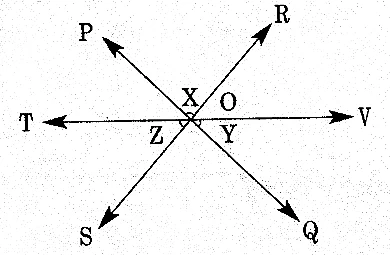
- ax=35°, y=45°, z=96°
- bx=30°, y=60°, z=90°Answer
- cx=30°, y=45°, z=96°
- dx=35°, y=40°, z=90°
Explanation
Option B is correct because the angles lying on one side of the straight line form a straight angle summing to 180 degrees, and their vertically opposite pairs divide the straight line into angles x, y, and z. x + y + z = 180° Ratio of x : y : z = 1 : 2 : 3 Sum of ratio parts = 1 + 2 + 3 = 6 x = (1/6) × 180° = 30° y = (2/6) × 180° = 60° z = (3/6) × 180° = 90° Option A: Incorrect because the sum of the angles is 176 degrees rather than 180 degrees, and the ratio is not 1:2:3. Option C: Incorrect because the angles sum to 171 degrees and do not follow the given ratio. Option D: Incorrect because the angles sum to 165 degrees and fail the ratio proportion.
- Q198Mensuration and geometry
Find the supplement of the angle 4/5 of 90°.
- a108°Answer
- b102°
- c109°
- d106°
Explanation
Option A is correct because four-fifths of 90° is 72°, and its supplementary angle is 180° - 72° = 108°. Given angle = (4/5) × 90° = 72° Supplementary angle = 180° - 72° = 108° Option B: 102° subtracts 78° instead of 72° from 180°. Option C: 109° is an arithmetic error in subtraction. Option D: 106° miscalculates 180° - 72°.
- Q199Data interpretation and probability
Directions: The following pie chart indicates the expenditure of a country on various sports during a particular year. Study the pie chart and answer questions 19 to 23. The ratio of the total expenditure on football to that of expenditure on hockey is
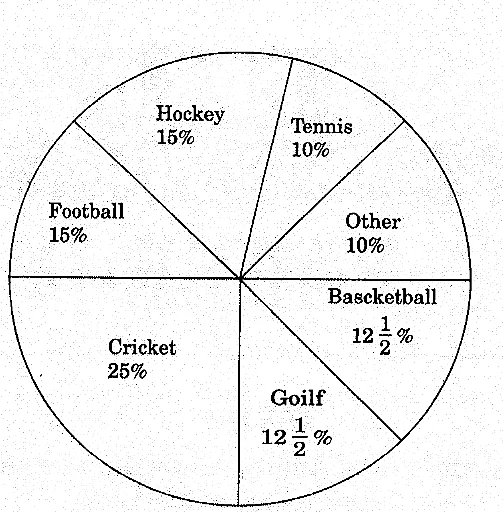
- a1:15
- b1:1Answer
- c15:1
- d3:20
Explanation coming soon.
- Q200Data interpretation and probability
Directions: The following pie chart indicates the expenditure of a country on various sports during a particular year. Study the pie chart and answer questions 19 to 23. If the total expenditure on sports during the year was Rs.1,20,00,000, how much was spent on basketball?
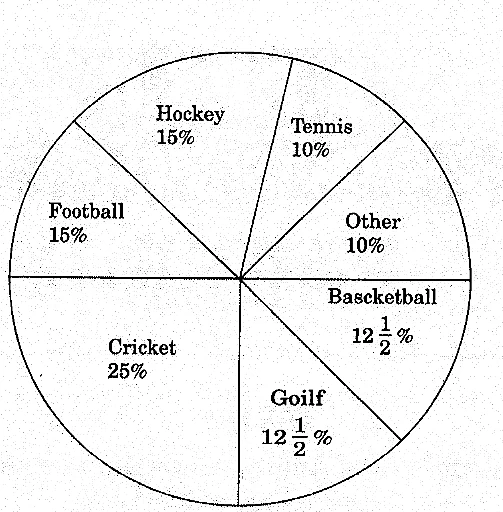
- aR.s 9,50,000
- bR.s 10,00,000
- cR.s 12,00,000
- dR.s 15,00,000Answer
Explanation coming soon.
Keep your place and save questions
Pick up where you stopped, bookmark questions to revise, and get topic-wise PYQ sets with short Telugu notes. Join the waitlist for early access.