Critically examine the implementation of the 73rd and 74th Constitutional Amendments. How far is it effective?
In short
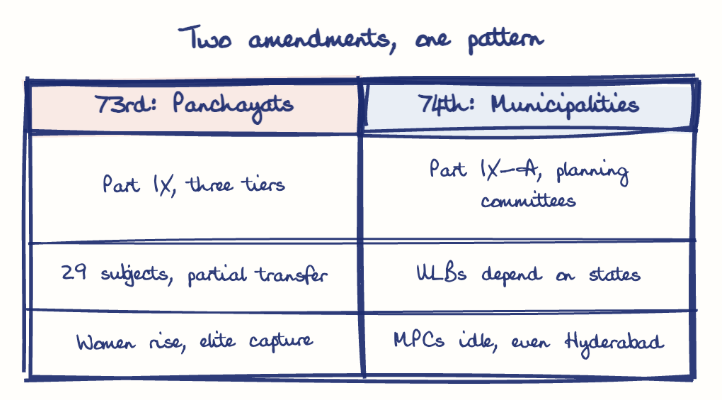
The 73rd and 74th Amendments (1992) gave Panchayats and Municipalities constitutional status, regular elections, one-third reservation for women and State Finance Commissions, deepening grassroots democracy. Their effectiveness is only partial, as states devolved few of the 29 Eleventh Schedule subjects, funds and functionaries, and Hyderabad's Metropolitan Planning Committee rarely functions.
Model answer
Ghissu Editorial · Verified 4 Oct 2026 · 265 words
Constitutional Entrenchment of Panchayats
The 73rd Amendment added Part IX, mandating a three-tier Panchayati Raj system, regular elections, reservations for Scheduled Castes, Scheduled Tribes, and women, and the establishment of State Election and Finance Commissions, institutionalising rural governance including in Telangana.
Partial Devolution of Powers
Despite the 11th Schedule listing 29 subjects, many states, including Telangana, have been slow in devolving adequate financial and administrative powers, limiting Panchayat autonomy.
Constitutional Status for Urban Local Bodies
The 74th Amendment introduced Part IX-A, granting constitutional recognition to Municipalities, mandating elections, reservations, and Metropolitan Planning Committees, formalising urban governance in Hyderabad.
Inadequate Functional Devolution and Planning
Urban Local Bodies remain dependent on state governments for funds and approvals; Metropolitan Planning Committees are often ineffective, causing fragmented urban governance.
Democratic Deepening and Inclusion
Both amendments enhanced political participation of women and marginalized groups, with Telangana showing gains in grassroots accountability through schemes like Mission Bhagiratha.
Limited Fiscal and Administrative Autonomy
Inadequate devolution of funds and functions constrains local bodies’ capacity to implement development projects independently.
State-Level Variability
Success depends on political will; Telangana has made progress post-statehood but challenges in decentralisation persist.
This model answer is indicative and the model can make mistakes; please verify key facts independently.
Sources
Practise this question
1Get the answer sheet
Sized for this question.
2Write your answer
Timed, by hand.
3Get it marked
Your score and what to fix.
This chapter in the exam
Federalism, Centre-State relations, local government, inter-state disputes4 questions
Asked in 2 of 2 sittings since 2016
Most tested: 73rd and 74th Constitutional Amendments and their implementation/effectiveness
- 2024Examine how the 73rd and 74th Constitutional Amendment Acts have strengthened democratic decentralization in India.
- 2024Evaluate the role of the Finance Commission in maintaining fiscal federalism in India.
All 4 questions, sorted by sub-topic, with model answers and practice.
Question from the official TGPSC Group-I Mains 2016 paper. Answer written by Ghissu's engine and checked against our editorial standards. Found an error? Tell us and we correct it within 48 hours.