TGPSC Group-I Prelims 2010
367 questions from the 2010 papers, each with the official answer and an explanation.
A question repeated across years is listed once, under one of the years it appeared.
- Q241HUMAN BODY, NUTRITION AND DISEASE
Myopia is related to what?
- aHeart
- bLungs
- cEyesAnswer
- dEars
Explanation
Option C is correct because myopia, commonly known as nearsightedness, is a refractive defect of the eye where close objects appear clearly but distant objects appear blurry. Option A: It is a circulatory organ and unrelated to optical refraction disorders. Option B: It is a respiratory organ and not affected by refractive visual conditions. Option D: It is an auditory and balancing organ that plays no role in vision.
- Q242HUMAN BODY, NUTRITION AND DISEASE
Blood is a
- aSolution
- bColloidAnswer
- cFluid substance
- dGel
Explanation
Option B is correct because physically and chemically, blood is a colloidal dispersion where blood cells and large protein molecules (like albumin and globulin) remain suspended in plasma without settling immediately. Option A: A true solution has solute particles smaller than 1 nanometer, whereas blood contains large suspended cellular elements and proteins. Option C: While blood is a fluid, scientifically its physical mixture classification is a colloid or suspension. Option D: A gel is a semi-solid colloidal system, whereas blood flows as a liquid.
- Q243HUMAN BODY, NUTRITION AND DISEASE
Microcytic anemia is caused by the deficiency of what?
- aFolacinAnswer
- bBiotin
- cNiacin
- dPantothenic acid
Explanation coming soon.
- Q244HUMAN BODY, NUTRITION AND DISEASE
Which of the following vitamins is related to protein production?
- aB₆Answer
- bB₁₂
- cB₁
- dB₂
Explanation
Option A is correct because Vitamin B6 (pyridoxine), in its active coenzyme form pyridoxal phosphate, plays an indispensable role in amino acid metabolism, transamination, and protein biosynthesis. Option B: B12 is primarily involved in DNA synthesis, erythrocyte maturation, and myelin maintenance. Option C: B1 serves primarily as a coenzyme in carbohydrate metabolism and cellular energy generation. Option D: B2 functions as a precursor for FAD and FMN in cellular respiration and oxidation-reduction reactions.
- Q245HUMAN BODY, NUTRITION AND DISEASE
Bronchitis is a :
- aNervous system diseaseAnswer
- bExcretory system disease
- cFlight system disease
- dDigestive system
Explanation coming soon.
- Q246HUMAN BODY, NUTRITION AND DISEASE
Widespread resistance of malarial parasite to drugs like chloroquine has prompted attempts to develop a malarial vaccine to combat malaria. Why is it difficult to develop an effective malaria vaccine?
- aMalaria is caused by several species of PlasmodiumAnswer
- bMan does not develop immunity to malaria during natural infection
- cVaccines can be developed only against bacteria
- dMan is only an intermediate host and not the definitive host
Official answer shown. The explanation is under review.
- Q247HUMAN BODY, NUTRITION AND DISEASE
What does the following symbol indicate?
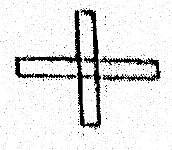
- aHospital
- bFirst AidAnswer
- cCrossroad
- dNo Parking
Explanation coming soon.
- Q248HUMAN BODY, NUTRITION AND DISEASE
Pacemaker is related to which of the following?
- aHeartAnswer
- bLung
- cLiver
- dKidney
Explanation
Option A is correct because a pacemaker is an electrical device implanted in the chest to regulate the rhythm and beating of the heart. Option B: Lungs are organs of respiratory gas exchange, not regulated by an electrical pacemaker. Option C: The liver is a metabolic and detoxification organ, completely unrelated to pacemaker therapy. Option D: Kidneys filter waste from the blood and manage electrolyte balance, which is not modulated by a cardiac pacemaker.
- Q249HUMAN BODY, NUTRITION AND DISEASE
With reference to the treatment of cancerous tumours, a tool called cyberknife has been making the news. In this context, which one of the following statements is not correct ?
- aIt is a robotic image guided system
- bIt delivers an extremely precise dose of radiation
- cIt has the capability of achieving submillimetre accuracy
- dIt can map the spread of tumour in the bodyAnswer
Explanation
Option D is correct because CyberKnife is a robotic therapeutic tool designed to deliver high-dose targeted stereotactic radiosurgery to localized lesions, not a whole-body diagnostic scanning tool used to map the spread of metastases. Option A: CyberKnife operates using real-time image guidance coupled with a robotic arm, making this a true statement. Option B: Delivering highly concentrated doses of radiation to destroy tumour cells is its core therapeutic purpose. Option C: The system is precisely calibrated to target tumours with submillimetre accuracy while adjusting for patient movement.
- Q250SCHOOL CHEMISTRY
Solvay periodic substance refers to which of the following?
- aSodiumAnswer
- bChlorine
- cPotassium
- dPhosphorus
Explanation
Option A is correct because the Solvay process is an industrial method developed by Ernest Solvay for the large-scale production of sodium carbonate using sodium chloride, ammonia, and limestone. Option B: Chlorine is manufactured industrially by the chlor-alkali electrolysis process, not the Solvay process. Option C: Potassium carbonate cannot be prepared by the Solvay method because potassium bicarbonate is too soluble to precipitate from solution. Option D: Phosphorus is extracted from phosphate mineral deposits and has no role in the Solvay process.
- Q251SCHOOL CHEMISTRY
The color given by excess Lithium in a Lithium chloride crystal:
- aViolet
- bGreen
- cPinkAnswer
- dYellow
Explanation
Option C is correct because heating lithium chloride in the presence of excess lithium vapour creates anion vacancies filled by unpaired electrons, known as F-centres, which absorb light and impart a pink colour to the crystal. Excess lithium in LiCl: pink Excess sodium in NaCl: yellow Excess potassium in KCl: violet Option A: Violet colour is produced by F-centres formed due to excess potassium in potassium chloride crystals. Option B: Green colour is not produced by metal excess defects in alkali halides. Option D: Yellow colour is produced by F-centres formed due to excess sodium in sodium chloride crystals.
- Q252SCHOOL CHEMISTRY
Cola transport easy drinks contain which of the following?
- aPhosphoric acidAnswer
- bFormic acid
- cLactic acid
- dCitric acid
Explanation
Option A is correct because phosphoric acid is added to cola beverages to impart a distinct tangy and sharp flavor while also acting as a preservative against microbial growth. Option B: Formic acid is a toxic compound found in ant stings and is unsafe for human food consumption. Option C: Lactic acid is naturally present in sour milk and curd, not standard cola soft drinks. Option D: Citric acid is predominantly used in clear, citrus-flavored sodas rather than dark colas.
- Q253SCHOOL CHEMISTRY
The substance / material used to ignite rocket fuel:
- aLiquid hydrogen
- bMethyl alcohol
- cAmmonium perchlorateAnswer
- dPotassium chlorate
Explanation
Option C is correct because ammonium perchlorate is a primary oxidizer used extensively in solid rocket propellants to initiate and sustain combustion. Option A: Liquid hydrogen serves as a cryogenic fuel rather than an oxidizer or ignition material. Option B: Methyl alcohol is a liquid fuel or solvent, not a primary solid rocket ignition substance. Option D: Potassium chlorate is too sensitive and unstable for standard large-scale rocket motor ignition.
- Q254SCHOOL CHEMISTRY
Permanent hardness of water is caused by the presence of which of the following?
- aCalcium sulfateAnswer
- bCalcium bicarbonate
- cSodium bicarbonate
- dMagnesium bicarbonate
Explanation
Option A is correct because permanent hardness cannot be removed by boiling and is caused by the soluble chlorides and sulfates of calcium and magnesium. Option B: Calcium bicarbonate causes temporary hardness, which is easily removed by boiling. Option C: Sodium bicarbonate does not contribute to either temporary or permanent hardness of water. Option D: Magnesium bicarbonate causes temporary hardness rather than permanent hardness.
- Q255SCHOOL CHEMISTRY
In which of the following ways is Sodium benzoate used?
- aFlavoring agent
- bPreservativeAnswer
- cColoring agent
- dTo neutralize sourness
Explanation
Option B is correct because sodium benzoate is an antimicrobial agent widely used as a food preservative to inhibit the growth of yeasts, moulds, and bacteria in acidic foods and beverages. Option A: It does not impart flavour to food products. Option C: It is a colourless compound and does not act as a dye or colouring agent. Option D: It is the salt of a weak acid and does not serve as an antacid or de-acidifying agent.
- Q256SCHOOL CHEMISTRY
Which of the following primarily contains mosquito repellent?
- aCalcium dihydrogen phosphateAnswer
- bPotassium hydrogen phosphate
- cSodium hydrogen sulfate
- dAmmonium bicarbonate
Explanation coming soon.
- Q257SCHOOL CHEMISTRY
Bardron is a:
- aBlue pigment
- bYellow pigmentAnswer
- cBrown pigment
- dOrange pigment
Explanation coming soon.
- Q258SCHOOL CHEMISTRY
Among the following metals, which is used as the purest metal?
- aSilver
- bCopper
- cIron
- dAluminiumAnswer
Official answer shown. The explanation is under review.
- Q259SCHOOL CHEMISTRY
22 carat gold contains how much weight:
- a8.4% copperAnswer
- b10.2% copper
- c11.4% copper
- d12.6% copper
Explanation
Option A is correct because 22 carat gold contains 22 parts pure gold and 2 parts alloy metal such as copper, which amounts to approximately 8.4 percent by weight. 24 carat gold equals 100 percent pure gold 22 carat gold contains 22 parts gold out of 24 total parts Alloy metal content equals 2 parts out of 24 parts Percentage of alloy metal equals 2 divided by 24 multiplied by 100, which is approximately 8.33 percent or 8.4 percent Option B: 10.2% copper corresponds to roughly 21.5 carat gold. Option C: 11.4% copper corresponds to roughly 21.3 carat gold. Option D: 12.6% copper corresponds to roughly 21 carat gold.
- Q260SCHOOL CHEMISTRY
Brass is an alloy of which of the following?
- aCopper and Aluminium
- bCopper and Tin
- cCopper and ZincAnswer
- dCopper and Nickel
Explanation
Option C is correct because brass is a substitutional alloy composed essentially of copper and zinc in varying proportions. Option A: Copper and aluminium form aluminium bronze, not brass. Option B: Copper and tin combine to form bronze, not brass. Option D: Copper and nickel form cupronickel, not brass.
- Q261SCHOOL CHEMISTRY
Non-stick utensils used in the kitchen are coated with what?
- aPolyvinyl chloride
- bPolytetrafluoroethyleneAnswer
- cPolystyrene
- dPolyamide
Explanation
Option B is correct because polytetrafluoroethylene (PTFE), widely known under the brand name Teflon, provides extreme non-reactivity, high thermal stability, and a very low coefficient of friction, making it ideal for non-stick cookware. Option A: Polyvinyl chloride decomposes at cooking temperatures and releases hazardous fumes, making it unusable for cooking surfaces. Option C: Polystyrene is a brittle polymer with low thermal resistance used mainly in disposable packaging and insulation. Option D: Polyamides (nylons) are used for textile fibres and engineering parts, not as non-stick coatings on utensils.
- Q262SCHOOL PHYSICS
Friction:
- aaccelerates motion
- bcompletely stops moving objects
- creduces the speed of motion.Answer
- dhas no effect on motion.
Explanation
Option C is correct because friction always opposes the relative motion between contacting surfaces, causing a moving body to decelerate and reduce its speed. Option A: Friction resists relative motion and dissipates mechanical energy into heat, so it decelerates rather than accelerates motion. Option B: Friction continuously reduces speed, but does not stop motion instantaneously without sufficient distance or time. Option D: Friction exerts a retarding force that directly alters the velocity of moving objects.
- Q263SCHOOL PHYSICS
The orbital period of a geostationary satellite is:
- a365 days
- b30 days
- c1 dayAnswer
- d12 hours
Explanation
Option C is correct because a geostationary satellite must match Earth's rotational period so that it appears stationary relative to a fixed point on Earth's equator. Rotational period of Earth on its axis: approximately 24 hours (1 day) Orbital period of a geostationary satellite: 24 hours (1 day) Orbital altitude: approximately 35786 km above the equator Option A: 365 days is Earth's orbital period around the Sun, not the period of an Earth-orbiting satellite. Option B: 30 days is roughly the orbital period of the Moon around Earth. Option D: 12 hours is typical for semi-synchronous satellite orbits, such as those used by GPS constellations.
- Q264SCHOOL PHYSICS
Inertia is a property of which of the following?
- aForce
- bDensity
- cMassAnswer
- dVolume
Explanation
Option C is correct because mass is the intrinsic quantitative measure of an object's inertia, directly determining how strongly it resists any change in its state of rest or uniform motion. Option A: Force is an external interaction that causes an acceleration rather than an inherent property of matter that resists it. Option B: Density is mass per unit volume, which describes how tightly matter is packed rather than its resistance to acceleration. Option D: Volume represents the spatial size of a body and does not determine how difficult it is to change the body's velocity.
- Q265SCHOOL PHYSICS
If force does not act on a system of particles, the external center of propagation of that system?
- aincreases
- bdecreases
- cbecomes zero
- dremains constantAnswer
Explanation
Option D is correct because by Newton's first law and the law of conservation of momentum, the velocity of the center of mass of an isolated system remains constant when no external force acts upon it. Option A: Increases is incorrect because an increase in the velocity or momentum of the center of mass requires a net positive external force. Option B: Decreases is incorrect because a decrease in the center of mass velocity requires a net retarding external force. Option C: Becomes zero is incorrect because if the center of mass has an initial non-zero velocity, it continues moving uniformly rather than stopping.
- Q266SCHOOL PHYSICS
If there is a 100 percent increase in an object's momentum, what is the increase in its kinetic energy?
- aThere will be a 300 percent increase.Answer
- bThere will be a 200 percent increase.
- cThere will be a 100 percent increase.
- dThere will be a 50 percent increase.
Explanation
Option A is correct because kinetic energy is proportional to the square of momentum, so doubling the momentum quadruples the kinetic energy, resulting in a 300 percent increase. Kinetic energy formula: KE = p^2 / (2m) Initial momentum: p New momentum after 100 percent increase: p' = 2p New kinetic energy: KE' = (2p)^2 / (2m) = 4 * KE Percentage increase: ((4 * KE - KE) / KE) * 100 = 300 percent Option B: A 200 percent increase mistakenly assumes kinetic energy triples rather than quadruples when momentum doubles. Option C: A 100 percent increase assumes a linear relationship between momentum and kinetic energy, ignoring the squared dependence. Option D: A 50 percent increase incorrectly divides the percentage change rather than applying the quadratic relationship.
- Q267SCHOOL PHYSICS
Among the following, in which does tea get cold very easily?
- aGlass cup
- bMetal cupAnswer
- cClay cup
- dPorcelain cup
Explanation
Option B is correct because metals are excellent thermal conductors with high thermal conductivity, allowing heat to rapidly conduct from the tea to the outer surface and dissipate into the air. Option A: Glass is a thermal insulator and dissipates heat far more slowly than metal. Option C: Clay has low thermal conductivity and porous walls that trap heat relatively well compared to metal. Option D: Porcelain is a ceramic material with very low thermal conductivity that retains heat effectively.
- Q268SCHOOL PHYSICS
A crack in a glass plate appears as an illusion:
- alike silverAnswer
- bgreen
- cblack
- dcolorful
Explanation
Option A is correct because total internal reflection occurs at the air-glass boundary inside the crack, reflecting almost all incident light and making the crack glisten like a polished silver surface. Option B: Total internal reflection reflects all visible wavelengths equally rather than selectively reflecting green light. Option C: Total internal reflection returns light to the viewer instead of absorbing it, which would otherwise make it look black. Option D: The crack does not act like a prism separating light systematically to produce a colorful appearance.
- Q269SCHOOL PHYSICS
To a geographer, the sky from a ship appears as:
- ablack
- bblueAnswer
- cblue
- dwhite
Explanation coming soon.
- Q270SCHOOL PHYSICS
The distance between two consecutive points in the same phase is its:
- aFrequency
- bAmplitude
- cLight intensity
- dWavelengthAnswer
Explanation
Option D is correct because wavelength is defined as the spatial distance between any two successive points that are in the same phase of oscillation, such as two consecutive crests or troughs. Option A: Frequency is the number of wave cycles passing a fixed point per unit time, not a physical distance. Option B: Amplitude is the maximum displacement of particles from their equilibrium position. Option C: Light intensity is a measure of radiant power per unit area, not a length or distance.
- Q271SCHOOL PHYSICS
What we use for alternating current:
- aEliminator
- bTransformerAnswer
- cBattery
- dDynamo
Explanation
Option B is correct because a transformer operates on the principle of mutual electromagnetic induction, which strictly requires a continuously varying or alternating current to induce a voltage in the secondary winding. Option A: A battery eliminator converts alternating current into direct current rather than utilizing AC for AC-specific tasks. Option C: A battery stores and delivers direct current and cannot operate on or provide alternating current directly. Option D: A standard dynamo produces direct current using a split-ring commutator.
- Q272SCHOOL PHYSICS
Albert Einstein was awarded the Nobel Prize for which of the following?
- aTheory of Special Relativity
- bPhotoelectric effectAnswer
- cInvention of the atomic bomb
- dBrownian motion
Explanation
Option B is correct because Albert Einstein was awarded the 1921 Nobel Prize in Physics specifically for his services to theoretical physics and especially for his discovery of the law of the photoelectric effect. Option A: Theory of Special Relativity was considered too controversial and unverified by the Nobel Committee at that time and was not cited for the award. Option C: Invention of the atomic bomb is historically incorrect because Einstein did not invent or build the atomic bomb. Option D: Brownian motion was mathematically explained by Einstein in 1905, but it was not the cited reason for his Nobel Prize.
- Q273Logical reasoning and analytical ability
What does a factory always have?
- asellers
- bfiles
- celectricity
- dworkersAnswer
Explanation
Option D is correct because a factory is an industrial production facility that fundamentally requires workers to carry out manufacturing operations, even if it operates manually without modern amenities. Option A: sellers are involved in marketing and retail distribution, not an inherent component located inside every factory. Option B: files are administrative tools that may be absent in informal or non-bureaucratic factories. Option C: electricity is not universal to all factories, as traditional or manual manufacturing units can operate without it.
- Q274Logical reasoning and analytical ability
A cube needs to be colored, avoiding the same color on adjacent surfaces. The minimum number of colors required for this is
- athreeAnswer
- bfour
- cfive
- dsix
Explanation
Option A is correct because a standard cube has three pairs of mutually opposite faces, and each pair can share the same color without any adjacent faces having matching colors. Option B: It uses more colors than the absolute minimum required. Option C: It exceeds the minimum necessary number of colors. Option D: It assigns a distinct color to each of the six faces, which is not the minimum.
- Q275Logical reasoning and analytical ability
Five girls are sitting in a row. Neither Sulekha nor Abha is next to Rakhi. Anuradha is not next to Sulekha. Rakhi is next to Monika. Monika is in the middle of the row. Then, who among the following is Anuradha next to?
- aRakhiAnswer
- bMonika
- cAbha
- dSulekha
Explanation
Option A is correct because Monika occupies the center position and Rakhi sits next to her, forcing Anuradha into the adjacent end seat since Sulekha and Abha cannot sit next to Rakhi. Row positions: 1, 2, 3, 4, 5 Position 3: Monika Position 2: Rakhi Positions next to Rakhi cannot be Sulekha or Abha: Position 1 must be Anuradha Positions 4 and 5: Sulekha and Abha in some order Anuradha at position 1 is adjacent to Rakhi at position 2 Option B: Monika is separated from Anuradha by Rakhi. Option C: Abha is placed on the opposite side of Monika and is not adjacent to Anuradha. Option D: Sulekha is placed on the opposite side of Monika and cannot be next to Anuradha.
- Q276Series, analogy and odd man out
Which one of the following numbers is wrong in the series? 1,6,2,12,8,24
- a2
- b8Answer
- c6
- d24
Explanation
Option B is correct because 8 breaks the alternating pattern of operations in the sequence. 1 × 6 = 6 6 ÷ 3 = 2 2 × 6 = 12 12 ÷ 3 = 4 4 × 6 = 24 Option A: 2 is correct in the series as it correctly follows 6 divided by 3. Option C: 6 is correct in the series as it correctly follows 1 multiplied by 6. Option D: 24 is correct in the series as it correctly follows 4 multiplied by 6.
- Q277Series, analogy and odd man out
One of the following sequence of numbers is incorrect. Identify it: 1, 6, 2, 12, 8, 24
- a-2
- b8Answer
- c6
- d24
Explanation
Option B is correct because replacing 8 with 4 maintains the consistent alternating rule of multiplying by 6 and dividing by 3. 1 × 6 = 6 6 ÷ 3 = 2 2 × 6 = 12 12 ÷ 3 = 4 4 × 6 = 24 Option A: -2 is not even an element in the original sequence. Option C: 6 correctly follows the rule 1 × 6 = 6. Option D: 24 correctly follows the rule 4 × 6 = 24.
- Q278Series, analogy and odd man out
Find the missing letter in the alternatives given below:
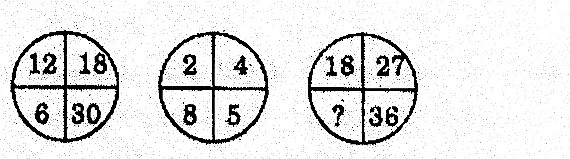
- a9Answer
- b12
- c18
- d6
Explanation coming soon.
- Q279Series, analogy and odd man out
Rearrange the letters BCARLMEDS to make a meaningful word:
- aCRUMBLED
- bSCRAMBLEDAnswer
- cLEADERS
- dDEALERS
Explanation
Option B is correct because SCRAMBLED contains the exact nine letters given in BCARLMEDS. Option A: CRUMBLED includes the letter U, which is not present in the given letters. Option C: LEADERS contains only seven letters and uses two Es, whereas the given set has only one E. Option D: DEALERS contains only seven letters and repeats E, which is missing from the original set.
- Q280Series, analogy and odd man out
Rearrange the letters BCARLMEDS to form a meaningful word?
- aCRUMBLED
- bSCRAMBLEDAnswer
- cLEADERS
- dDEALERS
Explanation
Option B is correct because the letter collection B, C, A, R, L, M, E, D, S contains exactly 9 letters which can be rearranged to spell the word SCRAMBLED. Option A: CRUMBLED contains the letter U, which is not present in BCARLMEDS. Option C: LEADERS contains only 7 letters and uses letters not matching the full original set. Option D: DEALERS contains only 7 letters and does not use all the letters provided.
Keep your place and save questions
Pick up where you stopped, bookmark questions to revise, and get topic-wise PYQ sets with short Telugu notes. Join the waitlist for early access.