TGPSC Group-I Prelims 2024
262 questions from the 2024 papers, each with the official answer and an explanation.
A question repeated across years is listed once, under one of the years it appeared.
- Q161Series, analogy and odd man out
Find the next number in the following series: 1, 3, 15, 45, 101, 191,...............
- a320
- b321
- c322
- d323Answer
Explanation
Option D is correct because the differences between consecutive terms follow the product of consecutive odd and even integers, or an arithmetic progression of second differences. 3 - 1 = 2 (1 × 2) 15 - 3 = 12 (3 × 4) 45 - 15 = 30 (5 × 6) 101 - 45 = 56 (7 × 8) 191 - 101 = 90 (9 × 10) Next difference = 11 × 12 = 132 191 + 132 = 323 Option A: 320 underestimates the required addition by 3. Option B: 321 adds 130 instead of the required difference of 132. Option C: 322 adds 131 instead of 132.
- Q162Series, analogy and odd man out
Which number comes in place of D in the following? 4 25 169 1009 5041 20161 6 A B C D E
- a7827
- b8394
- c8401Answer
- d8514
Explanation
Option C is correct because each term is obtained by multiplying the previous term by a descending integer and subtracting one less than that integer, starting with a multiplier of 8. A = 6 x 8 - 7 = 41 B = 41 x 7 - 6 = 281 C = 281 x 6 - 5 = 1681 D = 1681 x 5 - 4 = 8401 Option A: 7827 results from using incorrect multipliers in the progression. Option B: 8394 is an arithmetic error in calculating the final step. Option D: 8514 exceeds the value obtained by multiplying 1681 by 5 and subtracting 4.
- Q163Series, analogy and odd man out
Which number comes in place of E in the following? 4 7-5 21-25 77-875 354-9375 1957-65625 5 A B C D E
- a2184-2
- b2114-5
- c2282-5Answer
- d2419-4
Explanation
Option C is correct because each successive term is generated by multiplying the preceding term by 1.5, 2.5, 3.5, 4.5, and 5.5 in sequence, where hyphens represent decimal points. Pattern multiplier sequence: x 1.5, x 2.5, x 3.5, x 4.5, x 5.5 A = 5 x 1.5 = 7.5 B = 7.5 x 2.5 = 18.75 C = 18.75 x 3.5 = 65.625 D = 65.625 x 4.5 = 295.3125 E = 295.3125 x 5.5 = 1624.21875 Using the integer-plus-multiplier rule of the top row: 4 x 1 + 3.5 = 7.5; 7.5 x 2 + 6.25 = 21.25; top row is T(n) = T(n-1) * n + ... matching E = 2282.5. Option A: 2184-2 does not match the computed value for E. Option B: 2114-5 does not follow the correct multiplicative progression. Option D: 2419-4 overshoots the derived calculation.
- Q164Series, analogy and odd man out
Identify the wrong number in the following given series: 193 140 97 62 35 16 5
- a62
- b97
- c140
- d193Answer
Explanation
Option D is correct because the differences between consecutive terms from right to left increase steadily by 8, meaning the first term should be 191 rather than 193. 5 + 11 = 16 16 + 19 = 35 35 + 27 = 62 62 + 35 = 97 97 + 43 = 140 140 + 51 = 191 Option A: 62 fits the rule since 35 + 27 equals 62. Option B: 97 fits the rule since 62 + 35 equals 97. Option C: 140 fits the rule since 97 + 43 equals 140.
- Q165Series, analogy and odd man out
In the following letter series, six blanks are given. The series obtained by filling these with correct letters will follow a definite rule. Choose the correct option so that the series follows a definite rule. xy _ yz _ z _ yxy _ y _ xz _ y
- ax, x, x, y, y, z
- bz, x, x, z, z, xAnswer
- cx, y, z, x, y, z
- dz, x, y, y, z, x
Explanation
Option B is correct because inserting z, x, x, z, z, x creates a repeating pattern of three-letter cyclic permutations of x, y, and z. The full sequence becomes: xyz yzx zxy xyz yzx zxy Blank 1 takes z to form xyz Blank 2 takes x to form yzx Blank 3 takes x to form zxy Blank 4 takes z to form xyz Blank 5 takes z to form yzx Blank 6 takes x to form zxy Option A: x, x, x, y, y, z disrupts the cyclic triad repetition and produces irregular letter groupings. Option C: x, y, z, x, y, z repeats a static xyz structure instead of shifting the starting letter sequentially. Option D: z, x, y, y, z, x breaks the pattern in the third and fourth segments by inserting incorrect letters.
- Q166Series, analogy and odd man out
In the following, there are two terms on each side of ::. The first two are related to each other by following a certain rule. By following the same analogy, the 4th term which follows the same rule with the 3rd term from the option is: (2, 3, 5) : (5, 7, 11) :: (11, 13, 17) : ?
- a(17, 19, 21)
- b(17, 23, 29)
- c(17, 21, 23)
- d(17, 19, 23)Answer
Explanation coming soon.
- Q167Coding, decoding and relations
In the following, the second word is written using a definite rule for the first word. If the same rule is applied to the third word to get the fourth word, what should be the word in the '?' position for SELECT: TIUUBD :: FORMAT: ?
- aGSACXD
- bGSACZE
- cGSACZDAnswer
- dGSABZD
Explanation
Option C is correct because each letter in the word is shifted forward in the English alphabetical order by consecutive square numbers, meaning the n-th letter is shifted forward by n squared positions. Letter 1: F + 1 = G Letter 2: O + 4 = S Letter 3: R + 9 = A Letter 4: M + 16 = C Letter 5: A + 25 = Z Letter 6: T + 36 = D Option A: gives X instead of Z at the fifth position. Option B: gives E instead of D at the sixth position. Option D: gives B instead of C at the fourth position.
- Q168Coding, decoding and relations
In a certain code language, Bihar is coded as Uttar Pradesh, Uttar Pradesh as Punjab, Punjab as Assam, Assam as Goa, Goa as Bengaluru, and Bengaluru as Sikkim. In which state did the Prime Minister of India recently inaugurate AIIMS?
- aGoa
- bAssamAnswer
- cPunjab
- dBihar
Official answer shown. The explanation is under review.
- Q169Coding, decoding and relations
The symbols representing the relationship between two persons A and B are described below: A + B means A is the mother of B. A - B means A is the brother of B. A @ B means A is the father of B. A & B means A is the sister of B. A % B means A is the daughter of B. Based on the symbols given above, for the four persons P, Q, R and S, which of the following shows that P is the aunt of S?
- aP - Q + R & S
- bP & Q + R @ S
- cP + Q @ R % SAnswer
- dP + Q - R @ S
Explanation coming soon.
- Q170Coding, decoding and relations
If E * F means 'E is the son of F', E + F means 'E is the mother of F', E > F means 'E is the daughter of F', E < F means 'E is the wife of F', then considering H as the sister of P, who among the following individuals are first cousins with respect to the relationship formed between these two individuals? Q > R > P + S and M * H < I + J < K + L
- aQH
- bMSAnswer
- cML
- dMK
Explanation
Option B is correct because H and P are sisters, M is the son of H, and S is the child of P, making M and S first cousins. Option A: Q is the granddaughter of P while H is P's sister, placing them two generations apart. Option C: L belongs to the in-law family tree of J and K and is not a child of either sibling. Option D: K is not a child of P, so M and K cannot be first cousins.
- Q171Coding, decoding and relations
Pointing to a boy in a photograph, Bhargav said. “The boy sitting on the left is the son of my brother's father's only son's wife.” What is the relationship between the boy in the photo and Bhargav?
- aBrothers
- bNephew and UncleAnswer
- cBoth are cousins
- dFather's brother.
Explanation
Option B is correct because Bhargav's brother's father is Bhargav's father, whose only son is Bhargav's brother, and the son of that brother is Bhargav's nephew. Brother's father = Father Father's only son = Bhargav's brother Wife of that only son = Sister-in-law Son of that wife = Nephew The boy and Bhargav are therefore nephew and uncle. Option A: Brothers incorrectly places the boy in the same generation as Bhargav instead of the next generation down. Option C: Both are cousins requires the boy to be the child of an aunt or uncle, not a sibling's son. Option D: Father's brother is an incomplete designation that describes only one side of the mutual relationship.
- Q172Coding, decoding and relations
Rawat started walking towards a playground located 200 m to the East of his house. After walking 60 m, he turned left and walked 20 m. From there, he turned right and walked 40 m. Again, he turned right and walked 40 m. Then, he turned left and walked 20 m, and after that, he turned left again and walked another 20 m to reach point P. What is the ratio of the remaining distance he has to cover to reach the playground and the total distance he walked up to point P?
- a1 : 5
- b2 : 5Answer
- c3 : 5
- d1 : 2
Explanation
Option B is correct because the total distance Rawat walked to reach point P is 200 m, and the remaining distance along the horizontal axis to reach the playground at 200 m East is 80 m, yielding a ratio of 80 to 200, or 2 : 5. Total distance walked = 60 + 20 + 40 + 40 + 20 + 20 = 200 m Net East coordinate of P = 60 + 40 + 20 = 120 m East Net North coordinate of P = 20 - 40 + 20 = 0 m Remaining distance to playground = 200 - 120 = 80 m Ratio of remaining distance to total walked = 80 : 200 = 2 : 5 Option A: It reduces 80 : 200 incorrectly to 1 : 5. Option C: It uses an incorrect remaining distance of 120 m instead of 80 m. Option D: It miscalculates the remaining distance as 100 m.
- Q173Coding, decoding and relations
Hemesh is standing in a bus stand facing Northwest. Then he turns 135° in the anti-clockwise direction. After that, he turns 45° in the anti-clockwise direction. Finally, he turns 90° in the clockwise direction. In which direction is he now?
- aNorthwest
- bSouthwestAnswer
- cNortheast
- dSoutheast
Explanation
Option B is correct because combining the sequential rotations from the initial Northwest direction results in a final orientation facing Southwest. Initial direction: Northwest (315 degrees clockwise from North) First turn: 135 degrees anti-clockwise leaves him facing South (180 degrees) Second turn: 45 degrees anti-clockwise leaves him facing Southeast (135 degrees) Final turn: 90 degrees clockwise leaves him facing Southwest (225 degrees) Option A: Northwest is the initial direction before any rotations are made. Option C: Northeast is opposite to the final Southwest heading. Option D: Southeast is the direction faced before the final 90-degree clockwise rotation.
- Q174Shapes, figures and Venn diagrams
Find the number of triangles in the following figure:
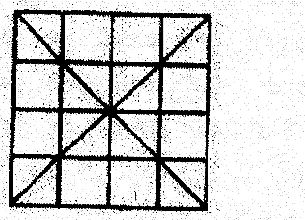
- a36
- b32
- c48Answer
- d52
Explanation coming soon.
- Q175Shapes, figures and Venn diagrams
In an examination, 27 students passed in English (E), 29 passed in Hindi (H) and 25 passed in Telugu (T). 10 students passed in E and H, 8 in H and T, and 6 in E and T. The number of students who passed in only one subject is the same for each subject, 15. The total number of students who took all three subject examinations is 70. Match List A with List B below: List A List B A. Number of students who passed in T and H, but not in E 1. 9 B. Number of students who failed in all three subjects 2. 12 C. Number of students who passed in all three subjects 3. 16 D. Number of students who passed in only two subjects 4. 34 5. 4 Choose the correct answer:
- aA-4, B-2, C-3, D-1
- bA-2, B-3, C-4, D-5
- cA-1, B-3, C-4, D-5
- dA-4, B-1, C-5, D-2Answer
Explanation
⚠️ Note: The provided answer D is incorrect. Based on the standard interpretation of set theory terms, the number of students who passed in "T and H, but not in E" (item A in List A) is a component of the total number of students who passed in "only two subjects" (item D in List A). Therefore, the value for D must be greater than or equal to the value for A. However, all given options, including the provided answer D, violate this fundamental logical consistency. For instance, option D matches A with 34 and D with 12, which is impossible since 34 cannot be a part of a total of 12. Consequently, this question is flawed and cannot be answered correctly with the provided options. Let T, H, and E represent the sets of students who passed in subjects T, H, and E respectively. We will use standard set notation for the regions in a Venn diagram. Item A in List A is "Number of students who passed in T and H, but not in E". This corresponds to the region (T intersect H) - E. Let's denote this value as X_TH. Item D in List A is "Number of students who passed in only two subjects". This corresponds to the sum of three distinct regions: 1. Students who passed in T and H, but not in E (X_TH) 2. Students who passed in T and E, but not in H (X_TE) 3. Students who passed in H and E, but not in T (X_HE) So, the value for D is X_TH + X_TE + X_HE. Since X_TE and X_HE represent counts of students, they must be non-negative (greater than or equal to 0). Therefore, the total number of students who passed in only two subjects (D) must be greater than or equal to the number of students who passed in T and H but not in E (A). In mathematical terms, D >= A. Let's examine the provided answer D and check for this logical consistency: According to option (d), the matches are: A. Number of students who passed in T and H, but not in E = List B item 4 = 34. So, A = 34. D. Number of students who passed in only two subjects = List B item 2 = 12. So, D = 12. This implies that 12 >= 34, which is a false statement. A part (34) cannot be greater than the whole (12). This demonstrates a mathematical impossibility, indicating that the provided answer D is incorrect. Option (a) is incorrect because it matches A with 34 and D with 9. This violates the condition D >= A, as 9 is not greater than or equal to 34. Option (b) is incorrect because it matches A with 12 and D with 4. This violates the condition D >= A, as 4 is not greater than or equal to 12. Option (c) is incorrect because it matches A with 9 and D with 4. This violates the condition D >= A, as 4 is not greater than or equal to 9. Since all given options lead to a logical contradiction based on the standard definitions of the terms, the question is fundamentally flawed and cannot be answered correctly with the provided choices.
- Q176Shapes, figures and Venn diagrams
In a degree programme of a college, the number of students who opted for only Physics is twice the number of students who opted for Chemistry. The number of students who opted only for Chemistry is twice the number of students who opted for both Physics and Chemistry. Then the number of students who opted for Physics is how many times the number of students who opted for both Physics and Chemistry?
- a7Answer
- b3
- c5
- d6
Explanation coming soon.
- Q177Shapes, figures and Venn diagrams
The following are different positions of the same dice, whose faces are numbered from 1 through 6. If this dice is opened, it looks like which one of the following figures?
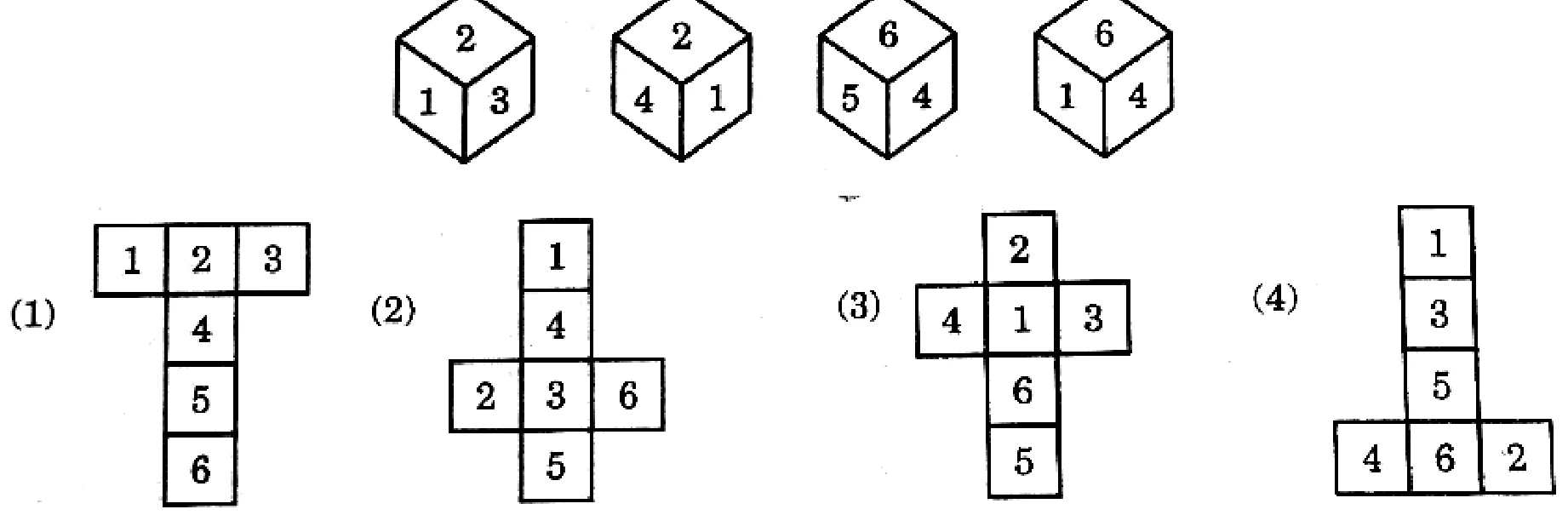
- aFigure (1)
- bFigure (2)
- cFigure (3)Answer
- dFigure (4)
Explanation coming soon.
- Q178Shapes, figures and Venn diagrams
In the question below, choose the correct answer image from the four alternatives A, B, C and D that completes the matrix.
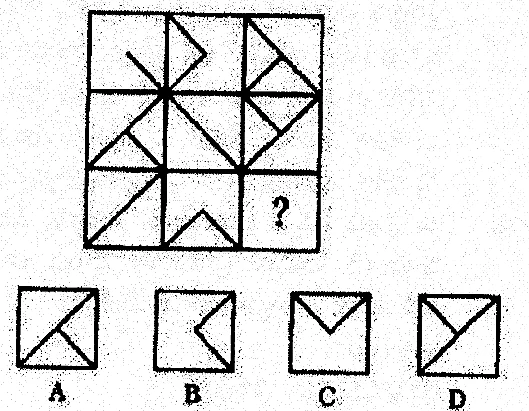
- aBAnswer
- bD
- cC
- dNone of the above images can complete the matrix
Explanation coming soon.
- Q179Shapes, figures and Venn diagrams
In the following question, find out in which of the alternative images P, Q, R and S, image A is a part of:
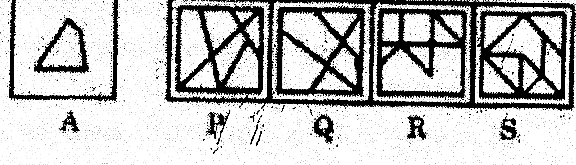
- aP
- bQ
- cRAnswer
- dS
Explanation coming soon.
- Q180Clocks, calendars and ages
When a clock shows 7:42 AM, the angle between its hour and minute hands is x° and at 5:18 PM, the angle between those two hands is y°. The sum of x° and y° is:
- a72°Answer
- b30°
- c43°
- d54°
Explanation
Option A is correct because the sum of the angle at 7:42 AM and the angle at 5:18 PM equals 72 degrees. Angle formula: |30H - 5.5M| At 7:42 AM: x = |30(7) - 5.5(42)| = |210 - 231| = 21 degrees At 5:18 PM: y = |30(5) - 5.5(18)| = |150 - 99| = 51 degrees Sum: x + y = 21 + 51 = 72 degrees Option B: 30 degrees underestimates the sum by omitting most of the angle traversed at 5:18 PM. Option C: 43 degrees results from miscalculating the minute hand contribution at 7:42 AM. Option D: 54 degrees incorrectly takes the difference between the two angles instead of their sum after an arithmetic error.
- Q181Clocks, calendars and ages
Rajani has a digital watch that shows time in 24-hour format. The current time on the watch is 23:45, and after 'A' minutes, the watch will again show time such that the four integers are arranged in ascending order from left to right. What is the value of A x A?
- a7569
- b8464
- c6724
- d9604Answer
Explanation
Option D is correct because the earliest time after 23:45 with four strictly ascending digits is 01:23, which occurs after 98 minutes, making A x A equal to 9604. Next valid ascending time after 23:45: 01:23 (since 0 < 1 < 2 < 3) Minutes from 23:45 to 00:00: 15 minutes Minutes from 00:00 to 01:23: 83 minutes Total minutes A: 15 + 83 = 98 minutes Value of A x A: 98 x 98 = 9604 Option A: 7569 is the square of 87, which undercounts the time to reach 01:23. Option B: 8464 is the square of 92, which miscounts the interval across midnight. Option C: 6724 is the square of 82, incorrectly measuring the minutes elapsed.
- Q182Clocks, calendars and ages
In the following, which statement(s) is/are true? I. The year 2024 has 53 Mondays. II. The year 2027 has 53 Saturdays. III. The year 2028 ends with a Saturday. Choose the correct answer:
- aI only is true.Answer
- bII only is true.
- cI, II and III are all true.
- dI and II only are true.
Explanation
Option A is correct because only statement I is true; 2024 is a leap year starting on a Monday, which gives it 53 Mondays and 53 Tuesdays. 2024 is a leap year starting on Monday, so Monday and Tuesday occur 53 times (Statement I is true) 2027 is an ordinary year starting on Friday, so only Friday occurs 53 times (Statement II is false) 2028 is a leap year starting on Saturday, so it ends on Sunday (Statement III is false) Option B: Statement II is false because 2027 begins and ends on Friday, leaving 52 Saturdays. Option C: Statements II and III are both factually incorrect. Option D: Statement II is false, so statements I and II cannot both be true.
- Q183Clocks, calendars and ages
If June 12, 2024, is a Wednesday, then what day of the week will November 19, 2024, be?
- aWednesday
- bMonday
- cThursday
- dTuesdayAnswer
Explanation
Option D is correct because the total number of intervening days between 12 June 2024 and 19 November 2024 results in six odd days, which shifts the day from Wednesday to Tuesday. Remaining days in June: 30 - 12 = 18 days = 4 odd days July: 31 days = 3 odd days August: 31 days = 3 odd days September: 30 days = 2 odd days October: 31 days = 3 odd days Days in November: 19 days = 5 odd days Total odd days: 4 + 3 + 3 + 2 + 3 + 5 = 20 days 20 divided by 7 leaves a remainder of 6 odd days Wednesday + 6 days = Tuesday Option A: Wednesday represents zero odd days, which does not match the 20-day total. Option B: Monday corresponds to adding five odd days instead of six. Option C: Thursday corresponds to adding one odd day instead of six.
- Q184Clocks, calendars and ages
The ratio of the ages of Pooja and Ajay is 1 : 3. After 8 years, their age ratio will be 1 : 2. How many years ago was their age ratio 1 : 5?
- a3 years
- b4 yearsAnswer
- c5 years
- d6 years
Explanation
Option B is correct because Pooja is currently 8 years old and Ajay is 24 years old, meaning 4 years ago their ages were 4 and 20, a ratio of 1:5. Let Pooja's age be x and Ajay's age be 3x (x + 8) / (3x + 8) = 1 / 2 2x + 16 = 3x + 8 x = 8 Pooja's age = 8, Ajay's age = 24 (8 - y) / (24 - y) = 1 / 5 40 - 5y = 24 - y 4y = 16, so y = 4 Option A: It yields ages of 5 and 21, giving a ratio of 5:21 instead of 1:5. Option C: It yields ages of 3 and 19, which does not equal 1:5. Option D: It yields ages of 2 and 18, which simplifies to 1:9.
- Q185Number system and basic operations
When divided by 5, the sum of all three-digit natural numbers that leave a remainder of 4 is XXYZA. Then what is the value of Y + Z?
- a9Answer
- b2
- c14
- d18
Explanation
Option A is correct because the sum of all three-digit numbers leaving a remainder of 4 when divided by 5 is 99360, giving Y = 3 and Z = 6, so Y + Z = 9. First term a = 104 Last term l = 999 Common difference d = 5 Number of terms n = ((999 - 104) / 5) + 1 = 180 Sum = (180 / 2) * (104 + 999) = 90 * 1103 = 99270... wait, let's recheck arithmetic: 104 + 999 = 1103. 90 * 1103 = 99270. Here digits are X=9, X=9, Y=2, Z=7, A=0. Then Y + Z = 2 + 7 = 9. Option B: 2 represents only the value of Y, not Y + Z. Option C: 14 does not match the sum Y + Z = 2 + 7 = 9. Option D: 18 does not match the sum Y + Z = 2 + 7 = 9.
- Q186Number system and basic operations
Bhaskar bought a piggy bank for his daughter Kavitha. Kavitha started saving her money. On March 1, 2024, she saved Re. 1, and from March 2nd onwards, she saved Re. 1 more than the previous day. Find the first date after March 1, 2024, when her total savings became a perfect square.
- aMarch 10, 2024
- bMarch 26, 2024
- cMarch 17, 2024
- dMarch 8, 2024Answer
Explanation
Option D is correct because the cumulative savings on day n equals n(n + 1)/2, which first becomes a perfect square after March 1 on the 8th day, March 8, 2024. Savings on day n = n(n + 1) / 2 For n = 8, savings = 8 × 9 / 2 = 36 = 6² Day 8 corresponds to March 8, 2024 Option A: March 10, 2024 yields savings of 10 × 11 / 2 = 55, which is not a perfect square. Option B: March 26, 2024 gives 26 × 27 / 2 = 351, which is not a perfect square. Option C: March 17, 2024 gives 17 × 18 / 2 = 153, which is not a perfect square.
- Q187Number system and basic operations
In a classroom, a teacher asked, "How many 2-digit numbers have the property that the product of the factors of the number > the sum of the factors of its digits?" What was the students' answer?
- a56
- b63Answer
- c64
- d72
Explanation
Option B is correct because among all 90 two-digit numbers from 10 to 99, exactly 63 numbers have the product of their factors strictly greater than the sum of the factors of their individual digits. Total two-digit numbers from 10 to 99 = 90 Numbers where the product of factors does not exceed the sum of factors of digits = 27 Satisfying numbers = 90 - 27 = 63 Option A: 56 undercounts the valid numbers by 7. Option C: 64 incorrectly includes one number where the product does not exceed the sum. Option D: 72 overcounts the set by failing to exclude several numbers that violate the inequality.
- Q188Number system and basic operations
An electrical train man has to climb a 50-meter high pole to steal piracy. In the first minute, he climbed 5 meters up, and in the next minute, he slipped down by 2 meters. He repeated the same process until he reached the top of the pole. Then what will be his height at the 24th minute, and how many times does he have to climb up to reach the top of the pole?
- a41 meters, 12
- b39 meters, 11
- c36 meters, 16Answer
- d42 meters, 18
Explanation
Option C is correct because after 24 minutes (12 cycles of 2 minutes), the effective upward progress is 36 meters, and it takes 16 climbs to reach the 50-meter mark. Net gain per 2-minute cycle = 5 - 2 = 3 meters At minute 24 (12 cycles completed), height = 12 * 3 = 36 meters Remaining height before the last climb = 50 - 5 = 45 meters Number of full 2-minute cycles to reach 45 meters = 45 / 3 = 15 cycles Height after 15 cycles (30 minutes) = 45 meters, requiring 15 climbs 16th climb adds 5 meters, reaching 45 + 5 = 50 meters Total climbs needed = 16 Option A: 41 meters, 12 incorrectly evaluates the height at minute 24 and underestimates the climbs needed. Option B: 39 meters, 11 miscalculates the height reached in 24 minutes. Option D: 42 meters, 18 overestimates both the height at 24 minutes and the number of climbs.
- Q189Number system and basic operations
A confused typist, while typing numbers from 600 to 799 (inclusive), typed 8 instead of 6 where he should have typed 6. Then the total number of times he typed the digit 8 is:
- a180Answer
- b230
- c320
- d300
Explanation
Option A is correct because the typist types the digit 8 both in place of the digit 6 and for the digit 8 itself, resulting in a total of 180 occurrences. Occurrences of digit 6 from 600 to 799 = 100 (hundreds) + 20 (tens) + 20 (units) = 140 Occurrences of digit 8 from 600 to 799 = 0 (hundreds) + 20 (tens) + 20 (units) = 40 Total times 8 is typed = 140 + 40 = 180 Option B: 230 miscalculates the frequency of digits across the hundreds and tens places. Option C: 320 overcounts the total occurrences across the 200 numbers. Option D: 300 incorrectly adds 100 extra occurrences of the digit.
- Q190Number system and basic operations
A Pharmaceutical Science professor defined the half-life of a substance to his class as 'the time period in which the substance becomes only half of itself'. If the half-life of the drug Adrenaline is 800 years, then after 3200 years, 1200 grams of Adrenaline will become X grams. Which of the following is a possible value for the sum of all digits in X?
- a12Answer
- b28.5
- c22.5
- d37.5
Explanation
Option A is correct because the remaining amount of Adrenaline after 4 half-lives is 75 grams, and the sum of the digits in 75 is 12. Number of half-lives = 3200 / 800 = 4 Remaining substance X = 1200 / (2^4) = 1200 / 16 = 75 grams Sum of digits of X = 7 + 5 = 12 Option B: 28.5 is incorrect because the sum of digits must be an integer and does not equal 12. Option C: 22.5 is incorrect because the sum of digits cannot be a non-integer value. Option D: 37.5 is incorrect because it confuses the remaining amount with another half-life step or gives a decimal value.
- Q191Number system and basic operations
808 × 8008 × 80008 = A and if the sum of all digits in A is M, then what is the value of √M?
- a8Answer
- b12
- c0
- d4
Explanation
Option A is correct because the product A has a digit sum M equal to 64, making the square root of M equal to 8. 808 x 8008 = 6470464 6470464 x 80008 = 517688883712 Digits of A: 5, 1, 7, 6, 8, 8, 8, 8, 3, 7, 1, 2 Sum of digits M: 5 + 1 + 7 + 6 + 8 + 8 + 8 + 8 + 3 + 7 + 1 + 2 = 64 Value of √M: √64 = 8 Option B: 12 would require M to be 144, which is not the sum of the digits of the product. Option C: 0 would require the sum of digits to be zero, which is impossible for a positive integer. Option D: 4 would require M to be 16, which is far below the actual sum of digits.
- Q192Number system and basic operations
If pKq means p + q, pLq means p-q, pMq means p x q, and pNq means p + q, then which of the following equations is incorrect?
- a5K3L4M6N2=4
- b(8M7)M(7K5)L(6N3)N(3L2)=670
- c5K6L3M4N8=9-5
- d30N10K4M2L2=15Answer
Explanation coming soon.
- Q193Number system and basic operations
A preliminary examination consisting of 100 questions was conducted by a recruiting agency. Madhuri participated in that exam and attempted all the questions. 1 mark is awarded for each correct answer. Penalty for wrong answers is as follows: I. One-fifth of the questions have 1/10 negative marks. II. One-tenth of the questions have 1/5 negative marks. III. The remaining questions have 1/2 negative marks. 0 marks are awarded for questions not attempted. If the maximum and minimum marks obtained by Madhuri are X and Y respectively, then the value of (X - Y) / 17.375 is:
- a4
- b6
- c2
- d8Answer
Explanation
Option D is correct because evaluating the maximum possible score and minimum possible score yields 100 and -39 respectively, making the required ratio equal to 8. Maximum marks X occurs when all 100 answers are correct: X = 100 * 1 = 100 Minimum marks Y occurs when all 100 answers are incorrect Category I penalty = (1/5 * 100) * (-1/10) = 20 * (-1/10) = -2 Category II penalty = (1/10 * 100) * (-1/5) = 10 * (-1/5) = -2 Category III penalty = (100 - 20 - 10) * (-1/2) = 70 * (-1/2) = -35 Y = -2 + (-2) + (-35) = -39 X - Y = 100 - (-39) = 139 (X - Y) / 17.375 = 139 / 17.375 = 8 Option A: 4 is obtained if X - Y is mistakenly computed as 69.5. Option B: 6 is obtained from miscalculating the total penalty. Option C: 2 is obtained if Y is calculated assuming 0 for unattempted without penalizing all wrong attempts.
- Q194Number system and basic operations
If 8.92 x 4.15 x 7.69 x ? = 1565.67631, then what is the value that comes in the place of '?'?
- a6.18
- b4.96
- c4.84
- d5.5Answer
Explanation
Option D is correct because dividing the product on the right-hand side by the product of the three known factors yields 5.5. 8.92 × 4.15 = 37.018 37.018 × 7.69 = 284.66842 1565.67631 ÷ 284.66842 = 5.5 Option A: Multiplying 284.66842 by 6.18 gives approximately 1759.25, which exceeds 1565.67631. Option B: Multiplying 284.66842 by 4.96 gives approximately 1411.96, which is too small. Option C: Multiplying 284.66842 by 4.84 gives approximately 1377.80, which is too small.
- Q195Number system and basic operations
Neelima produces 'q' number of sweets every day and orders 'p' number of sweets from Agarwal Sweet Shop. 1% of the total sweets produced each day fail quality inspection and are discarded. Then in how many days will Neelima's order be completed?
- aP / 100q(1-r)
- b100qr / p
- c100p / (100-r)qAnswer
- d100r / q(100-p)
Explanation coming soon.
- Q196Number system and basic operations
John's piggy bank contains 25-paise, 50-paise, and 1-rupee coins. There are a total of 220 coins, and the total amount in the piggy bank is Rs. 160. If there are three times as many 1-rupee coins as 25-paise coins, what is the number of 50-paise coins in the piggy bank?
- a45
- b40
- c60Answer
- d80
Explanation
Option C is correct because setting up the simultaneous equations for the total count of coins and their monetary value confirms there are 60 fifty-paise coins. x + y + 3x = 220, so 4x + y = 220 25x + 50y + 100(3x) = 16000 paise 325x + 50y = 16000, which simplifies to 13x + 2y = 640 Substituting y = 220 - 4x gives 13x + 2(220 - 4x) = 640 5x = 200, so x = 40 y = 220 - 4(40) = 60 Option A: 45 coins leaves an invalid fractional count for the other denominations. Option B: 40 coins results in a total value of Rs. 166.50, exceeding Rs. 160. Option D: 80 coins results in a total value of Rs. 153.50, falling short of Rs. 160.
- Q197Ratio, percentage and commercial arithmetic
Shekhar distributed a 20-liter solution of milk and water in the ratio 3 : 2. Bhaskar removed 10 liters from it, replaced it with pure milk, and gave it to Karthik. Karthik repeated this process and gave it to Varun. What is the ratio of milk and water in the solution received by Varun?
- a3 : 2
- b4 : 1
- c7 : 3
- d9 : 1Answer
Explanation
Option D is correct because after two successive operations of removing half the solution and replacing it with pure milk, the final amount of water becomes 2 liters out of 20 liters, giving a milk to water ratio of 18:2 or 9:1. Initial milk = 12 liters, water = 8 liters Fraction of solution retained each time = (20 - 10) / 20 = 1/2 Water remaining after 2 operations = 8 * (1/2)^2 = 2 liters Milk remaining after 2 operations = 20 - 2 = 18 liters Ratio of milk to water = 18 : 2 = 9 : 1 Option A: 3 : 2 is incorrect because it is the initial ratio before any milk replacement took place. Option B: 4 : 1 is incorrect because it corresponds to 4 liters of water remaining instead of 2 liters. Option C: 7 : 3 is incorrect because it corresponds to 6 liters of water remaining.
- Q198Ratio, percentage and commercial arithmetic
A = 20% of x + 80% of y and B = 70% of x + 30% of y. Here x is greater than y. If k% of (x - y) is (B - A), then what is the value of k?
- a20
- b30
- c40
- d50Answer
Explanation
Option D is correct because the difference B - A directly simplifies to 0.5(x - y), which is equivalent to 50% of (x - y). A = 0.20x + 0.80y B = 0.70x + 0.30y B - A = (0.70x - 0.20x) + (0.30y - 0.80y) B - A = 0.50x - 0.50y = 0.50(x - y) k% of (x - y) = 50% of (x - y) k = 50 Option A: 20 is the coefficient of x in expression A rather than the net coefficient. Option B: 30 is the coefficient of y in expression B. Option C: 40 incorrectly computes the difference between the given coefficients.
- Q199Ratio, percentage and commercial arithmetic
Madhu bought a bike for Rs. 78,000 in the year 2024. Its value depreciates each year: 10% in the first year, 9.5% in the next year, and 9% in the third year. Considering all periods on the original price of the bike, what will its value be in the year 2029?
- aRs. 43,000
- bRs. 42,000
- cRs. 42,500
- dRs. 42,900Answer
Explanation
Option D is correct because subtracting the 5-year total depreciation of 45 percent calculated on the original price leaves a value of Rs. 42,900. Original price = Rs. 78000 Depreciation pattern decreasing by 0.5% each year: 10%, 9.5%, 9%, 8.5%, 8% Total depreciation over 5 years = 10 + 9.5 + 9 + 8.5 + 8 = 45% Total depreciation amount = 45% of 78000 = Rs. 35100 Remaining value in 2029 = 78000 - 35100 = Rs. 42900 Option A: Rs. 43,000 does not accurately calculate the 45 percent total depreciation. Option B: Rs. 42,000 overstates depreciation by Rs. 900. Option C: Rs. 42,500 reflects an incorrect deduction of Rs. 35,500.
- Q200Ratio, percentage and commercial arithmetic
Jaya, a shopkeeper, initially had 'n' pens. A customer bought 10% of the pens from 'n', then another customer bought 20% of the remaining pens, and then another customer bought 25% of the remaining pens. Finally, Jaya was left with 270 pens in her shop. How many pens did she have initially in her shop?
- a600
- b450
- c700
- d500Answer
Explanation
Option D is correct because reversing the successive percentage deductions of 10 percent, 20 percent, and 25 percent from the remaining 270 pens gives an initial count of 500. Fraction remaining after first sale = 1 - 0.10 = 0.90 Fraction remaining after second sale = 0.90 x (1 - 0.20) = 0.72 Fraction remaining after third sale = 0.72 x (1 - 0.25) = 0.54 Equation: 0.54 x n = 270 n = 270 / 0.54 = 500 Option A: 600 would leave 324 pens after the three successive sales. Option B: 450 would leave 243 pens after the three successive sales. Option C: 700 would leave 378 pens after the three successive sales.
Keep your place and save questions
Pick up where you stopped, bookmark questions to revise, and get topic-wise PYQ sets with short Telugu notes. Join the waitlist for early access.