APPSC Group-I Prelims 2023
304 questions from the 2023 papers, each with the official answer and an explanation.
A question repeated across years is listed once, under one of the years it appeared.
- Q201Nanotechnology and the emerging technologies
With reference to “Blockchain Technology”, consider the following statements : I. It is a public ledger that everyone can inspect, but no single user controls. II. The structure and design of blockchain is such that all the data in it are about cryptocurrency only. III. Applications that depend on basic features of blockchain can be developed without anybody's permission. Which of the statements given above is/are correct ?
- aI only
- bI and II only
- cIII only
- dI and III onlyAnswer
Explanation coming soon.
- Q202HUMAN BODY, NUTRITION AND DISEASE
In the reduced or microgravity of Space, the astronauts' faces become red and bloated due to the blood and cerebrospinal fluid shifting towards the head causing them to have round, puffy faces and thinner legs. This phenomenon is known as
- aDebye-Falkenhagen Effect
- bDe Hass-Van Alphen Effect
- cAharonov-Bohm Effect
- dCharlie Brown EffectAnswer
Explanation
Option D is correct because the cephalad fluid shift in microgravity causes facial puffiness resembling the comic character Charlie Brown, leading to the term Charlie Brown effect. Option A: Debye-Falkenhagen Effect describes the increase in electrical conductivity of an electrolyte solution at very high frequencies. Option B: De Hass-Van Alphen Effect is an oscillatory variation in the magnetic susceptibility of metals at low temperatures and high magnetic fields. Option C: Aharonov-Bohm Effect is a quantum phenomenon where a charged particle is affected by electromagnetic potentials despite zero field strength.
- Q203HUMAN BODY, NUTRITION AND DISEASE
In eye donation, which part of the eye of the donor is utilized?
- a1. Iris
- b2. Lens
- c3. Retina
- d4. CorneaAnswer
Explanation
Option D is correct because eye donation involves harvesting the clear, avascular front layer of the eye, known as the cornea, to treat corneal blindness via keratoplasty. Option A: The iris cannot be transplanted to restore vision and is discarded during eye banking. Option B: Cataracts are treated using synthetic artificial intraocular lenses rather than donor lenses. Option C: The retina is delicate central nervous tissue that cannot be transplanted to treat vision loss.
- Q204HUMAN BODY, NUTRITION AND DISEASE
Match the following: A. Malaria P. Bone marrow B. Filaria Q. Brain C. Encephalitis R. Blood cells D. Leukaemia S. Lymph nodes
- aAR, BS, CQ, DPAnswer
- bAS, BP, CR, DQ
- cAQ, BS, CR, DP
- dAQ, BR, CS, DP
Explanation
Option A is correct because Plasmodium parasites of malaria destroy red blood cells, Wuchereria bancrofti in filaria blocks lymph nodes, encephalitis is inflammation of the brain, and leukaemia is a malignancy of blood-forming tissues in the bone marrow. Option B: incorrectly matches malaria to lymph nodes and filaria to bone marrow. Option C: incorrectly matches malaria to the brain and encephalitis to red blood cells. Option D: incorrectly matches malaria to the brain and filaria to red blood cells.
- Q205SCHOOL PHYSICS
The Rocket works on the principle of
- aNewton's 1st law
- bNewton's 2nd law
- cNewton's 3rd lawAnswer
- dKepler's law
Explanation
Option C is correct because a rocket operates by expelling hot exhaust gases backward at high velocity, which exerts an equal and opposite forward reaction force on the rocket in accordance with Newton's third law of motion. Option A: Newton's first law describes inertia rather than the generation of propulsion through action and reaction. Option B: Newton's second law quantifies force and acceleration, but the driving principle of thrust generation is the action-reaction pair. Option D: Kepler's laws describe the orbital motion of planets and satellites, not the propulsion mechanism of rockets.
- Q206STATE SCIENCE: what the two states run
MEDHAS is an end-to-end solution provided by the National Informatics Centre - Andhra Pradesh State Centre (NIC-APSC) for which of the following sectors?
- aSchool Education
- bAgriculture
- cMedical EducationAnswer
- dIndustry
Explanation
Option C is correct because MEDHAS stands for Medical Education and Health Administration System, a comprehensive digital platform developed by NIC-APSC to streamline academic, administrative, and clinical activities in government medical colleges and teaching hospitals across Andhra Pradesh. Option A: School Education uses platforms like Student Info and Ammavodi, not MEDHAS. Option B: Agriculture employs digital portals such as e-Crop and Rythu Bharosa for farmer services. Option D: Industry relies on the Single Desk Portal for industrial approvals and clearances.
- Q207STATE SCIENCE: what the two states run
The following App developed by Government of Andhra Pradesh is an SOS service for women in distress or danger.
- aSpandana
- bBharosa
- cDishaAnswer
- dPrajwala
Explanation
Option C is correct because the Disha App was launched by the Andhra Pradesh Police and state government to provide a rapid SOS emergency alert service that dispatches immediate police response to women in danger. Option A: Spandana is the centralized citizen grievance registration and redressal platform of Andhra Pradesh. Option B: Bharosa refers to integrated support centres established primarily in Telangana for women and child victims of violence. Option D: Prajwala is a non-governmental organization working to eradicate sex trafficking, not an official SOS mobile app developed by the state government.
- Q208Logical reasoning and analytical ability
Select the missing numbers from the given alternatives. The table reads: 17, 12, 11 / 47, 43, ? / 4, 5, 6
- a55Answer
- b49
- c53
- d46
Explanation coming soon.
- Q209Logical reasoning and analytical ability
P, Q, R and S are four statements. Relation between these statements is as follows : I. If P is true, then Q must be true. II. If Q is true, then R must be true. III. If S is true, then either Q is false or R is false. Which of the following must be true ?
- aIf P is true, then S is falseAnswer
- bIf S is false, then Q must be true
- cIf Q is true, then P must be true
- dIf R is true, then Q must be true
Explanation
Option A is correct because if P is true, then Q is true and consequently R is true, which makes both Q and R true; by the contrapositive of statement III, S must be false. P is true => Q is true (by I) Q is true => R is true (by II) Therefore, P is true => both Q and R are true Statement III states: S is true => Q is false or R is false Contrapositive of III: both Q and R are true => S is false Therefore, P is true => S is false Option B: commits the fallacy of denying the antecedent, as S being false does not guarantee Q is true. Option C: affirms the consequent of statement I, which is logically invalid. Option D: affirms the consequent of statement II, which does not guarantee that Q must be true.
- Q210Logical reasoning and analytical ability
Consider the following pattern of numbers : 2 + 4 + 6 = 14 12 + 7 + 3 = 22 17 + 5 + 8 = 18 9 + 7 + 1 = # Which number will come in place of the # ?
- a17
- b16
- c10
- d11Answer
Official answer shown. The explanation is under review.
- Q211Logical reasoning and analytical ability
P, Q, R and S are four statements. Relation between these statements is as follows: I. If P is true, then Q must be true. II. If Q is true, then R must be true. III. If S is true, then either Q is false or R is false. Which of the following must be true? 1. If P is true, then S is false 2. If S is false, then Q must be true 3. If Q is true, then P must be true 4. If R is true, then Q must be true
- a1. If P is true, then S is falseAnswer
- b2. If S is false, then Q must be true
- c3. If Q is true, then P must be true
- d4. If R is true, then Q must be true
Explanation
Option A is correct because if P is true, then Q is true, which makes R true, leading to both Q and R being true; by contrapositive of statement III, S must therefore be false. Option B: S being false does not guarantee that Q is true, committing the fallacy of denying the antecedent. Option C: Q being true does not imply P must be true, committing the fallacy of affirming the consequent. Option D: R being true does not imply Q must be true, which is also an invalid converse deduction.
- Q212Logical reasoning and analytical ability
In a college, 25% students play football. A student who does not play football, plays cricket. Every cricket player wears a cap. Which of the following conclusions cannot be made from the above data ? I. 25% of the students do not wear caps. II. No cricketer plays football. Select the correct answer using the code given below: 1. I only 2. II only 3. Both I and II 4. Neither I nor II
- aI only
- bII only
- cBoth I and IIAnswer
- dNeither I nor II
Explanation
Option C is correct because neither conclusion can be deduced from the premises: a football player might also play cricket and wear a cap, so cap-wearers among football players are possible, and non-football players playing cricket does not forbid a cricketer from playing football too. The statement says: If not Football, then Cricket (Football complement is a subset of Cricket) It does not state that Cricket and Football are mutually exclusive Therefore, football players could also play cricket and wear caps Conclusion I assumes football players cannot wear caps, which is unproven Conclusion II assumes mutual exclusivity, which is not stated Option A: It identifies only I as cannot be made, missing that II also cannot be deduced. Option B: It identifies only II as cannot be made, missing that I also cannot be deduced. Option D: It falsely claims both conclusions can be drawn when neither logically follows.
- Q213Series, analogy and odd man out
Find the missing number in the diagram given below.
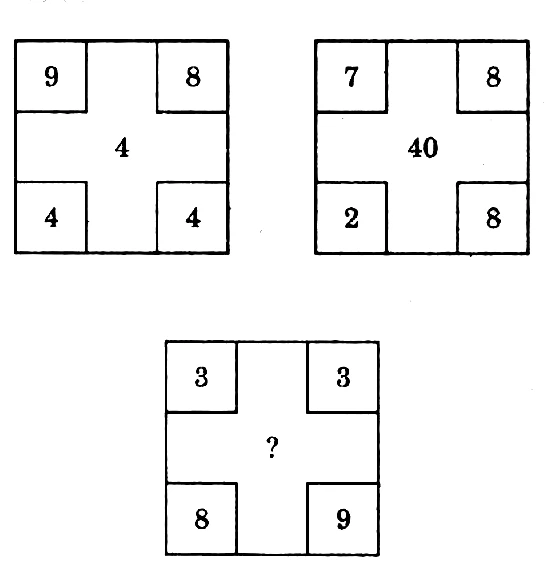
- a4
- b3Answer
- c2
- d1
Explanation coming soon.
- Q214Series, analogy and odd man out
Vaccination drive for Covid-19 is carried out in a village of 1000 people. The first person that comes for vaccination is placed in Group A, the next two in Group B, the next 3 in Group C, the next 4 in Group D, and the next 5 in Group E. After the 5th member of Group E, the pattern repeats, starting from 1 member in Group A and so on. The last beneficiary to be vaccinated belongs to
- aGroup A
- bGroup B
- cGroup C
- dGroup DAnswer
Explanation
Option D is correct because each full cycle of distribution takes 15 people, and dividing 1000 by 15 leaves a remainder of 10, which places the 1000th beneficiary in Group D. One cycle total: 1 + 2 + 3 + 4 + 5 = 15 people 1000 / 15 = 66 cycles with a remainder of 10 people Person 1 of the remainder goes to Group A Persons 2 and 3 go to Group B Persons 4, 5, and 6 go to Group C Persons 7, 8, 9, and 10 go to Group D Option A: Group A only accounts for the 1st person of the final 10 remaining people. Option B: Group B covers the 2nd and 3rd persons of the final remainder. Option C: Group C covers up to the 6th person of the final remainder.
- Q215Series, analogy and odd man out
Find the wrong term in the given series. 7, 12, 40, 222, 1742, 17390, 208608
- a7
- b12
- c40
- d1742Answer
Explanation
Option D is correct because following the rule of subtracting n and then multiplying by 2n, the fifth term evaluates to 1744, making 1742 the incorrect term in the sequence. (7 - 1) * 2 = 12 (12 - 2) * 4 = 40 (40 - 3) * 6 = 222 (222 - 4) * 8 = 1744 (1744 - 5) * 10 = 17390 (17390 - 6) * 12 = 208608 Option A: 7 is the valid starting term of the sequence. Option B: 12 is correct because (7 - 1) * 2 equals 12. Option C: 40 is correct because (12 - 2) * 4 equals 40.
- Q216Series, analogy and odd man out
In the following question, select the number which can replace the question mark (?) from the given alternatives:
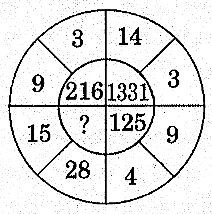
- a2197Answer
- b343
- c2144
- d1231
Explanation coming soon.
- Q217Coding, decoding and relations
English alphabets A to Z are numbered with the first 26 consecutive prime numbers. If PQR = 519 and UVW = 705, then what is JKL equal to ? 291
- a915
- b129
- c291Answer
- d97
Explanation
Option C is correct because each letter is assigned its corresponding prime number from the first 26 primes, and the code for a word is three times the sum of these prime values. J is the 10th prime = 29 K is the 11th prime = 31 L is the 12th prime = 37 Sum of values = 29 + 31 + 37 = 97 Total code value = 97 multiplied by 3 = 291 Option A: 915 is an incorrect arithmetic multiple of the prime values. Option B: 129 is an anagram of the correct number rather than the calculated value. Option D: 97 is only the raw sum of the prime values without multiplying by 3.
- Q218Coding, decoding and relations
There are 6 members A, B, C, D, E and F in a family who are spread across 3 generations. There are two couples in the family and no one from the third generation is married. E is the wife of C. F and B are a couple and the only people belonging to their generation. There are 4 male members in the family. Which of the following must be true ?
- aD is the grandson of A.
- bA and E belong to the same generation.
- cThere is no female in the third generation.Answer
- dE is the father of F.
Explanation
Option C is correct because the family consists of four males and two females, with female members already identified as E and one spouse in the second-generation couple F and B, meaning the third generation contains only male members. Option A: D and A belong to the same third generation, so D cannot be the grandson of A. Option B: E is in the first generation while A is in the third generation, so they do not share a generation. Option D: E is explicitly stated to be the wife of C, so E is female and cannot be a father.
- Q219Coding, decoding and relations
In a row of 40 girls, when Ankitha was shifted 3 to her left by four places, her number from the left end of the row becomes 10. What was the number of Kanchana from the right end of the row if Kanchana was three places to the right of Ankitha's original position?
- a24Answer
- b25
- c22
- d23
Explanation
Option A is correct because Ankitha's original position was 14th from the left, placing Kanchana 17th from the left, which translates to 24th from the right end of the row. Ankitha's shifted position from left: 10 Ankitha's original position from left: 10 + 4 = 14 Kanchana's position from left: 14 + 3 = 17 Kanchana's position from right: (Total girls - Position from left) + 1 = (40 - 17) + 1 = 24 Option B: 25 omits adding 1 when converting the rank from the left end to the right end. Option C: 22 miscalculates Kanchana's position by shifting in the wrong direction along the row. Option D: 23 adds Kanchana's offset to Ankitha's shifted position instead of her original position.
- Q220Coding, decoding and relations
In a class, Raghu got the 11th rank and he was 31st from the bottom of the list of boys passed. Three boys did not take the examination and one failed. What is the total strength of the class ?
- a45Answer
- b46
- c35
- d42
Explanation
Option A is correct because the total strength of the class comprises all the students who passed the examination along with those who were absent and the one who failed. Passed students equal 11 plus 31 minus 1, which equals 41 Students who did not take the examination equal 3 Students who failed equal 1 Total class strength equals 41 plus 3 plus 1, which equals 45 Option B: 46 incorrectly avoids subtracting 1 when combining the top and bottom ranks of Raghu, double-counting him. Option C: 35 omits both Raghu's top rank offset and the non-passing students. Option D: 42 accounts for passed students and the failed student but neglects the three absent students.
- Q221Coding, decoding and relations
Kranthi is facing west. She then turns 45 degrees in the clockwise direction and then another 180 degrees in the same direction and then 270 degrees in the anti-clockwise direction. Which direction is she facing now ?
- aSouth
- bNorth-west
- cWest
- dSouth-westAnswer
Explanation
Option D is correct because computing the net angular displacement from the initial facing direction of West points her towards South-West. Initial direction: West (270 degrees) Total clockwise turn: 45 + 180 = 225 degrees Total anti-clockwise turn: 270 degrees Net turn: 270 - 225 = 45 degrees anti-clockwise West shifted 45 degrees anti-clockwise: South-West Option A: South would require an anti-clockwise turn of 90 degrees from West. Option B: North-west corresponds to a net 45-degree clockwise shift instead of anti-clockwise. Option C: West assumes that the clockwise and anti-clockwise turns cancelled each other out completely.
- Q222Shapes, figures and Venn diagrams
100 students were to participate in school games. 60 students participated in game 1, while 50 students participated in game 2. 10 students did not come on time, so they were disqualified. How many students participated in only one of the games ?
- a20
- b40
- c70Answer
- d30
Explanation
Option C is correct because out of the 90 students who participated, 20 participated in both games, leaving exactly 70 students who participated in only one game. Eligible participating students: 100 - 10 = 90 Students in game 1: n(A) = 60 Students in game 2: n(B) = 50 Students in both games: n(A and B) = 60 + 50 - 90 = 20 Students in only one game: 90 - 20 = 70 Option A: It represents the number of students who participated in both games, not only one. Option B: It subtracts the intersection twice from the total eligible students incorrectly. Option D: It incorrectly subtracts the two individual game participants from the original 100 without accounting for the intersection.
- Q223Shapes, figures and Venn diagrams
In a school sports competition, 40% students participated in shooting, 35% students participated in wrestling, 32% students participated in boxing, 9% students participated in shooting and wrestling, 11% students participated in boxing and wrestling, 8% students participated in shooting and boxing and 5% students participated in all the three sports. If 64 students did not participate in any sport, then find the total number of students in the school.
- a450
- b350
- c500
- d400Answer
Explanation
Option D is correct because applying the principle of inclusion-exclusion shows that 84% of students participate in at least one sport, meaning the 64 non-participating students constitute 16% of the school. Union percentage = 40 + 35 + 32 - 9 - 11 - 8 + 5 = 84% Non-participating percentage = 100% - 84% = 16% Total students = 64 / 0.16 = 400 Option A: 450 corresponds to non-participants representing approximately 14.2% of the student population. Option B: 350 assumes non-participants make up around 18.3% of the total. Option C: 500 incorrectly assumes non-participants account for 12.8% of the total.
- Q224Shapes, figures and Venn diagrams
When the following shape is folded into a cube, what is the expected cube?
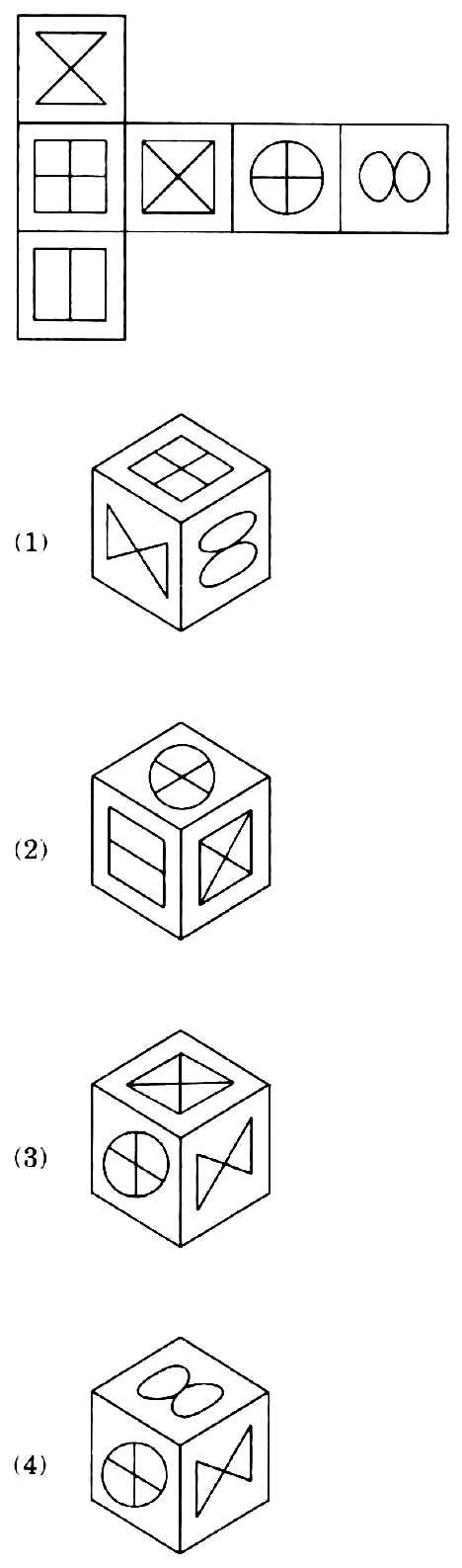
- aCube (1)
- bCube (2)
- cCube (3)Answer
- dCube (4)
Explanation coming soon.
- Q225Shapes, figures and Venn diagrams
A child made a big cube by joining 64 smaller red cubes. He then painted the faces of the big cube in yellow colour, except one face. His teacher came and dismantled all the cubes and asked him to count the number of cubes whose two faces are yellow. If the child answered correctly, then how many cubes did he count ?
- a4
- b16
- c20Answer
- d8
Explanation
Option C is correct because omitting paint on one face leaves 16 edge cubes with two yellow faces and converts 4 corner cubes of the unpainted face into two-face yellow cubes, giving a total of 20 cubes. Total smaller cubes = 64, giving n = 4 Fully painted cube has 12 * (4 - 2) = 24 two-face painted cubes The 4 edges bordering the unpainted face lose 4 * 2 = 8 two-face painted cubes, leaving 16 The 4 corners of the unpainted face now have 2 painted faces instead of 3 Total two-face yellow cubes: 16 + 4 = 20 Option A: It counts only the converted corner cubes while ignoring all remaining edge cubes. Option B: It overlooks the 4 corner cubes that become two-face yellow cubes due to the unpainted face. Option D: It accounts only for the cubes that lost a painted face on the unpainted surface.
- Q226Shapes, figures and Venn diagrams
What is the number of triangles in the figure given below?
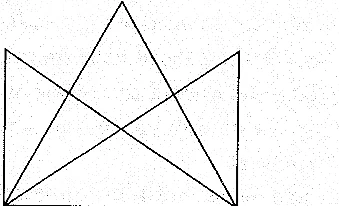
- a13
- b15
- c14Answer
- d16
Explanation coming soon.
- Q227Shapes, figures and Venn diagrams
The figure below shows the opened-up version of a cube with dots on each face: Which of these cubes (I and II) show the correct position of the dots? Select the correct answer using the code given below:
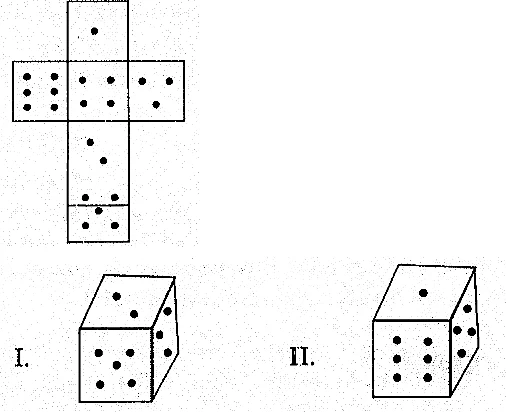
- aI only
- bII only
- cBoth I and IIAnswer
- dNeither I nor II
Explanation coming soon.
- Q228Clocks, calendars and ages
A watch loses 90 seconds in an hour and the watch owner adjusts the time lost by the watch in one day at the end of 48 hours. After how many days will the watch show the correct time before the watch owner adjusts the time ?
- a80 days
- b40 daysAnswer
- c60 days
- dNone of the above
Explanation
Option B is correct because the watch has an effective net loss of 36 minutes every 2 days, requiring 40 days to accumulate the 720 minutes of loss needed to show the correct time. Loss in 48 hours (2 days): 48 x 90 seconds = 4320 seconds = 72 minutes Adjustment at the end of 48 hours: 24 x 90 seconds = 2160 seconds = 36 minutes Net loss every 2 days: 72 - 36 = 36 minutes Net loss rate per day: 18 minutes per day Time to lose 12 hours (720 minutes): 720 / 18 = 40 days Option A: 80 days doubles the required duration by halving the effective daily loss. Option C: 60 days assumes an incorrect daily net loss of 12 minutes. Option D: None of the above is incorrect because 40 days is the exact period required.
- Q229Clocks, calendars and ages
What can be the maximum sum of Saturdays and Sundays in a normal year ?
- a104
- b105Answer
- c106
- d107
Explanation
Option B is correct because a normal year contains 52 complete weeks plus one additional day, yielding 52 Saturdays and 52 Sundays, with the single remaining day able to increase either the count of Saturdays or Sundays to 53. Normal year: 365 days = 52 weeks + 1 day 52 weeks guarantee 52 Saturdays and 52 Sundays Sum from complete weeks: 52 + 52 = 104 days If the extra day is a Saturday, total Saturdays become 53 and Sundays remain 52 If the extra day is a Sunday, total Sundays become 53 and Saturdays remain 52 Maximum sum: 53 + 52 = 105 days Option A: 104 represents the baseline sum of 52 weeks without counting the 365th day. Option C: 106 would require two extra weekend days, which is impossible even in a leap year. Option D: 107 exceeds the mathematical ceiling of weekend days possible in any 365-day year.
- Q230Clocks, calendars and ages
If in a particular non-leap year, the month of June had 5 Mondays, then that year must have started with which one of the following days ?
- aThursday or Friday
- bFriday or Wednesday
- cThursday or Saturday
- dNone of the aboveAnswer
Explanation
Option D is correct because for June to have 5 Mondays in a non-leap year, 1 June must be either a Monday or a Sunday, which mathematically requires 1 January of that year to have been a Thursday or a Wednesday, a pairing not listed in options A, B, or C. June has 30 days, so 5 Mondays require 1 June (Monday) or 2 June (Monday) Odd days from 1 January to 1 June in a non-leap year: 31 + 28 + 31 + 30 + 31 = 151 days 151 divided by 7 leaves a remainder of 4 odd days If 1 June is Monday, 1 January is Monday minus 4 days = Thursday If 1 June is Sunday, 1 January is Sunday minus 4 days = Wednesday Valid starting days are Thursday or Wednesday Option A: Friday is incorrect because it would make 1 June a Tuesday, giving June only 4 Mondays. Option B: Friday is incorrect because it does not yield 5 Mondays in June. Option C: Saturday is incorrect because it would make 1 June a Wednesday, giving June only 4 Mondays.
- Q231Clocks, calendars and ages
Ramesh said to his daughter, “I am four times as old as you now. Five years from now, I will be thrice as old as you.” His daughter asked him, “Ten years from now, how many times my age would you be ?” What would Ramesh's answer be ?
- a2 times
- b1-5 times
- c2-5 timesAnswer
- dNone of the above
Explanation
Option C is correct because Ramesh is presently 40 and his daughter is 10, meaning in 10 years he will be 50 and she will be 20, making him 2.5 times her age. Let daughter's present age be D and Ramesh's age be 4D. 4D + 5 = 3(D + 5) 4D + 5 = 3D + 15, which gives D = 10 and Ramesh's age = 40 Ten years later, daughter is 20 and Ramesh is 50. 50 / 20 = 2.5 Option A: corresponds to 40 divided by 20, which fails to account for Ramesh aging 10 years. Option B: corresponds to Ramesh being only 30 when his daughter is 20. Option D: is incorrect because the exact answer of 2.5 is provided in Option C.
- Q232Number system and basic operations
124 chocolates were left when the total chocolates in a box were divided equally among 403 students. How many chocolates would remain if the chocolates from the same box are distributed equally among 31 students ?
- a0Answer
- b5
- c124
- d23
Explanation
Option A is correct because the total number of chocolates can be expressed as 403k + 124, and both 403 and 124 are exactly divisible by 31, leaving no remainder. 403 = 31 x 13 124 = 31 x 4 + 0 Remainder = 0 Option B: 5 results from incorrect division of 124 by 31. Option C: 124 is the remainder when dividing by 403, not 31, and a remainder cannot exceed the divisor. Option D: 23 is the result of subtracting 31 from other values erroneously instead of taking the modulus.
- Q233Number system and basic operations
If we listed all numbers from 100 to 10,000, how many times would the digit 5 be printed ?
- a3980Answer
- b3700
- c3840
- d378
Explanation
Option A is correct because the total count of the digit 5 in all four-digit numbers from 0000 to 9999 is 4000, and subtracting the 20 occurrences in the range 00 to 99 gives 3980. Total numbers from 0000 to 9999 = 10000 Total digits written = 10000 x 4 = 40000 Occurrences of 5 in 0000 to 9999 = 40000 / 10 = 4000 Occurrences of 5 in 0 to 99 = 20 Occurrences from 100 to 10000 = 4000 - 20 = 3980 Option B: 3700 underestimates the count by miscalculating the frequency across hundreds and thousands blocks. Option C: 3840 fails to account for 5 appearing across all place values systematically. Option D: 378 severely undercounts by considering only a single place value or restricted sub-ranges.
- Q234Number system and basic operations
The total number of integers between 400 and 600, each of which, either begins with 5 or ends with 5 but not both, is
- a10
- b100Answer
- c110
- d120
Explanation
Option B is correct because there are 90 integers that begin with 5 but do not end with 5, and 10 integers that end with 5 but do not begin with 5, giving a total of 100. Integers from 401 to 599 that begin with 5 = 100 (500 to 599) Integers that begin and end with 5 = 10 (505, 515, ..., 595) Integers beginning with 5 only = 100 - 10 = 90 Integers ending with 5 from 401 to 499 = 10 (405, 415, ..., 495) Total integers meeting the condition = 90 + 10 = 100 Option A: 10 counts only the integers ending with 5 in the 400s, ignoring those beginning with 5. Option C: 110 fails to subtract the overlap of numbers that both begin and end with 5. Option D: 120 overcounts by failing to correctly partition the numbers between 400 and 600.
- Q235Number system and basic operations
A shopkeeper has three cloth pieces of lengths 7 m, 3 m 85 cm and 12 m 95 cm respectively. He measures each of the three cloth pieces, with a rod at his disposal and finds that the length of each cloth piece is an integral multiple of the length of the rod. What can be the maximum length of the rod ?
- a1m
- b25 cm
- c35 cmAnswer
- d42 cm
Explanation
Option C is correct because the maximum length of the rod that can measure all three pieces of cloth an integral number of times is the Highest Common Factor of their lengths. 7 m = 700 cm 3 m 85 cm = 385 cm 12 m 95 cm = 1295 cm 700 = 35 * 20 385 = 35 * 11 1295 = 35 * 37 HCF(700, 385, 1295) = 35 cm Option A: 1 m does not divide 385 cm or 1295 cm integrally. Option B: 25 cm does not divide 385 cm or 1295 cm without a remainder. Option D: 42 cm does not divide 700 cm or 385 cm without a remainder.
- Q236Number system and basic operations
Let N be the greatest number that will divide 6360, 7420 and 9540, leaving the same remainder in each case. Then the sum of the digits of N is :
- a7Answer
- b5
- c6
- d8
Explanation
Option A is correct because the greatest number N dividing a set of numbers with the same remainder equals the HCF of their absolute differences, and the sum of the digits of N is 7. Difference 1 = 7420 - 6360 = 1060 Difference 2 = 9540 - 7420 = 2120 Difference 3 = 9540 - 6360 = 3180 N = HCF(1060, 2120, 3180) = 1060 Sum of digits of N = 1 + 0 + 6 + 0 = 7 Option B: 5 is incorrect as the digits sum to 7. Option C: 6 is incorrect as the digits sum to 7. Option D: 8 is incorrect as the digits sum to 7.
- Q237Number system and basic operations
Ramesh wants to plant 372 tomato plants, 558 chilli plants and 1116 onion plants in equal rows. Also, he wants to make distinct rows of each plant, i.e. every row should have only one kind of plant. What are the minimum number of rows that are required ?
- a8
- b11Answer
- c14
- d16
Explanation
Option B is correct because the minimum number of rows is obtained by maximizing plants per row using the HCF, which is 186, giving a total of 11 rows. HCF(372, 558, 1116) = 186 plants per row Rows for tomato plants = 372 / 186 = 2 Rows for chilli plants = 558 / 186 = 3 Rows for onion plants = 1116 / 186 = 6 Total minimum rows = 2 + 3 + 6 = 11 Option A: 8 is incorrect because it underestimates the required rows and would require a plant-per-row count larger than the common factor. Option C: 14 is incorrect because it represents an arithmetic error in adding row totals or using an incorrect divisor. Option D: 16 is incorrect because it would result from a non-maximal common factor.
- Q238Number system and basic operations
Meher purchases 3 apples, 7 bananas and 1 lemon for Rs. 285. Rohan buys 4 apples, 5 bananas and 1 lemon for Rs.245. How much does Harish pay if he buys 1 apple, 11 bananas and 1 lemon?
- aRs.345
- bRs.365Answer
- cRs.385
- dRs.375
Explanation
Option B is correct because taking twice the first purchase and subtracting the second purchase gives the exact combination of fruits Harish buys, resulting in Rs. 365. Let A, B, and L be the costs of one apple, one banana, and one lemon respectively. 3A + 7B + L = 285 4A + 5B + L = 245 Multiply the first equation by 2: 6A + 14B + 2L = 570 Subtract the second equation: (6A - 4A) + (14B - 5B) + (2L - L) = 570 - 245 2A + 9B + L = 325 Subtract the second from the first equation: -A + 2B = 40, so B - A = 40 - B Direct linear combination: 2(3A + 7B + L) - (4A + 5B + L) = 2A + 9B + L = 325 (not target) Target: A + 11B + L Notice that 3(3A + 7B + L) - 2(4A + 5B + L) = (9A - 8A) + (21B - 10B) + (3L - 2L) = A + 11B + L Value = 3(285) - 2(245) = 855 - 490 = 365 Option A: Incorrect because Rs. 345 underestimates the linear combination value by 20. Option C: Incorrect because Rs. 385 overestimates the required total by 20. Option D: Incorrect because Rs. 375 overestimates the required total by 10.
- Q239Number system and basic operations
How many pairs of positive integers m, n satisfy the following equation : 1/m + 4/n = 1/12, where n is an odd integer less than 60 ?
- a3Answer
- b6
- c4
- d7
Explanation
Option A is correct because exactly three odd values of n strictly between 48 and 60 divide 576, producing valid integer values for m. 1/m = 1/12 - 4/n = (n - 48)/(12n) m = 12n/(n - 48) = 12 + 576/(n - 48) For m to be positive, n must be greater than 48 Odd values of n less than 60 are 49, 51, 53, 55, 57, 59 Values of (n - 48) dividing 576 are 1 (n=49), 3 (n=51), and 9 (n=57) Option B: 6 counts all odd integers in the interval instead of testing divisibility of 576. Option C: 4 incorrectly includes a non-factor such as n - 48 = 5 or 7. Option D: 7 exceeds the total number of odd integers between 48 and 60.
- Q240Number system and basic operations
If x = - 0.5, then which of the following has the smallest value ?
- a2 ¹/ˣ
- b1/xAnswer
- cx ¹/²
- d2ˣ
Explanation
Option B is correct because evaluating the expressions at x = -0.5 shows that 1/x yields the lowest real value among the choices. Option A: 2^(1/x) = 2^(-2) = 0.25 Option B: 1/x = 1/(-0.5) = -2 Option C: x^(1/2) is the square root of -0.5, which is not a real number. Option D: 2^x = 2^(-0.5) = 1/sqrt(2) is approximately 0.707 Option A: 2 ¹/ˣ is equal to positive 0.25, which is greater than -2. Option C: x ¹/² is an imaginary number and does not have a smaller real value than -2. Option D: 2ˣ is equal to approximately positive 0.707, which is greater than -2.
Keep your place and save questions
Pick up where you stopped, bookmark questions to revise, and get topic-wise PYQ sets with short Telugu notes. Join the waitlist for early access.