APPSC Group-I Prelims 2023
304 questions from the 2023 papers, each with the official answer and an explanation.
A question repeated across years is listed once, under one of the years it appeared.
- Q241Number system and basic operations
A change-making machine contains one-rupee, two-rupee and five-rupee coins. The total number of coins is 300. The amount is Rs.960. If the number of one-rupee coins and two-rupee coins are interchanged, the value comes down by Rs.40. The total number of five-rupee coins is
- a1.100
- b2.140Answer
- c3.60
- d4.150
Explanation
Option B is correct because setting up the system of linear equations for the number and values of the coins shows that there are 140 five-rupee coins. Let x, y, z be the number of 1-rupee, 2-rupee, and 5-rupee coins respectively. x + y + z = 300 x + 2y + 5z = 960 Interchanging x and y: 2x + y + 5z = 960 - 40 = 920 Subtracting the two value equations: (x + 2y + 5z) - (2x + y + 5z) = 960 - 920 => y - x = 40, so y = x + 40. Substitute y into the first two equations: 2x + z = 260 and 3x + 5z = 880. Multiply 2x + z = 260 by 5: 10x + 5z = 1300. Subtract: 7x = 420 => x = 60. Then z = 260 - 2(60) = 140. Option A: 100 leads to an incorrect total coin count or money value. Option C: 60 is the count of one-rupee coins, not five-rupee coins. Option D: 150 yields a total value higher than Rs. 960.
- Q242Ratio, percentage and commercial arithmetic
Latha went to the market to buy some vegetables. While leaving her house she checked her wallet and got to know that she had some hundred-rupee notes and some twenty-rupee notes. After shopping she had the same number of hundred-rupee notes as she originally had twenty-rupee notes and the same number of twenty-rupee notes as she originally had hundred-rupee notes. If the remaining money was one-third of what she initially had while stepping out of her house, find the initial ratio of the number of hundred-rupee notes and twenty-rupee notes.
- a7:1Answer
- b1:7
- c1:8
- d8:1
Explanation
Option A is correct because setting up the equation where final money is one-third of the initial money yields a ratio of 7:1 for the number of hundred-rupee notes to twenty-rupee notes. Let the initial number of 100-rupee notes be x and 20-rupee notes be y Initial amount = 100x + 20y Remaining amount = 100y + 20x Given: 100y + 20x = (1/3) * (100x + 20y) 300y + 60x = 100x + 20y 280y = 40x x / y = 280 / 40 = 7 / 1 Option B: 1:7 is incorrect because it inverts the ratio of hundred-rupee notes to twenty-rupee notes. Option C: 1:8 is incorrect because it results from an algebraic sign error during reduction. Option D: 8:1 is incorrect because the ratio reduces to 7:1, not 8:1.
- Q243Ratio, percentage and commercial arithmetic
Two liquids A and B are in the ratio 5 : 1 in container 1 and 1 : 3 in container 2. In what ratio should the contents of the two containers be mixed so as to obtain a mixture of A and B in the ratio 2 : 1 ?
- a2:3
- b4:3
- c3:2
- d5:2Answer
Explanation
Option D is correct because applying the rule of alligation on the proportion of liquid A gives a mixing ratio of 5 : 2. Fraction of A in container 1 = 5 / 6 Fraction of A in container 2 = 1 / 4 Fraction of A in required mixture = 2 / 3 Difference 1 = (2/3) - (1/4) = 5/12 Difference 2 = (5/6) - (2/3) = 2/12 = 1/6 Required ratio = (5/12) : (2/12) = 5 : 2 Option A: 2:3 is incorrect because mixing in this proportion yields a mixture lower in concentration of liquid A than 2:1. Option B: 4:3 is incorrect because it does not balance the alligation differences. Option C: 3:2 is incorrect because it underrepresents the required amount of container 1.
- Q244Ratio, percentage and commercial arithmetic
The total number of students in a class is 400. The ratio of number of students who like Arts and the ones who like Science is 3 : 5. The number of students who like Science is more than the ones who like Arts by how much ? 100
- a140
- b100Answer
- c180
- d16
Explanation
Option B is correct because the difference between the shares of Science and Arts students corresponds to two-eighths of the total 400 students, which equals 100. Total students = 400 Ratio of Arts to Science = 3 : 5 Total parts = 3 + 5 = 8 Value per part = 400 / 8 = 50 Students liking Science = 5 * 50 = 250 Students liking Arts = 3 * 50 = 150 Difference = 250 - 150 = 100 Option A: 140 results from an incorrect subtraction or miscalculating the unit value of the ratio. Option C: 180 incorrectly calculates the difference using arbitrary ratio proportions. Option D: 16 arises from dividing the class size incorrectly instead of finding the difference between category counts.
- Q245Ratio, percentage and commercial arithmetic
In a badminton tournament between schools A and B, school A won 50% of the matches played in the first three weeks. At the end of the tournament, its success rate was 75%. If 6 matches were played in the first three weeks and school A won all its matches played after that, how many matches did the tournament have ?
- a16
- b8
- c15
- d12Answer
Explanation
Option D is correct because School A won 3 matches in the first three weeks and won 6 more consecutive matches to finish with 9 wins out of 12 total matches (75%). Matches in first three weeks = 6 Wins in first three weeks = 50% of 6 = 3 Let subsequent matches played and won be x Total wins = 3 + x Total matches = 6 + x Success rate equation = (3 + x) / (6 + x) = 3 / 4 Cross-multiplying gives 4 * (3 + x) = 3 * (6 + x) 12 + 4x = 18 + 3x, so x = 6 Total tournament matches = 6 + 6 = 12 Option A: 16 assumes School A played 10 subsequent matches instead of 6. Option B: 8 gives a total of only 5 wins out of 8, which is 62.5% rather than 75%. Option C: 15 results in a fractional number of matches.
- Q246Ratio, percentage and commercial arithmetic
In a Irural market there are two types of vendors, X and Y. 70 percent of the vendors are X, and 60% of the X earn Rs.50,000 or more in a month. Total number of vendors who earn Rs.50,000 or more per month in the rural market is 48 percent of the total vendors. What percentage of Y earn less than Rs.50,000 ?
- a18%
- b80%Answer
- c20%
- d24%
Explanation
Option B is correct because 80% of vendors belonging to type Y earn less than Rs. 50,000 per month. Assume total vendors = 100 Type X vendors = 70, Type Y vendors = 30 Type X earning 50000 or more = 60% of 70 = 42 Total earning 50000 or more = 48% of 100 = 48 Type Y earning 50000 or more = 48 - 42 = 6 Type Y earning less than 50000 = 30 - 6 = 24 Percentage of Y earning less than 50000 = (24 / 30) * 100 = 80% Option A: 18% results from an arithmetic error subtracting the high earners of X from total vendors. Option C: 20% represents the percentage of type Y vendors who earn Rs. 50,000 or more. Option D: 24% is the raw count of type Y vendors earning less than Rs. 50,000 out of 100 total vendors, not their proportion within group Y.
- Q247Ratio, percentage and commercial arithmetic
A businessman wants to make some profit by selling a certain item. He thinks about several methods to make profit. Which of the following would maximize his profit? I. Sell that item at 10% profit. II. Use an incorrect weight which is 100 grams less than 1 kg, but is marked as 1 kg. III. Mix 10% impurities in that item and sell that item at cost price. IV. Increase the price by 5%, and use an incorrect weight whose real value is 5% less than what is marked on it. Select the answer using correct code.
- aIV only
- bI only
- cII onlyAnswer
- dIII only
Explanation
Option C is correct because using 900 grams instead of 1000 grams yields a higher profit percentage than any of the other three methods. Method I profit = 10.00% Method II profit = (100 / 900) * 100 = 11.11% Method III profit = (10 / 100) * 100 = 10.00% Method IV profit = ((1.05 / 0.95) - 1) * 100 = 10.53% Option A: IV only yields a profit of approximately 10.53%, which is less than the 11.11% gained in Method II. Option B: I only yields 10% profit, which is lower than both Method II and Method IV. Option D: III only yields 10% profit on the original cost, falling short of Method II.
- Q248Ratio, percentage and commercial arithmetic
A shopkeeper is selling his goods at 40% discount, but is still able to make 20% profit on the list price. By what percentage does he mark up his goods ?
- a60%
- b40%
- c80%
- d100%Answer
Explanation
Option D is correct because equating the selling price under both a 40% discount on marked price and a 20% profit on cost price shows the marked price must be double the cost price. Let Cost Price = CP and Marked Price = MP Selling Price = MP * (1 - 0.40) = 0.60 * MP Selling Price = CP * (1 + 0.20) = 1.20 * CP 0.60 * MP = 1.20 * CP, so MP = 2 * CP Markup percentage = ((2 * CP - CP) / CP) * 100 = 100% Option A: 60% merely adds the numeric discount percentage of 40% to 20% without accounting for the different base values. Option B: 40% confuses the discount percentage with the required markup percentage. Option C: 80% underestimates the necessary markup to absorb a 40% discount while keeping a 20% net profit.
- Q249Ratio, percentage and commercial arithmetic
Pranav sold two books at the same price. On one book he made a profit of 10% while on the other, he incurred a loss of 10%. In this case, which of the following statements is correct ?
- aHe makes no profit or loss
- bHe suffers a loss of 1%Answer
- cHe makes a profit of 1%
- dHe suffers a loss of 2%
Explanation
Option B is correct because when two articles are sold at the same selling price with equal percentage gain and loss, the overall transaction always incurs a loss equal to the square of the common percentage divided by 100. Loss percentage = (Common percentage / 10)^2 Loss percentage = (10 / 10)^2 = 1% Option A: It falsely assumes the equal percentage gain and loss on equal selling prices cancel out. Option C: It incorrectly concludes that the transaction results in a net profit. Option D: It doubles the true net loss percentage.
- Q250Ratio, percentage and commercial arithmetic
The Compound interest on a certain sum for 2 years is Rs.1,512 and Simple interest is Rs.1,440. If the sum is invested such that the Simple interest is Rs.2,592 and the number of years is equal to the rate of interest per annum, then find the rate?
- a5%
- b6%Answer
- c7%
- d8%
Explanation
Option B is correct because the difference between the compound and simple interest over two years reveals the initial interest rate, which is then used to find the principal and solve for the new rate. Simple interest per year = 1440 / 2 = Rs 720 Difference between CI and SI = 1512 - 1440 = Rs 72 Initial rate = (72 / 720) * 100 = 10% Sum = 720 / 0.10 = Rs 7200 New condition: SI = (P * R * T) / 100 where T = R 2592 = (7200 * R * R) / 100 = 72 * R^2 R^2 = 36, so R = 6% Option A: 5% gives an interest of only Rs 1800 for 5 years on the same principal. Option C: 7% yields an interest of Rs 3528 over 7 years, exceeding Rs 2592. Option D: 8% yields an interest of Rs 4608 over 8 years, which is far too high.
- Q251Ratio, percentage and commercial arithmetic
There are nine 2-digit consecutive odd numbers. If 59 is the mean of the first five such numbers, then what is the mean of all the nine numbers ?
- a73
- b63Answer
- c65
- d61
Explanation
Option B is correct because the mean of five consecutive odd numbers is the third number, and the mean of all nine consecutive odd numbers is the fifth number in the sequence. First 5 consecutive odd numbers have mean 59, so the 3rd number is 59 The series begins: 55, 57, 59, 61, 63, 65, 67, 69, 71 The middle (5th) term of all 9 numbers is 63 Mean of all 9 numbers = 63 Option A: 73 corresponds to the tenth odd number, which lies outside the set. Option C: 65 is the sixth number in the sequence rather than the fifth term. Option D: 61 is the fourth number in the sequence.
- Q252Ratio, percentage and commercial arithmetic
The following table of grouped data represents the weight (in kgs) of 100 articles: | Class Weight (in kgs) | Frequency (Number) | |---|---| | 3-5 | 8 | | 5-7 | 25 | | 7-9 | 45 | | 9-11 | 18 | | 11-13 | 4 | Calculate the mean weight for an article.
- a7.6 kg
- b7.7 kgAnswer
- c7.8 kg
- d7.9 kg
Explanation
Option B is correct because computing the sum of the products of class midpoints and their corresponding frequencies yields a mean of 7.7 kg. Class midpoints: 4, 6, 8, 10, 12 Products of frequency and midpoint: 8*4 = 32, 25*6 = 150, 45*8 = 360, 18*10 = 180, 4*12 = 48 Sum of fx = 32 + 150 + 360 + 180 + 48 = 770 Total frequency = 8 + 25 + 45 + 18 + 4 = 100 Mean = 770 / 100 = 7.7 kg Option A: 7.6 kg is incorrect due to an underestimation of the products sum. Option C: 7.8 kg occurs if the upper boundary is taken instead of the true midpoint for one of the classes. Option D: 7.9 kg is incorrect as the weighted sum does not reach 790.
- Q253Time, work, speed and distance
The ratio of jobs done by 30 girls to the job done by 25 boys, in the same time period is 5 : 6. If 9 girls and 10 boys can finish a job in 40/13 days, then how many girls are required to complete the job in 6 days ?
- a16
- b18
- c12Answer
- d14
Explanation
Option C is correct because the total work equals 72 girl-days, meaning 12 girls working together can finish the job in 6 days. Work ratio: (30 * g) / (25 * b) = 5 / 6, which gives b = 1.44g Combined daily rate of 9 girls and 10 boys = 9g + 10(1.44g) = 23.4g Total work = 23.4g * (40/13) = 72g Girls required for 6 days = 72g / (6 * g) = 12 Option A: Overestimates the workforce, providing 96 girl-days instead of the required 72. Option B: Provides 108 girl-days, completing the work in only 4 days. Option D: Provides 84 girl-days, which exceeds the required job size.
- Q254Time, work, speed and distance
A tank has eight pipes, some of which fill the tank and the rest empty the tank. Each inlet pipe fills the tank in 8 hours while each outlet pipe empties it in 6 hours. If all the pipes are kept open when the tank is full, it takes 6 hours to drain the tank. How many pipes are inlet pipes ?
- aTwo
- bThree
- cFourAnswer
- dFive
Explanation
Option C is correct because having 4 inlet pipes and 4 outlet pipes balances the drainage rate to empty the full tank in exactly 6 hours. Inlet rate per pipe = 1/8 tank per hour Outlet rate per pipe = -1/6 tank per hour Combined rate with n inlets and (8 - n) outlets = n/8 - (8 - n)/6 = -1/6 3n - 4(8 - n) = -4 7n = 28 n = 4 Option A: Leaves 2 inlets and 6 outlets, causing the tank to empty in 1.33 hours. Option B: Leaves 3 inlets and 5 outlets, causing the tank to empty in 2.18 hours. Option D: Leaves 5 inlets and 3 outlets, causing a net filling rate instead of draining.
- Q255Time, work, speed and distance
Excluding stoppages, the speed of a bus is 84 kmph and including stoppages, it is 70 kmph. For how many minutes does the bus 57 stop per hour?
- a10 minutesAnswer
- b8 minutes
- c15 minutes
- d12 minutes
Explanation
Option A is correct because the stoppage time per hour is calculated using the formula (speed without stoppage - speed with stoppage) / speed without stoppage, converted to minutes. Stoppage time per hour = (84 - 70) / 84 hours Stoppage time per hour = 14 / 84 = 1/6 hour In minutes = (1/6) × 60 = 10 minutes Option B: It represents an incorrect evaluation of (14/84) × 60. Option C: It corresponds to 1/4 of an hour instead of 1/6 of an hour. Option D: It corresponds to 1/5 of an hour instead of 1/6 of an hour.
- Q256Time, work, speed and distance
Ajeet and Sujeet go for shopping in a mall. They use an escalator to move between various floors. The escalator moves at a constant speed. Ajeet takes nine steps for every five of Sujeet's steps. Ajeet takes 30 steps to reach the top of the escalator, while Sujeet takes 20 steps to reach the top. If the escalator was turned off, how many steps would they have to take to walk up ?
- a40 steps
- b50 steps
- c60 steps
- d80 stepsAnswer
Explanation
Option D is correct because the stationary step count of the escalator equals the sum of a person's steps and the escalator's movement during that time. Let stepping speeds be 9s for Ajeet and 5s for Sujeet, and escalator speed be e Ajeet time = 30 / (9s) Sujeet time = 20 / (5s) = 4 / s Total steps N = 30 + e * (30 / 9s) = 20 + e * (4 / s) 10 = e / s * (4 - 10/3) = (2/3) * (e / s) e / s = 15 N = 20 + 4 * 15 = 80 steps Option A: 40 steps fails to account for the proper relative stepping speeds. Option B: 50 steps incorrectly assumes the escalator contributes half the total distance. Option C: 60 steps represents only the escalator's motion during Sujeet's climb instead of total steps.
- Q257Time, work, speed and distance
A beats B by 15 seconds in a 200 m race, B beats C by 25 seconds in a 500 m race, C beats D by 32 seconds in an 800 m race and D beats E by 35 seconds in a 1 km race. What must be the speed of A in order to beat E by 800 m in a 2 km race ?
- a2.5 m/s
- b3.33 m/sAnswer
- c5 m/s
- d6-66 m/s
Official answer shown. The explanation is under review.
- Q258Mensuration and geometry
The circumference of the front wheel of a cart is 30 feet and that of the back wheel is 36 feet. What is the distance travelled by the cart, when the front wheel has done five more revolutions than the rear wheel ?
- a1.850 feet
- b2.800 feet
- c3.720 feet
- d4.900 feetAnswer
Explanation
Option D is correct because setting up the equation for revolutions shows that the distance required for the smaller front wheel to make five more turns than the rear wheel is 900 feet. Circumference of front wheel = 30 feet Circumference of rear wheel = 36 feet Equation: (D / 30) - (D / 36) = 5 D x (6 - 5) / 180 = 5 D / 180 = 5 D = 900 feet Option A: 1.850 feet results from miscalculating the difference in revolutions between the wheels. Option B: 2.800 feet fails to satisfy the condition of a 5-revolution difference. Option C: 3.720 feet corresponds to a difference of 4 revolutions rather than 5 revolutions.
- Q259Mensuration and geometry
5 persons will live in a tent. If each person requires 16 m² of floor area and 100 m³ space for air, then the height of the cone of smallest size to accommodate these persons would be
- a18-75 mAnswer
- b16 m
- c10-25 m
- dNone of the above
Explanation
Option A is correct because dividing the total required volume by the base area gives the height of the cone as 18.75 m. Total floor area = 5 × 16 = 80 m² Total air volume = 5 × 100 = 500 m³ Volume of a cone = (1/3) × base area × height 500 = (1/3) × 80 × height Height = (500 × 3) / 80 = 18.75 m Option B: 16 m is incorrect because it uses an improper formula or equates height directly to the individual floor area. Option C: 10-25 m is an incorrect calculation that fails to satisfy the volume formula for a cone. Option D: None of the above is incorrect because Option A accurately represents 18.75 m.
- Q260Mensuration and geometry
A 5 × 5 × 5 cube is formed using 1 × 1 × 1 cubes. If we add another layer of such 1 × 1 × 1 cubes in the 5 × 5 × 5 cube, then what will be the number of 1 × 1 × 1 cubes in the newly formed cube ?
- a216Answer
- b150
- c175
- d264
Explanation
Option A is correct because adding one layer to increase the cube dimension from 5 units to 6 units results in a total volume of 6 cubed unit cubes. Original side length = 5 New side length after adding a layer = 6 Total number of 1 × 1 × 1 cubes = 6 × 6 × 6 = 216 Option B: 150 gives the surface area of a 5 × 5 × 5 cube rather than the total cubes in the enlarged cube. Option C: 175 is an arbitrary value that does not correspond to the volume of any integral cube. Option D: 264 incorrectly calculates the number of unit cubes required to form the new cube.
- Q261Data interpretation and probability
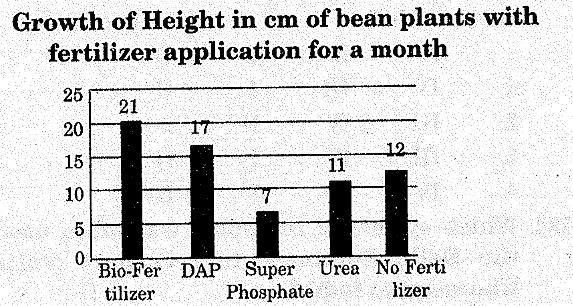
Read the following sentences and answer the questions (117-120) below: The following diagram shows the growth of height in centimeters of bean plants with applications of fertilizer after a month. Observe the diagram and answer the questions. Growth of Height in cm of bean plants with fertilizer application for a month Could it be safely concluded that for the growth of the bean plant, application of fertiliser is always beneficial?
- aYes
- bNoAnswer
- cMaybe
- dData is insufficient
Explanation
Option B is correct because plants grown with certain fertilizers like Urea and Super Phosphate achieved less height than the control plant with no fertilizer. Height with No Fertilizer = 12 cm Height with Urea = 11 cm Height with Super Phosphate = 7 cm Option A: Yes is incorrect because Super Phosphate and Urea resulted in poorer growth than using no fertilizer at all. Option C: Maybe is incorrect because the provided chart definitively demonstrates that growth is not always improved. Option D: Data is insufficient is incorrect because the chart provides clear comparative growth measurements for all conditions.
- Q262Data interpretation and probability
There are 6 tasks and 6 people. Task 1 cannot be assigned either to person 1 or to person 2; task 2 must be assigned to either person 3 or person 4. Every person is to be assigned one task. In how many ways can the assignment be done ?
- a144Answer
- b180
- c192
- d360
Explanation
Option A is correct because assigning Task 2 to one of two valid people leaves three valid choices for Task 1, after which the remaining four tasks can be assigned in 4! ways. Choices for Task 2 (Person 3 or Person 4) = 2 Choices for Task 1 from remaining eligible people (excluding Person 1 and Person 2) = 3 Ways to assign the remaining 4 tasks to the remaining 4 people = 4! = 24 Total ways = 2 multiplied by 3 multiplied by 24 = 144 Option B: 180 miscounts the branching of available candidates for Task 1. Option C: 192 assumes 4 people remain available for Task 1 instead of 3. Option D: 360 ignores the restriction barring Person 1 and Person 2 from Task 1.
- Q263Data interpretation and probability
There are two different ways of going from city A to city B. There are 3 different ways of going from city B to city C. There are two different ways of going from city C that are not passing through city B. How many different ways of going from city A to city C are there ?
- a6Answer
- b8
- c10
- d12
Official answer shown. The explanation is under review.
- Q264Data interpretation and probability
Anand and Rishi are the two biggest competitors of chess. The probability of Rishi losing a game against Anand is 75%. What is the probability that Anand loses at least one out of the four games played between them ?
- a81/256
- b3/4
- c1/2
- d175/256Answer
Explanation
Option D is correct because the probability of Anand losing at least one game equals one minus the probability of Anand winning every single game. Probability of Anand winning any single game = 75% = 3/4 Probability of Anand winning all four games = (3/4)^4 = 81/256 Probability of Anand losing at least one game = 1 - (81/256) = 175/256 Option A: 81/256 represents the complementary probability that Anand wins all four games. Option B: 3/4 is the single-game winning probability rather than the four-game outcome. Option C: 1/2 falsely assumes equal chances for the combined multi-game event.
- Q265Data interpretation and probability
A decorative lamp has 2 brown, 3 green and 4 white bulbs. What is the probability of lighting three bulbs such that at least one bulb that glows is white ?
- a37/42Answer
- b23/38
- c45/47
- d29/33
Explanation
Option A is correct because the probability of selecting at least one white bulb is found by subtracting the probability of selecting no white bulbs from 1. Total bulbs = 2 brown + 3 green + 4 white = 9 Non-white bulbs = 2 brown + 3 green = 5 Total ways to choose 3 bulbs = 9C3 = 84 Ways to choose 3 non-white bulbs = 5C3 = 10 Probability of selecting no white bulbs = 10 / 84 = 5 / 42 Probability of at least one white bulb = 1 - (5 / 42) = 37/42 Option B: 23/38 is an erroneous fraction that does not match the sample space. Option C: 45/47 uses an incorrect total number of combinations. Option D: 29/33 miscalculates both the favorable non-white combinations and total sample space.
- Q266Psychological abilities
You are an officer-in-charge for providing food facilities to the survivors of a cyclone affected area. Despite your best possible efforts, people level allegations against you that you are making money out of the funds sanctioned for relief. You would ... Let an enquiry be set up to look into the matter
- aStop providing the food facilities till the matter is resolved
- bLet an enquiry be set up to look into the matterAnswer
- cRequest your senior to appoint some other person in your place
- dIgnore the allegations
Explanation
Option B is correct because welcoming an independent inquiry demonstrates administrative integrity, transparency, and accountability while allowing essential relief distribution to continue without interruption. Option A: Halting life-saving food supplies directly harms vulnerable disaster victims who depend entirely on state relief. Option C: Requesting a replacement evades official duty and creates a presumption of wrongdoing during a severe crisis. Option D: Ignoring allegations of financial misconduct compromises public trust and undermines good governance.
- Q267Psychological abilities
As a citizen, you have some work Grama Sachivalayam and have submitted an application for the same. The official there calls you repeatedly and without directly asking you, sends out feelers for a bribe. You want to get your work done. You would....
- aSend a formal complaint
- bGive a bribe
- cBehave as if you have not understood the feelers and pursue your application
- dVerbally complain to the higher officials about the feelers and ask for helpAnswer
Official answer shown. The explanation is under review.
- Q268Psychological abilities
You have been made responsible to procure medical items at a short notice to be used for an area affected by a pandemic. On finding the price mentioned by the suppliers, you found that the lowest price quoted is approximately five times more than the approved rate of the Government. You would ...
- aAccept the lowest priceAnswer
- bReject the quotes and call for fresh quotes
- cRefer the matter to the higher authorities and wait
- dThreaten the medical suppliers about a possible cancellation of the license
Official answer shown. The explanation is under review.
- Q269Psychological abilities
You are handling a time-bound project. Suddenly, you meet with an accident. Your immediate superior insists that you complete the task. You would ...
- aStay away from work till you recover.
- bSuggest an alternate person to your superior who can handle the project.Answer
- cInform your superior of your inability to finish the project on time.
- dRequest for an extension of deadline.
Explanation
Option B is correct because proposing a capable alternate professional ensures that a time-bound project proceeds on schedule while addressing your genuine physical incapacity due to an accident. Option A: Staying away without offering an operational solution stalls the time-bound project and damages workflow. Option C: Stating inability without proposing a workaround leaves management without an immediate path to complete the project. Option D: Requesting an extension is inappropriate when the assignment has strict external time constraints and can be delegated.
- Q270Psychological abilities
You have differences of opinion regarding the project report prepared by your subordinate. The report has to be submitted immediately. The subordinate is justifying the information given in the report. You would ...
- aTell him to reconsider the results
- bConvince the subordinate that he is wrong
- cUpdate and correct the report on your ownAnswer
- dWarn the subordinate not to justify the incorrect information
Explanation
Option C is correct because an immediate submission deadline requires the presiding authority to take final ownership of the document, correct errors directly, and ensure timely delivery without administrative delay. Option A: Telling the subordinate to reconsider will cause delays that lead to missing the urgent deadline. Option B: Engaging in an extended debate to convince the subordinate wastes time required for immediate report submission. Option D: Warning the subordinate is confrontational and fails to resolve the immediate operational need to submit an accurate report.
- Q271People: appointments, honours and passings
The first woman appointed as the Director General of the Council of Scientific and Industrial Research.
- a1. Jyotirmayee Dash
- b2. Neena Gupta
- c3. Chandrima Saha
- d4. Nallathamby KalaiselviAnswer
Explanation
Option D is correct because Dr. Nallathamby Kalaiselvi was appointed in August 2022 as the first woman Director General of the Council of Scientific and Industrial Research. Option A: Jyotirmayee Dash is an organic chemist and Shanti Swarup Bhatnagar awardee who has not held the post of DG CSIR. Option B: Neena Gupta is a mathematician known for resolving the Zariski Cancellation Problem, not an administrator of CSIR. Option C: Chandrima Saha was the first woman President of the Indian National Science Academy, not the Director General of CSIR.
- Q272People: appointments, honours and passings
Match the following persons with their respective positions/designations as on October 2022. List-I List-II a. IMF - Executive Director i. Sanjay Kishan Kaul b. DRDO Chairman ii. Krishmamurty Subrahmanyan c. Supreme Court legal services committee chairman iii. Sameer V. Kamath d. Scientific Advisor to Minister of Defence iv. G. Satish Reddy
- a1. a-i, b-iii, c-ii, d-iv
- b2. a-ii, b-iii, c-iv, d-i
- c3. a-iii, b-ii, c-i, d-iv
- d4. a-ii, b-iii, c-i, d-ivAnswer
Explanation
Option D is correct because it matches each designated official to their exact appointment as of October 2022. a. IMF Executive Director: Krishnamurthy Subramanian b. DRDO Chairman: Samir V. Kamat c. Supreme Court Legal Services Committee Chairman: Sanjay Kishan Kaul d. Scientific Advisor to Minister of Defence: G. Satish Reddy Option A: assigns Sanjay Kishan Kaul to the IMF and Krishnamurthy Subramanian to the legal services committee. Option B: assigns G. Satish Reddy to the legal services committee and Sanjay Kishan Kaul to the defence ministry post. Option C: assigns Samir V. Kamat to the IMF and Krishnamurthy Subramanian to the DRDO.
- Q273People: appointments, honours and passings
The present Supreme Court Chief Justice of India is
- aH.J.Kania
- bS.A. Bobde
- cN.V.RamanaAnswer
- dRanjan Gogoi
Explanation
Option C is correct because Justice N. V. Ramana served as the 48th Chief Justice of India from April 2021 to August 2022. 46th Chief Justice of India: Ranjan Gogoi 47th Chief Justice of India: S. A. Bobde 48th Chief Justice of India: N. V. Ramana Option A: H. J. Kania was the first Chief Justice of India, serving from 1950 to 1951. Option B: S. A. Bobde preceded Justice N. V. Ramana as the 47th Chief Justice of India. Option D: Ranjan Gogoi served as the 46th Chief Justice of India from 2018 to 2019.
- Q274People: appointments, honours and passings
Smt. Draupadi Murmu was worked as Governor of which State?
- aOdisha
- bJharkhandAnswer
- cWest Bengal
- dMadhya Pradesh
Explanation
Option B is correct because Smt. Draupadi Murmu served as the first woman Governor of Jharkhand from May 2015 to July 2021 before being elected the 15th President of India. Option A: Smt. Draupadi Murmu was an MLA and cabinet minister in the Government of Odisha, but never served as its Governor. Option C: She never served as the Governor of West Bengal, an office held by Jagdeep Dhankhar during that era. Option D: She was never appointed Governor of Madhya Pradesh, where Mangubhai C. Patel serves.
- Q275People: appointments, honours and passings
Which institute has bagged the Sardar Patel Outstanding ICAR Institute Award 2021 (in the Large Institute Category) for its overall performance?
- aICAR - National Academy of Agricultural Research Management (NAARM)Answer
- bICAR - Central Research Institute for Dryland Agriculture (CRIDA)
- cICAR-Indian Institute of Millets Research
- dICAR - Indian Institute of Oilseeds Research
Explanation
Option A is correct because the National Academy of Agricultural Research Management, located in Hyderabad, bagged the Sardar Patel Outstanding ICAR Institute Award 2021 in the Large Institute Category for its institutional performance. Option B: ICAR - Central Research Institute for Dryland Agriculture did not win the 2021 award in this category. Option C: ICAR - Indian Institute of Millets Research did not win the Large Institute Category award for 2021. Option D: ICAR - Indian Institute of Oilseeds Research was not the recipient of this award.
- Q276People: appointments, honours and passings
Which doctor got the Dhanvantari Award in March, 2017?
- aDr. S.Bhattacharya
- bDr. S.K.Sarin
- cDr. D.Nageshwar ReddyAnswer
- dDr. B.K.Goyal
Explanation
Option C is correct because noted gastroenterologist and Chairman of the Asian Institute of Gastroenterology, Dr. D. Nageshwar Reddy, was honoured with the prestigious Dhanvantari Award in March 2017 for his outstanding contributions to medical science. Option A: Dr. S. Bhattacharya was not the recipient of this edition of the award. Option B: Dr. S. K. Sarin, while a prominent hepatologist, did not receive the award in March 2017. Option D: Dr. B. K. Goyal was the founder and managing trustee of the Dhanvantari Medical Foundation, not the awardee on this occasion.
- Q277People: appointments, honours and passings
Identify the names of Ramon Magsaysay 2022 Awardees from the following : I. Sotheara Chhim II. Bernadette J. Madrid III. Tan Soo Heong IV. Gary Bencheghib V. Tadashi Hattori
- aI, II, IV and VAnswer
- bI, III, IV and V
- cI, II, III and IV
- dAll of the above
Explanation
Option A is correct because the 2022 Ramon Magsaysay Award was conferred upon Sotheara Chhim, Bernadette J. Madrid, Gary Bencheghib, and Tadashi Hattori. 2022 Ramon Magsaysay Awardees: Sotheara Chhim from Cambodia Bernadette J. Madrid from the Philippines Gary Bencheghib from Indonesia Tadashi Hattori from Japan Option B: Tan Soo Heong is included, who was never named as a recipient, while Bernadette J. Madrid is excluded. Option C: Tan Soo Heong is erroneously listed as an awardee, and Tadashi Hattori is omitted. Option D: All of the above is incorrect because Tan Soo Heong is not a Ramon Magsaysay laureate.
- Q278Sports
Match the following List I with List II with regard to Arjuna Awards 2022: | Name of Sportsperson | Discipline | | :--- | :--- | | a. Sushila Devi | i. Shooting | | b. Omprakash Mitharwal | ii. Weightlifting | | c. Vikas Thakur | iii. Para Badminton | | d. Tarun Dhillon | iv. Deaf Badminton | | e. Jerlin Anika J. | V. Judo |
- aa-iii, b-iv, e-i, d-ii, e-v
- ba-iii, b-v, c-ii, d-i, e-iv
- ca-v, b-i, c-ii, d-iii, e-ivAnswer
- da-v, b-ii, e-iii, d-i, e-iv
Explanation
Option C is correct because it correctly matches each Arjuna Awardee of 2022 with their respective sports discipline. Sushila Devi: Judo Omprakash Mitharwal: Shooting Vikas Thakur: Weightlifting Tarun Dhillon: Para Badminton Jerlin Anika J.: Deaf Badminton Option A: Incorrectly matches Sushila Devi to Para Badminton and Omprakash Mitharwal to Deaf Badminton. Option B: Incorrectly matches Sushila Devi to Para Badminton and Omprakash Mitharwal to Judo. Option D: Incorrectly matches Omprakash Mitharwal to Weightlifting and Vikas Thakur to Para Badminton.
- Q279Events, summits and observances
Consider the following statements with reference to G20 summit : I. The two-day G20 summit was held in Bali, Indonesia in 2022. II. “Recover Together, Recover Stronger” is the theme for India's G20 presidency. III. “One Earth, One Family, One Future” is the theme for Indonesia's G20 presidency. IV. “Data for Development” will be the integral part of overall theme of India's G20 presidency. Which of the statements given above are correct ?
- aI and II only
- bI and III only
- cI and IV onlyAnswer
- dII and III only
Explanation
Option C is correct because the 17th G20 Summit was held in Bali, Indonesia in November 2022 (Statement I), and Data for Development was a key integral focus under India's presidency (Statement IV). Bali Summit (Indonesia, 2022) theme: Recover Together, Recover Stronger New Delhi Summit (India, 2023) theme: One Earth, One Family, One Future (Vasudhaiva Kutumbakam) Option A: Incorrect because Statement II wrongly attributes Indonesia's theme to India. Option B: Incorrect because Statement III wrongly attributes India's theme to Indonesia. Option D: Incorrect because both Statement II and Statement III interchanged the themes of the two nations.
- Q280Events, summits and observances
Recently, the term ‘Chicago Convention’ is frequently seen in the news. Which of the following sector is it associated with ?
- aCarbon Capture
- bCivil AviationAnswer
- cMerchant Shipping
- dChlorofluorocarbons
Explanation
Option B is correct because the Convention on International Civil Aviation, commonly known as the Chicago Convention, was signed in 1944 to establish principles and technical foundations for safe and orderly international air transport, leading to the creation of the International Civil Aviation Organization. Option A: Carbon capture frameworks are governed by international climate mechanisms under the UNFCCC, not the Chicago Convention. Option C: Merchant shipping standards and maritime safety are handled by the International Maritime Organization through conventions like SOLAS and MARPOL. Option D: The phase-out of chlorofluorocarbons is governed by the Montreal Protocol, not the Chicago Convention.
Keep your place and save questions
Pick up where you stopped, bookmark questions to revise, and get topic-wise PYQ sets with short Telugu notes. Join the waitlist for early access.